
 العربية
 Español
 中文
中文 Deutsch
 Français
 Português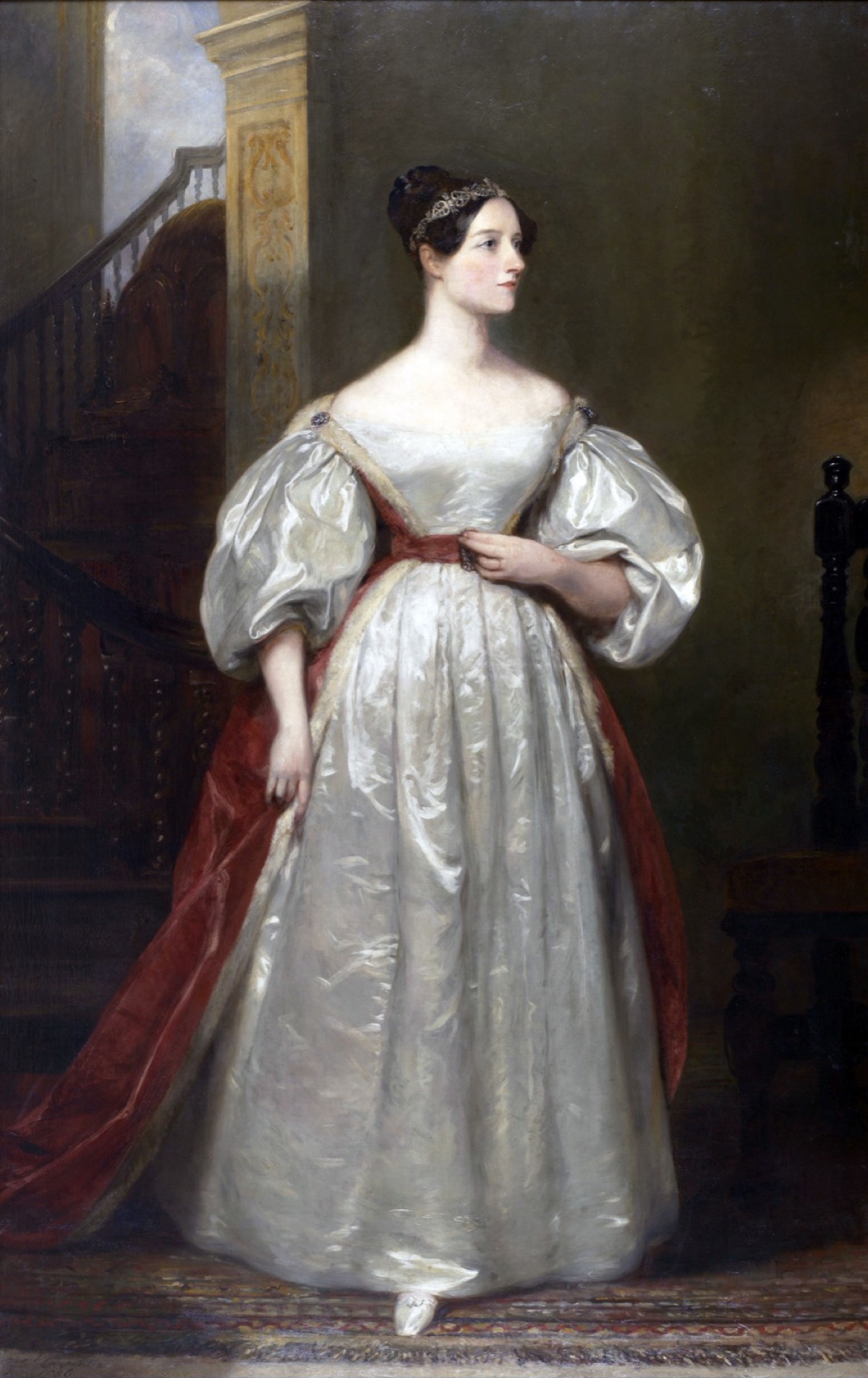
In 1843, a young mathematician published a step-by-step program for a computer - written for a machine that did not yet exist, and would never be built in her lifetime. Her name was Augusta Ada King, Countess of Lovelace. The program, tucked into the notes of a translated scientific paper, is widely regarded as the first algorithm ever published for a computer. But her greater gift was an idea: she was the first person to see that a computer is not a calculator but a machine for manipulating symbols of any kind - numbers, music, language - a full century before the electronic computer arrived.
- Who: Augusta Ada King, Countess of Lovelace (1815-1852), daughter of the poet Lord Byron
- What: her English translation of Luigi Menabrea's paper on Charles Babbage's Analytical Engine, plus seven original Notes (A-G) - about three times longer than the article itself
- Note G: a complete method to compute Bernoulli numbers on the engine - the first algorithm ever published for a machine
- The vision: that the engine might one day “act upon other things besides number” - even “compose elaborate and scientific pieces of music”
- The legacy: Lovelace is widely called the world’s first computer programmer; the U.S. Department of Defense named the Ada programming language after her
1. A Machine Ahead of Its Century
By the late 1830s, the English polymath Charles Babbage had sketched the design for a general-purpose, programmable computer - the Analytical Engine. Its architecture is startlingly modern. It had a “mill” that did the arithmetic (the equivalent of a modern CPU) and a “store” that held the numbers (memory - up to 1,000 numbers of 40 decimal digits each, very roughly 16 kB). It was programmed with punched cards borrowed from the Jacquard weaving loom, and - crucially - it supported loops and conditional branching. In principle, it was a real computer. Babbage, plagued by funding troubles and engineering disputes, never managed to finish building it.
In 1840 Babbage travelled to Turin to describe the engine. An Italian military engineer (and future prime minister of Italy), Luigi Federico Menabrea, wrote the lecture up in French, published in 1842. Enter Ada Lovelace.
2. The Translator Who Wrote More Than the Author
Lovelace had met Babbage in 1833, introduced by their mutual friend, the scientist Mary Somerville. Babbage, dazzled by her mathematical mind, called her the Enchantress of Number. Over roughly nine months in 1842-43 she translated Menabrea’s French memoir into English - and then, at Babbage’s suggestion, added a series of her own explanatory Notes, labelled A through G. Together they ran about three times the length of the original paper. The work appeared in Taylor’s Scientific Memoirs in 1843, signed only with her initials, “A.A.L.”
3. Note G: The First Program
The last and most famous note, Note G, is a fully worked-out plan for making the Analytical Engine compute the Bernoulli numbers - an important sequence in mathematics - laid out as a table of operations the machine would perform in sequence, complete with loops that reused the same instructions. It is this table that historians point to as the first published algorithm designed to be carried out by a machine, and the reason Lovelace is so often called the world’s first computer programmer.
Babbage had offered to work out the Bernoulli calculation to save her the trouble. In his own 1864 memoir he recorded that Lovelace “sent [it] back to me for an amendment, having detected a grave mistake which I had made.” The first programmer was also, in effect, the first code reviewer - and a printer’s slip in the published table is sometimes affectionately called the first “bug.”
An honest footnote: Babbage had scribbled small, unpublished program fragments a few years earlier, so scholars debate the exact credit. What is not in doubt is that Note G was the first full program ever published - and that Lovelace grasped, more clearly than anyone of her time, what such a program meant.
4. The Leap No One Else Made
Everyone around Babbage saw a magnificent calculator. Lovelace saw a universal machine. In her Notes she reasoned that if the engine could manipulate numbers by fixed rules, it could manipulate anything whose relationships could be written as rules. The engine, she wrote, might “act upon other things besides number,” and - in her most quoted line - if the rules of harmony could be expressed to it, the machine might “compose elaborate and scientific pieces of music of any degree of complexity or extent.”
That is the whole idea of the modern computer, stated in 1843: a device that processes symbols, not just sums. Every photo, song, message, and AI model running today is a footnote to that single insight. She called this blend of rigour and imagination her “poetical science.”
5. The Question She Left for Turing - and for Us
Lovelace was also careful about what a machine could not do. “The Analytical Engine,” she wrote, “has no pretensions whatever to originate anything. It can do whatever we know how to order it to perform.” A machine, in other words, only follows our instructions - it does not create.
A century later, Alan Turing quoted her directly in his landmark 1950 paper Computing Machinery and Intelligence, naming this argument “Lady Lovelace’s Objection” - and set out to answer it. Can a machine ever surprise us, or genuinely originate? In the age of systems that write, draw, and compose, the question Ada Lovelace posed in 1843 is more alive than ever.
In 1980 the U.S. Department of Defense named a new programming language Ada in her honour - and gave its reference standard the number MIL-STD-1815, chosen for her birth year, 1815. Every second Tuesday of October, Ada Lovelace Day celebrates the achievements of women in science, technology, engineering and maths.
Why It Still Matters
Ada Lovelace never saw a working computer; the Analytical Engine existed only on paper. Yet in a single set of notes she wrote the first program, described the difference between a calculator and a computer, and framed the debate about machine creativity that still runs through artificial intelligence today. It is one of the most remarkable acts of foresight in the history of science - a reminder that the future is often imagined long before it is built.
Sources & further reading
- Menabrea, L. F., with notes by Ada Lovelace: “Sketch of the Analytical Engine… with Notes by the Translator” (Taylor’s Scientific Memoirs, 1843)
- Wikipedia: Note G · Ada Lovelace · Analytical Engine
- Bodleian Libraries: Ada Lovelace and the Analytical Engine
- A. M. Turing, “Computing Machinery and Intelligence” (Mind, 1950) - on “Lady Lovelace’s Objection”
Curated by Jerry Cards - jerrycards.com. We celebrate the ideas and discoveries that built the modern world. More at jerrycards.com/news.