
 العربية
 Español
 中文
中文 Deutsch
 Français
 Português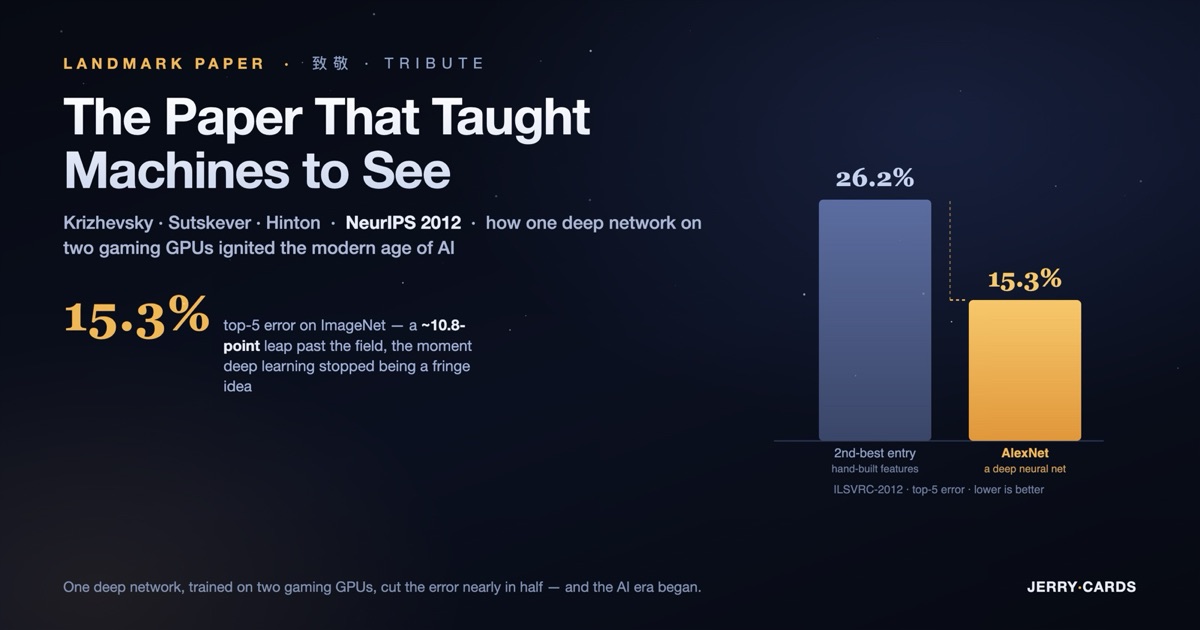
In the autumn of 2012, a computer program looked at a million photographs, named what was in them better than anything before it - and, almost overnight, changed the direction of technology. The program was a neural network its creators called AlexNet. It won an image-recognition contest by the widest margin the competition had ever seen, and in doing so it ended a long, slow era in artificial intelligence and began the one we are living in now. The remarkable part is that it did this with almost no new theory - just a handful of older ideas, combined with unusual care, and run on the kind of graphics cards gamers buy to play video games.
This is a tribute to the eight-page paper that taught machines to see.
- Who: Alex Krizhevsky, Ilya Sutskever and Geoffrey E. Hinton, University of Toronto
- The paper: ‘ImageNet Classification with Deep Convolutional Neural Networks,’ Advances in Neural Information Processing Systems 25 (NeurIPS 2012), pp. 1097–1105
- The contest: the ImageNet Large Scale Visual Recognition Challenge (ILSVRC) - classify ~1.2 million photos into 1,000 categories
- The result: a top-5 error rate of 15.3%, versus 26.2% for the second-best entry
- The network: 8 learned layers (5 convolutional + 3 fully connected), 60 million parameters, ~650,000 neurons
- The hardware: two NVIDIA GTX 580 gaming GPUs, trained for about five to six days
1. First, someone had to build the exam
Before a machine can be tested on seeing, someone has to decide what ‘seeing’ means and gather the evidence. That was the quiet, unglamorous achievement of ImageNet, a dataset assembled by the computer scientist Fei-Fei Li and her collaborators and first presented in 2009. Where earlier vision datasets held a few tens of thousands of images, ImageNet gathered millions - eventually more than 14 million photographs, each hand-labelled by people into tens of thousands of categories organized by meaning.
From 2010, a slice of it powered an annual competition, the ILSVRC, built around a manageable 1,000 categories and roughly 1.2 million training images. The scoring metric became famous: the top-5 error rate, the fraction of test images for which the correct label was not among the system’s five best guesses. It is a forgiving measure - and even so, for the first two years, the best systems in the world could not get below about a quarter of the images wrong. Progress was real but glacial, a point or so a year, wrung out of elaborate hand-engineered features. Many researchers quietly assumed that is how computer vision would always advance.
2. The result that stopped the room
Then the 2012 results came in. AlexNet finished with a top-5 error rate of 15.3%. The next-best entry, built on the traditional hand-crafted approach, managed 26.2%. In a field accustomed to fighting for a single percentage point, one system had won by more than ten - very nearly halving the error in a single year.
A jump that large is not an incremental improvement; it is a signal that something categorical has changed. What had changed was the kind of system that won. AlexNet was not a clever arrangement of rules written by vision experts. It was a deep neural network that had taught itself, from the raw pixels of a million examples, which shapes and textures and patterns matter. The experts had been out-performed by a machine that learned.
Real photos are ambiguous - a husky can look like a wolf, a mushroom like a dozen close cousins - so the benchmark asks whether the right answer is in the model’s five best guesses. Cutting that error from 26% to 15% meant AlexNet was not just a little better at easy pictures; it was fundamentally better at the hard, confusable ones that hand-built systems kept tripping over.
3. No new theory - three old ideas, combined
The most instructive thing about AlexNet is how little of it was new. The core - a convolutional neural network trained by backpropagation - dated to work by Yann LeCun and others in the 1980s and 1990s, itself built on the backpropagation algorithm popularized by Hinton and colleagues in 1986. The genius of the 2012 paper was in assembling the right pieces at the right scale, and making them train. Three choices stand out.
Depth, learned end to end. AlexNet stacked five convolutional layers - which scan an image for local patterns, from edges up to whole objects - on top of three fully connected layers that combine those patterns into a decision, ending in a 1,000-way choice. Nothing about what an edge or a texture ‘is’ was programmed in; all 60 million parameters were learned from the images themselves.
The ReLU, for speed. Older networks passed each neuron’s output through a smooth, saturating curve that slowed learning to a crawl in deep stacks. AlexNet used the Rectified Linear Unit (ReLU) - a rule so simple it is almost a joke: if the input is negative, output zero; otherwise pass it through unchanged. That one change let the big network train several times faster, which is what made training it at all practical.
Dropout, against memorizing. A network with 60 million parameters can simply memorize its training images and fail on anything new - the curse of overfitting. To fight it, the authors used a then-new trick called dropout: during training, randomly switch off half the neurons in the big layers on each pass, so the network can never lean on any single one and is forced to learn features that are robust. They rounded this out with data augmentation - cropping, flipping and colour-shifting the training photos to manufacture endless variety.
4. The secret weapon was a gaming graphics card
There was one more ingredient, and it was not an algorithm. Training a network this large was far too slow on ordinary processors. So Krizhevsky wrote the code to run on the graphics processing unit (GPU) - the massively parallel chip designed to render video-game worlds, which happens to be superb at the same dense arithmetic that neural networks need. AlexNet trained on two NVIDIA GTX 580 cards, each with just 3 GB of memory, for about a week, its architecture carefully split across the pair.
The computing power to make deep learning work was already sitting inside consumer PCs. AlexNet did not wait for exotic new hardware; it repurposed the gaming GPU. That realization - that neural networks and graphics chips were a perfect match - reshaped an entire industry, and turned the company that made those cards into one of the most valuable on Earth.
5. What one paper set in motion
The reaction was swift. A skeptical field looked at that 15.3% and changed its mind almost at once; within a year the ImageNet leaderboard was dominated by deep networks, and the old hand-built pipelines were effectively retired. The three authors incorporated a company, DNNresearch, which Google acquired in 2013. From there the ideas spread into everything.
| What AlexNet’s approach enabled | Where you meet it |
|---|---|
| Image understanding | Photo search and tagging, face unlock, visual translation |
| Medical imaging AI | Systems that flag tumours and disease in scans |
| Machine perception | The vision stack in driver-assistance and robotics |
| The deep-learning toolkit | The same recipe - deep nets, GPUs, backprop - now behind the large language models you use today |
The people mattered as much as the method. Geoffrey Hinton, who had championed neural networks through decades when they were unfashionable, went on to share the 2018 Turing Award (with Yoshua Bengio and Yann LeCun) and the 2024 Nobel Prize in Physics (with John Hopfield) for the foundations of machine learning. Ilya Sutskever became a co-founder and chief scientist of OpenAI. And the paper itself has since been cited more than 180,000 times - among the most influential scientific papers of the century.
6. The lesson worth keeping
It is tempting to imagine breakthroughs as bolts of pure novelty. AlexNet is a useful corrective. Its pieces - convolutional networks, backpropagation, the ReLU, GPUs - already existed. What Krizhevsky, Sutskever and Hinton supplied was the conviction that, combined at scale and engineered with care, those pieces would work where everyone assumed they would not. The revolution came not from a new idea but from taking old ideas seriously enough to push them past the point where they finally paid off.
We celebrate the finished marvels - the assistant that answers, the car that brakes, the app that reads a scan. This is a tribute to the modest, decisive paper underneath them all: the eight pages, in the winter of 2012, that opened everyone’s eyes.
Sources & further reading
- Original paper: A. Krizhevsky, I. Sutskever & G. E. Hinton, ‘ImageNet Classification with Deep Convolutional Neural Networks’, Advances in Neural Information Processing Systems 25 (NeurIPS 2012)
- The benchmark: O. Russakovsky et al., ‘ImageNet Large Scale Visual Recognition Challenge’, International Journal of Computer Vision (2015) · image-net.org
- Overview & impact: AlexNet (Wikipedia) · ImageNet (Wikipedia)
- The people: The Nobel Prize in Physics 2024 (Hopfield & Hinton) · 2018 ACM A. M. Turing Award (Bengio, Hinton, LeCun)
Curated by Jerry Cards - jerrycards.com. Our 致敬 (tribute) series celebrates the landmark papers and discoveries that quietly built the modern world. More at jerrycards.com/news.