
 العربية
 Español
 中文
中文 Deutsch
 Français
 Português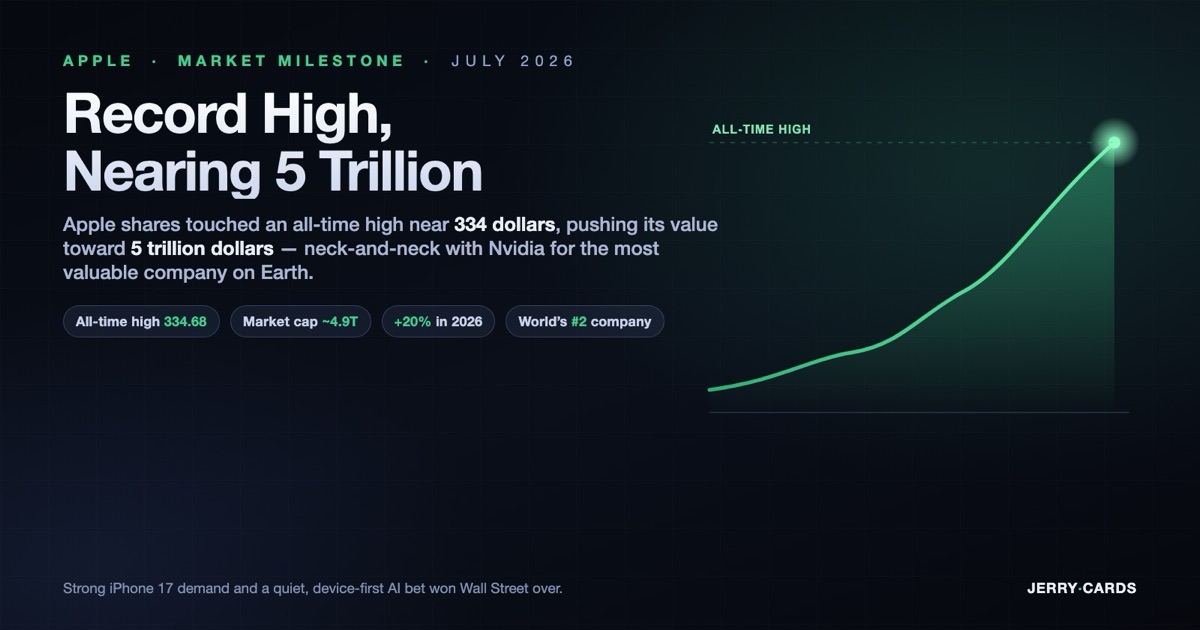
The company a chorus of analysts wrote off as an AI also-ran a year ago is now, by market value, in a photo finish for the most valuable business on the planet. In mid-July 2026, Apple stock set a run of all-time highs, closing at a record near $333 on July 16 - with an intraday peak of $334.68 - and lifting Apple's market capitalization to roughly $4.9 trillion. That is its highest valuation ever, a hair short of the $5 trillion mark, and close enough to Nvidia that the two have been trading the crown by the hour. The remarkable part is not just the number. It is how Apple got there: with the quietest artificial-intelligence strategy in big tech, not the loudest.
- Record close: about $333 on July 16, 2026; intraday high $334.68
- Market cap: roughly $4.9 trillion - its highest ever, nearing $5T
- Rank: the world’s #2 company, in a near-dead-heat with Nvidia (~$5.0T)
- 2026 so far: up about 20%; up roughly 50% over 12 months
- Street targets: Citi $365, HSBC $366 (upgraded to Buy)
- Next test: fiscal Q3 earnings on July 30, 2026
1. What actually happened
Apple shares climbed steadily through the first half of July and then broke to fresh records. On July 16, 2026, the stock closed at an all-time high of about $333 and touched an intraday peak of $334.68, and it printed new highs again the following session. At those levels Apple was worth roughly $4.9 trillion - the most it has ever been worth - making it the second-most valuable public company in the world, just behind Nvidia at around $5.0 trillion. In the sessions that followed, the gap between the two narrowed to a rounding error, and by some accounts Apple briefly edged ahead of Nvidia intraday. After the initial surge, the stock eased back toward $328 by July 21 - still comfortably in record territory.
For perspective on the move: Apple is up about 20% in 2026 and roughly 50% over the past year, having climbed from a 52-week low near $201. This is not a meme-stock spike; it is the world’s largest consumer-technology company grinding to a new all-time high.
2. The three engines behind the run
Engine 1 - iPhone 17 demand that refused to cool
The single biggest driver is old-fashioned: people are buying iPhones. Demand for the iPhone 17 lineup has held up strongly even as the broader market for phones and laptops has softened, and Apple has kept gaining share at the premium end. When rivals are discounting into a weak market and Apple is not, that is a powerful signal about brand strength. Citi, raising its price target to $365 from $315, pointed to exactly this - Apple’s ‘premium brand,’ loyal customer base and ‘design-driven demand’ letting it keep taking share.
Engine 2 - the quiet, device-first AI bet
For most of 2025, Apple’s measured pace on generative AI looked like a liability while competitors announced ever-larger data-center build-outs. The narrative has flipped. Apple’s approach is deliberately less capital-intensive and more device-focused: rather than spending tens of billions to win a cloud-compute arms race, it runs much of Apple Intelligence on the device itself, across an installed base of more than 2 billion active devices. That base is the moat. It means Apple can monetize AI through hardware upgrades and high-margin services instead of burning cash on infrastructure - and in a market suddenly nervous about how quickly the AI spending boom will pay off, ‘slow and steady, and already profitable’ became a feature, not a bug. HSBC captured the shift by upgrading Apple to Buy from Hold and lifting its target to $366 from $260, citing the AI push and a deep product pipeline.
Cloud-heavy AI strategies convert revenue into enormous capital spending on chips and data centers, which pressures margins and free cash flow. Apple’s on-device model pushes much of the compute cost onto hardware the customer already paid for. The AI feature helps sell the next iPhone and deepen services engagement - so, for Apple, more AI can mean higher margins rather than lower ones. That is the crux of why investors re-rated the stock.
Engine 3 - the China green light
On July 16, 2026, Chinese regulators cleared Apple to roll out Apple Intelligence features in China with local partners Alibaba and Baidu. China is Apple’s second-largest market, and the absence of AI features there had been a genuine overhang on both sales and sentiment. Removing it unlocked a large, upgrade-hungry customer base for Apple’s AI story - and the approval landing in the same week as the record highs was no coincidence.
3. The rotation that gave it a tailwind
There was also a market-structure tailwind. Through the first half of 2026, memory and storage chip stocks had soared on the AI-driven boom in demand for high-bandwidth memory. As some investors grew wary of how far those names had run, money rotated toward steadier ways to own the AI theme - and Apple, with its fortress balance sheet, prodigious cash flow and lower volatility, became a natural home for it. In a jittery tape, Apple increasingly traded like a blue-chip safe haven that still offers AI upside.
4. The fundamentals underneath
The valuation is built on a genuinely large and profitable business. In its most recent fiscal year (ended September 27, 2025), Apple generated roughly $416 billion in revenue, up about 6%, at a gross margin near 48% - extraordinary profitability for a company of its size. Its Services arm, which Citi estimates is now running near $31 billion a quarter at very high margins, is the high-multiple engine that increasingly justifies the premium the market pays for the stock.
| Metric | Where it stands (mid-July 2026) |
|---|---|
| All-time high (close / intraday) | ~$333 / $334.68 (July 16) |
| Market capitalization | ~$4.9 trillion (world’s #2) |
| 2026 performance | up ~20% YTD; ~50% over 12 months |
| Price / earnings | ~40x (rich by its own history) |
| FY2025 revenue / gross margin | ~$416B (+6%) / ~48% |
| Analyst targets | Citi $365 · HSBC $366 (Buy) |
5. What to watch next
The rally has, understandably, made Apple expensive by its own standards - near 40x earnings - so expectations are now high. The next milestone is fiscal Q3 (April-June) earnings on July 30, 2026, where investors will look for confirmation that iPhone momentum, Services growth and the China opening are showing up in the numbers. Beyond that, the September launch event - expected to bring the iPhone 18 line and a more capable, AI-enhanced Siri - is the catalyst Citi flagged as shaping sentiment into the back half of the year. For a company this size to keep setting records, it simply has to keep executing. So far in 2026, it has.
The takeaway
Apple’s climb to an all-time high and the doorstep of a $5 trillion valuation is a case study in a simple idea: you do not have to win the loudest race to win. While rivals competed on data-center scale, Apple leaned on the things it has always been best at - desirable hardware, a loyal two-billion-device base, and high-margin services - and let AI ride on top of them. A year after being cast as the AI laggard, it is competing for the title of most valuable company on Earth.
Sources
- CNBC: Apple just hit a record high; HSBC says it still has room to run (upgrade to Buy, $366 target)
- MacDailyNews: Apple shares hit new all-time closing ($333.26) and intraday ($334.68) highs
- The Motley Fool: Apple stock hits a new all-time high: is it still a buy? (~$4.8-4.9T market cap, ~40x earnings, July 30 earnings)
- FX Leaders: AAPL tests record highs as Citi lifts target to $365; premium brand and design-driven demand
- Macrotrends: Apple (AAPL) stock price history
Curated by Jerry Cards - jerrycards.com. We research the week’s most consequential tech, science, and business news so you don’t have to. More at jerrycards.com/news. Nothing here is investment advice.