
 العربية
 Español
 中文
中文 Deutsch
 Français
 Português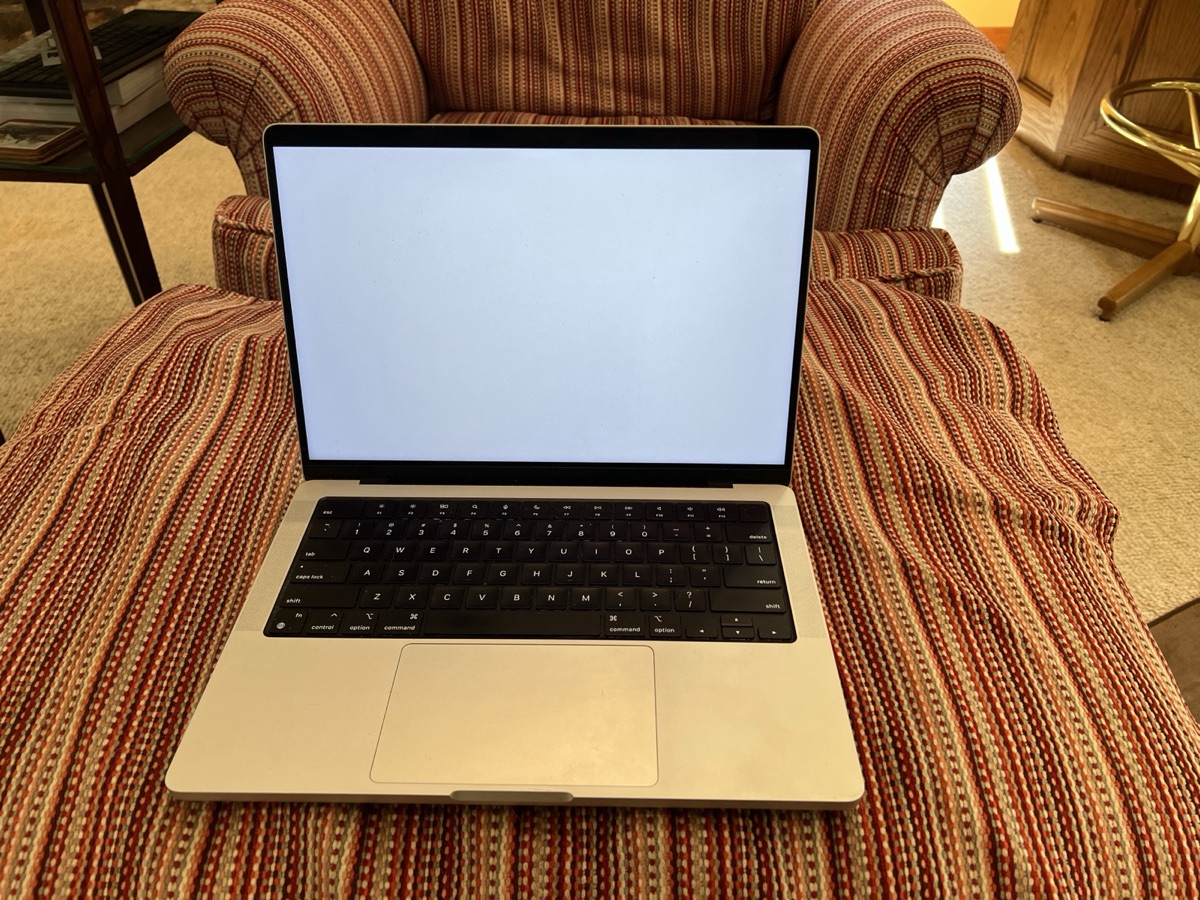
For a decade and a half, one of Apple’s most consistent positions was that you should not touch your Mac’s screen. Steve Jobs said so on stage. His successors repeated it. Touch belonged to the iPhone and iPad; the Mac had a trackpad, and that was that. So the most striking thing about the latest report from Bloomberg’s Mark Gurman is not a spec - it is a reversal. Apple, Gurman reports, is finally building a touchscreen Mac: a completely redesigned MacBook Pro, built around an OLED display, that could reach customers as soon as late 2026.
Here is exactly what has been reported, why a touch-enabled Mac is a bigger deal than it sounds, what OLED and the Dynamic Island would add, the last-minute chip shake-up behind it - and how much of this to treat as real.
- Source: Bloomberg’s Mark Gurman (his Power On reporting, late June–July 2026)
- What: a redesigned MacBook Pro - Apple’s first Mac with a touchscreen and its first with an OLED display
- Sizes: 14-inch and 16-inch
- Timing: reportedly targeting a window between late 2026 and early 2027
- Chips: M5 Pro and M5 Max - after Apple reportedly cancelled the M6 Pro/Max to fast-track a more powerful M7 generation
- Also reported: the iPhone’s Dynamic Island comes to macOS, a hole-punch camera replaces the notch, plus a thinner chassis and reinforced hinge
- Status: a report, not an official Apple announcement - expected, not confirmed
1. What Gurman Reported
According to Gurman, Apple is developing a next-generation MacBook Pro that represents the line’s biggest overhaul since the 2021 redesign. The centerpiece is a switch to an OLED display - a first for any Mac - paired with a touch layer, making it the first Mac you can operate by tapping and swiping the screen directly. Both the 14-inch and 16-inch models are said to be part of the plan, targeting a release window that spans late 2026 into early 2027.
The redesign reportedly goes deeper than the panel. Gurman’s reporting, along with related supply-chain coverage, describes a thinner chassis rebuilt to house the new display and touch hardware, a hole-punch camera that finally does away with the notch cut into the top of the screen, and a reinforced hinge - a practical necessity once people start pressing on the display. Apple has not announced a name; some outlets have floated other branding, but Gurman’s reporting frames it as a MacBook Pro.
2. Why a Touchscreen Mac Is Such a Reversal
To appreciate why this report matters, rewind to October 2010. Unveiling new Macs, Steve Jobs was asked why Apple did not simply add touch to its laptops. His answer became doctrine. Vertical touch surfaces, he argued, are “ergonomically terrible”: hold your arm up to poke at a laptop screen and, as he put it, after a while “your arm wants to fall off.” Touch, in Apple’s telling, was for devices you hold flat or in your hand - the iPhone and, later, the iPad - not for a screen standing upright behind a keyboard.
That “gorilla arm” argument hardened into a decade-long company line. Senior executives batted away touchscreen-Mac questions for years, pointing customers who wanted touch toward the iPad instead. The trackpad, and later features like the short-lived Touch Bar, were Apple’s answer. So a MacBook Pro you can actually touch would not be a routine spec bump - it would be Apple publicly changing its mind about one of its most repeated design beliefs. Reporting over the past year suggests the shift is driven by how comfortable a generation raised on iPhones and iPads has become with touch, and by the practical payoff of building the Mac and iPad around more of the same interaction ideas.
3. What OLED and the Dynamic Island Add
The OLED switch is the quieter half of the story, but arguably the one most people would feel every day. Today’s MacBook Pro uses a mini-LED backlit LCD - excellent, but still a backlight shining through a liquid-crystal layer. OLED works differently: every pixel makes its own light and can switch fully off.
- True blacks & contrast: pixels that turn off entirely deliver perfect blacks and effectively infinite contrast, so dark scenes and HDR content look dramatically better.
- Efficiency: a black or dark interface draws less power because dark pixels are simply off - potentially helping battery life.
- Thinner design: with no separate backlight layer, OLED panels can be slimmer, feeding directly into the thinner chassis Gurman describes.
- Faster response: OLED pixels change state quickly, which can mean crisper motion.
The other headline feature is a familiar one crossing over from the phone: the Dynamic Island. On the iPhone, it is the pill-shaped cutout around the front camera that expands into a live, interactive space for things like music playback, timers, and call controls. Bringing it to macOS would give the Mac a new home for glanceable, ongoing activities - and, conveniently, a graceful way to handle the front camera in a near-borderless OLED design.
Introduced on the iPhone 14 Pro in 2022, the Dynamic Island turns the area around the front-facing camera into a small, shape-shifting interface. Instead of hiding the camera cutout, Apple made it useful - it grows and morphs to show live activities such as directions, timers, and now-playing music. Adapting it for a laptop-sized screen would be its first move beyond the iPhone.
4. The Chip Twist: M5 Pro/Max Now, M7 Later
The freshest wrinkle in Gurman’s reporting is about silicon. The OLED MacBook Pro was widely expected to debut with Apple’s next-generation M6 Pro and M6 Max chips. Instead, Gurman reports, Apple has cancelled the M6 Pro and M6 Max and redirected that effort into a more ambitious M7 generation - designed with more computing and graphics power for on-device AI and demanding professional software.
The practical upshot: the first OLED, touchscreen MacBook Pro will reportedly launch on M5 Pro and M5 Max chips - the high-end silicon Apple already ships - with M7 Pro and M7 Max versions arriving later, potentially as soon as the end of 2027. Read optimistically, that is good news for anyone eager to see this machine: leaning on proven M5 silicon means the redesign does not have to wait for a brand-new chip generation to ship.
5. The Bigger Picture: Apple’s 2026 Mac Plans
The touchscreen MacBook Pro is the flashiest item on a busy reported roadmap. Across his recent reporting, Gurman has described a wide 2026–2027 refresh of the Mac line that also includes:
- An updated iMac moving to M5, reportedly with new color options.
- Refreshed Mac mini and Mac Studio models on M5-generation chips.
- New Apple external monitors and a more affordable low-cost MacBook.
- A base 14-inch MacBook Pro reportedly slated to move to an M6 chip.
Taken together, it adds up to one of Apple’s most active stretches of Mac development in years - with the OLED, touch-enabled MacBook Pro as its centerpiece.
How Solid Is This?
- It is a report, not an announcement. Everything here comes from Bloomberg’s reporting, not from Apple. The company has confirmed none of it, and it declines to comment on unreleased products.
- Plans genuinely change. The cancelled-M6 twist is itself proof of how fluid these roadmaps are; features, names, and dates can all shift before launch.
- The track record is strong, not perfect. Mark Gurman is among the most reliable Apple reporters working, which is why this carries weight - but even the best sourcing is not a guarantee.
- Treat specifics as ‘expected.’ The broad direction - OLED, touch, a redesign - looks increasingly well-supported; exact chips, sizes, and timing are the parts most likely to move.
The Bottom Line
If the reporting holds, Apple is about to do something it spent 15 years saying it would not: put a touchscreen on a Mac - and wrap it in the Mac’s first OLED display, a slimmer body, and a dash of iPhone DNA in the Dynamic Island. It would be the most dramatic MacBook Pro in years, and thanks to a pragmatic bet on existing M5 Pro/Max chips, it may arrive sooner than the skeptics expected. Nothing is official yet - but the direction is one of the most exciting things on Apple’s horizon.
Sources
- Mark Gurman, Bloomberg Power On - reporting on Apple’s OLED/touchscreen MacBook Pro and 2026 Mac plans (late June–July 2026), summarized via Gurman’s own roadmap post
- Six Colors: Report: Apple changes chip and OLED MacBook Pro release plans
- MacRumors: Upcoming Apple Products Guide · Apple to Release These 16 New Products Later This Year
- Macworld: Touchscreen MacBook Pro: design, processor, specs and release
Image: 2021 14-inch MacBook Pro photo by Oops4321, via Wikimedia Commons, licensed CC BY-SA 4.0.
Curated by Jerry Cards - jerrycards.com. We read the week’s most consequential tech and science news so you don’t have to. More at jerrycards.com/news.