
 العربية
 Español
 中文
中文 Deutsch
 Français
 Português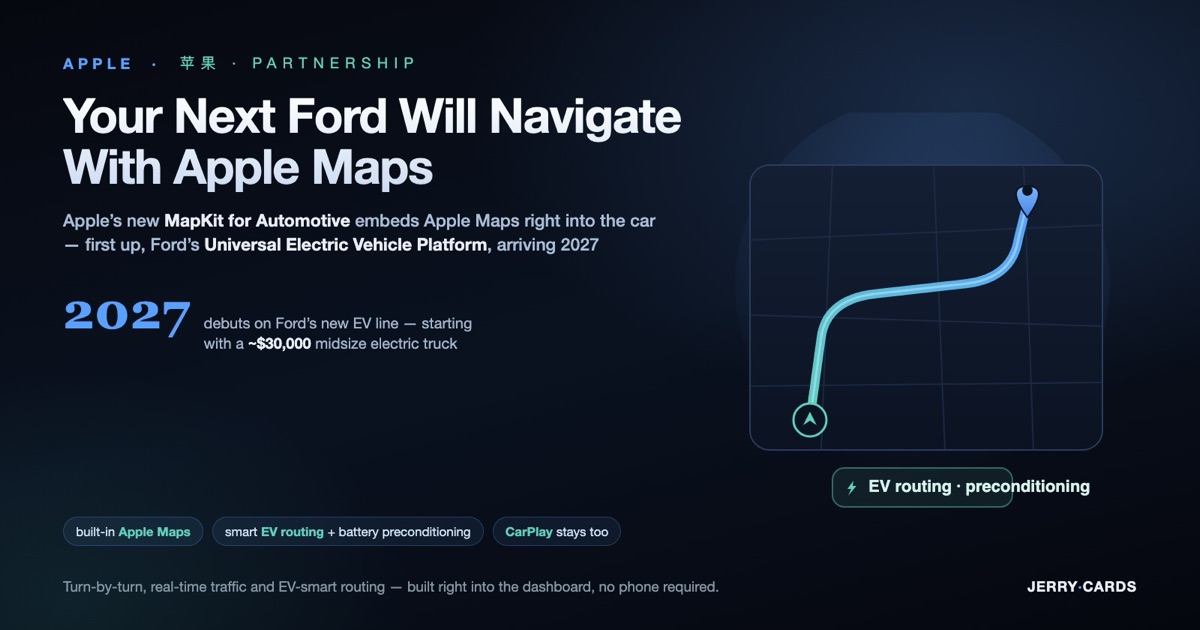
Apple Maps is about to move off your iPhone and into the dashboard itself. On July 23, 2026, Apple and Ford announced that Apple Maps will be built directly into Ford’s next generation of electric vehicles - not mirrored from a phone over a cable, but embedded natively in the car’s own system. The bridge is a brand-new Apple developer kit, MapKit for Automotive, and Ford is the first automaker to build on it. It is a genuine milestone: for drivers, for Ford’s EV ambitions, and for Apple Maps, a service that has quietly grown from a rocky 2012 debut into a platform a company the size of Ford is willing to put at the center of its cars.
- What: Apple Maps built natively into Ford vehicles, via Apple’s new MapKit for Automotive developer kit
- Who: Apple and Ford (announced July 23, 2026)
- Where it lands first: Ford’s new Universal Electric Vehicle (UEV) Platform
- When: arriving in 2027, starting with a midsize electric truck priced around $30,000
- Standout feature: intelligent EV routing that plans charging stops and preconditions the battery before you reach a charger
- Good news for fans: CarPlay stays available alongside the built-in experience
1. What Apple actually announced
The headline product is MapKit for Automotive, a new software development kit that lets automakers embed Apple Maps navigation directly into a vehicle’s built-in infotainment system. This is different from Apple CarPlay. CarPlay projects your iPhone’s interface onto the car’s screen; MapKit for Automotive puts Apple Maps into the car as a native part of the vehicle, running whether or not a phone is connected. In other words, the map becomes part of the car.
Ford is the launch partner. Apple Maps will power the navigation experience on Ford’s new Universal Electric Vehicle (UEV) Platform - the flexible architecture Ford is building to underpin a whole family of affordable EVs. The first vehicle out of the gate is a midsize electric truck priced around $30,000, expected in 2027, with additional body styles planned to follow on the same platform.
2. What drivers get
Baked into the dashboard, Apple Maps brings the features iPhone users already rely on - now tuned for the realities of driving an electric vehicle.
| Feature | What it does |
|---|---|
| Turn-by-turn navigation | Guided directions with natural-language search - ask for places the way you would say them |
| Real-time traffic | Live traffic and incident information to route around delays |
| Place cards | Detailed information on destinations so you pick the right one, fast |
| Intelligent EV routing | Plans charging stops along the way and preconditions the battery before you arrive at a charger, to help cut charging time |
That last row is the one that matters most for an EV. Battery preconditioning - warming or cooling the pack to its ideal temperature before you plug in - can meaningfully shorten a fast-charging stop, and doing it automatically based on the route you have set is exactly the kind of small, smart touch that makes an electric car easier to live with.
3. CarPlay is not going away
If you are a CarPlay devotee, breathe easy. Apple was explicit that CarPlay will continue to be available on Ford vehicles, working alongside the new built-in Apple Maps experience. The two are complementary: the embedded maps give you great navigation the moment you start the car, phone or no phone, while CarPlay still lets you bring your apps, messages, and music along for the ride. Apple also noted that it does not collect location data tied to individual users through the in-vehicle maps.
4. The bigger idea: maps as the backbone of hands-free driving
There is a forward-looking reason a carmaker would want rich, road-level map data wired deep into the vehicle. Ford said the same Apple Maps data will help feed its next-generation BlueCruise hands-free highway driving system, developed with its Latitude AI team, toward a smoother “on-ramp-to-off-ramp” experience. Precise maps are quietly becoming core infrastructure for driver assistance and, eventually, more automated driving - the car needs to know the road ahead in detail, not just what its cameras can see in the moment.
5. Why it is a milestone for Apple Maps
It is easy to forget how far Apple Maps has come. It launched in 2012 to famously mixed reviews. More than a decade of rebuilding later - new data, redesigned cartography, lane guidance, transit, detailed city experiences - it has become a navigation platform good enough that Ford is willing to embed it at the heart of its electric-vehicle future. Winning a built-in role in another company’s cars, rather than simply riding along on a phone, is a strong vote of confidence in the product.
“Apple Maps delivers the best map experience in the world, and we’re excited to bring the power of Maps’ navigation technology to Ford’s innovative Universal Electric Vehicle Platform.”
- Eddy Cue, Apple’s senior vice president of Services
“We’re proud to embed Apple Maps’ navigation and mapping technology directly into our Universal Electric Vehicle Platform, giving customers the ultimate navigation experience alongside our Ford app.”
- Jim Farley, Ford CEO
The timeline
- July 23, 2026: Apple and Ford announce the partnership and Apple’s MapKit for Automotive.
- 2027: the experience arrives with Ford’s Universal Electric Vehicle Platform, beginning with a ~$30,000 midsize electric truck.
- Beyond: the same map data helps power Ford’s next-generation BlueCruise hands-free highway driving, with more UEV models to follow.
Sources
- Apple Newsroom: Apple Maps to power the navigation experience for the Ford Universal Electric Vehicle Platform
- TechCrunch: Ford bets on Apple for its next generation of EVs
- 9to5Mac: Apple Maps is becoming Ford’s new navigation mode for select vehicles
Curated by Jerry Cards - jerrycards.com. We tell the stories behind the technology, science, and ideas shaping our world. More at jerrycards.com/news.