
 العربية
 Español
 中文
中文 Deutsch
 Français
 Português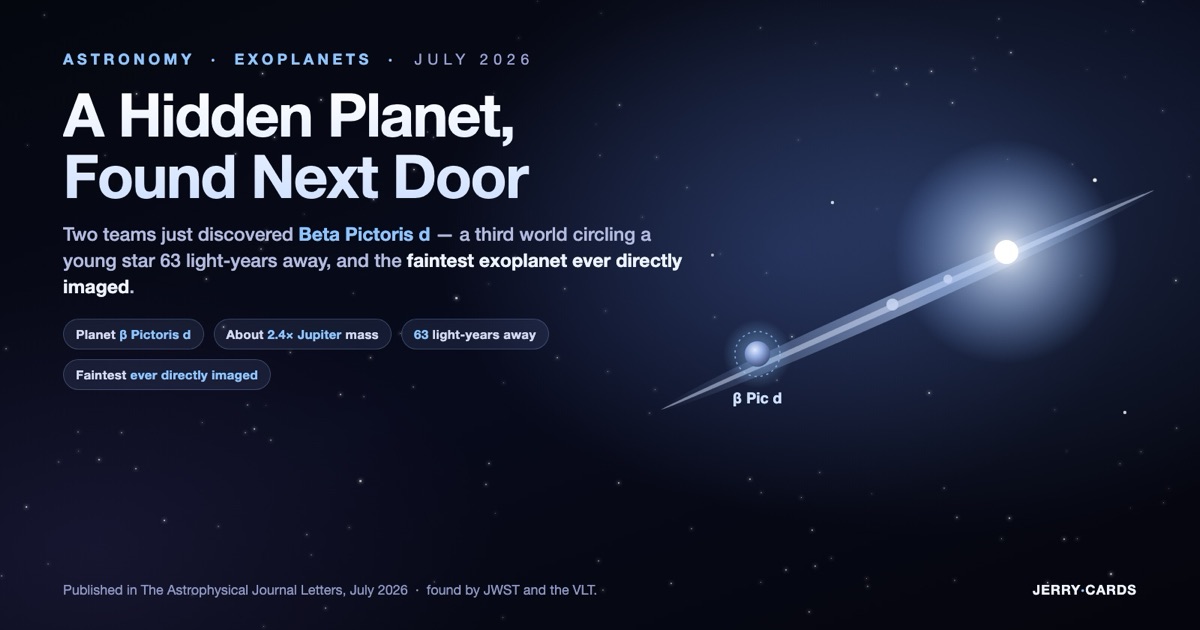
A planet had been hiding in plain sight for more than a decade - and it took two telescopes, two teams, and a clever change of tactics to finally catch it. Astronomers have discovered a third planet orbiting Beta Pictoris, one of the most closely watched young stars in the entire sky, just 63 light-years from Earth. The new world, Beta Pictoris d, is a gas giant that had eluded a generation of planet-hunters - and the way it was finally found points to a powerful new method for discovering the faintest worlds around other stars.
- What: a newly discovered giant planet, Beta Pictoris d - the third known planet in the system
- Where: orbiting Beta Pictoris, a bright young star ~63 light-years away
- Size & orbit: about 2.4x the mass of Jupiter, orbiting roughly 26-30 AU out - about as far as Neptune sits from our Sun
- How: two independent teams, using NASA's James Webb Space Telescope and ESO's Very Large Telescope
- Record: at 100x fainter than Beta Pictoris b, it is the faintest exoplanet ever directly imaged from Earth
- Published: two papers in The Astrophysical Journal Letters, July 2026
1. A star we thought we knew
Few stars have been studied as lovingly as Beta Pictoris. It is a hot, bright, A-type star roughly 1.8 times the mass of the Sun, and it is astonishingly young - only around 20 million years old, a cosmic newborn next to our 4.6-billion-year-old Sun. In 1984 it became the first star ever seen to be encircled by a debris disk - a vast, edge-on ring of gas and dust that is the leftover rubble of planet formation. For forty years, that disk has been a front-row seat to the messy, beautiful process of building worlds.
By 2019, astronomers had already found two giant planets there: Beta Pictoris b, first imaged in 2008, and Beta Pictoris c, detected in 2019. The system was a textbook example of planet formation caught in the act. What almost nobody expected was that a third planet was still lurking, unseen, in the data astronomers had already collected.
2. Two teams, two telescopes, one hidden world
The remarkable part of this story is that two independent teams found the same planet at the same time, by completely different routes - and both landed in the same journal in July 2026.
The James Webb team. A group led by Aidan Gibbs of the University of California, San Diego was not even hunting for a new planet. While studying the system with the James Webb Space Telescope's NIRSpec spectrograph, they serendipitously caught the chemical signature of a giant planet's atmosphere - a distinctive series of carbon-monoxide absorption lines - and then confirmed it by detecting water and methane with Webb's mid-infrared instrument, MIRI. Crucially, they measured the light's Doppler shift to prove the object was gravitationally bound to Beta Pictoris, not a background star. Their paper carries the fitting title ‘Discovery of an Exterior Third Planet Orbiting β Pictoris.’
The Very Large Telescope team. Independently, a team led by Ben Sutlieff of the University of Edinburgh, using the European Southern Observatory's Very Large Telescope (VLT) in Chile, went digging - and found the very same planet sitting quietly in more than a decade of archival images, overlooked all along. Their paper's title says it all: ‘Direct Imaging Discovery of Giant Exoplanet β Pictoris d: A Decade-long Game of Hide-and-seek.’
Traditional direct imaging tries to see a planet as a faint point of light next to a dazzling star - like spotting a firefly beside a searchlight. The Webb team did something different: they spread the light into a spectrum and looked for the molecular fingerprint that only a planet's warm atmosphere would leave - carbon monoxide, water, methane. Because those features move with the planet, they reveal both its presence and its motion. This is the first time a directly imaged planet has been discovered primarily through this kind of moderate-resolution spectroscopy - a new lens for finding worlds too faint to catch any other way.
3. Meet Beta Pictoris d
| Property | What the studies report |
|---|---|
| Mass | About 2.4x the mass of Jupiter (the smallest of the three known planets) |
| Orbit | Roughly 26-30 AU - the widest, outermost orbit of the three, near the inner edge of the debris disk |
| Brightness | ~100x fainter than Beta Pictoris b - the faintest exoplanet ever directly imaged from Earth |
| Host star | Beta Pictoris - ~1.8 solar masses, ~63 light-years away, only ~20 million years old |
| Found by | JWST NIRSpec + MIRI (Gibbs et al.) and ESO VLT (Sutlieff et al.) |
| Published | The Astrophysical Journal Letters, July 2026 |
Sitting out at the cold edge of the system, Beta Pictoris d completes a striking picture: three giant planets, arranged from the inner system all the way out to the fringe of the dusty disk, all still settling into their orbits around a star younger than the human species.
4. Why this discovery matters
- A rare full-family portrait. Beta Pictoris now joins HR 8799 as only the second star system in which astronomers have directly imaged three or more planets. Systems we can photograph planet-by-planet are precious: they let us study how giant worlds are spaced, how they interact, and how a solar system arranges itself.
- A newborn system, caught forming. Because Beta Pictoris is so young and still wrapped in its debris disk, its planets are essentially fresh from the oven. Studying them is as close as we get to watching the early history of a planetary system unfold in real time.
- A powerful new detection method. The spectroscopic approach that revealed Beta Pictoris d can find and characterize planets that are simply too faint for classic imaging - meaning there may be many more hidden worlds waiting in data we have already collected.
‘Planet d, it seems, has been playing a game of hide-and-seek with us for over a decade, and only now can we say “found you!”’
— Dr. Jayne Birkby, University of Oxford
What we still don’t know
- Its exact temperature and clouds. Follow-up analysis of the planet’s atmosphere - its precise temperature, weather, and composition - is still ongoing.
- Its exact orbit. The orbital distance is currently a range (~26-30 AU); pinning down the full orbit will take more observations over time.
- Whether more planets remain. If a world this substantial could hide for a decade, the same spectroscopic technique may yet turn up other faint companions here and elsewhere.
The takeaway
There is something wonderful about a planet that was in our data the whole time, patiently waiting to be noticed. Beta Pictoris d was not found by building a bigger telescope, but by asking a smarter question - reading a star’s light for the chemistry of a world instead of straining to see its glow. Two teams, working independently with two of the finest observatories ever built, arrived at the same quiet new world at the same moment. It is a reminder that the sky still has secrets close to home - and that we are getting cleverer, and more curious, about how to find them.
Sources
- NASA / Webb: NASA’s Webb Discovers Hidden Planet in Famous Star System
- Astrophysical Journal Letters (Gibbs et al., 2026): Discovery of an Exterior Third Planet Orbiting β Pictoris
- Astrophysical Journal Letters (Sutlieff et al., 2026): Direct Imaging Discovery of Giant Exoplanet β Pictoris d: A Decade-long Game of Hide-and-seek
- Sci.News: Astronomers Discover and Directly Image Third Planet in Beta Pictoris System
- Universe Today: This Exoplanet Hid for 10 Years Before Astronomers Finally Found It
Curated by Jerry Cards - jerrycards.com. We research the week’s most consequential tech, science, and business news so you don’t have to. More at jerrycards.com/news.