
 العربية
 Español
 中文
中文 Deutsch
 Français
 Português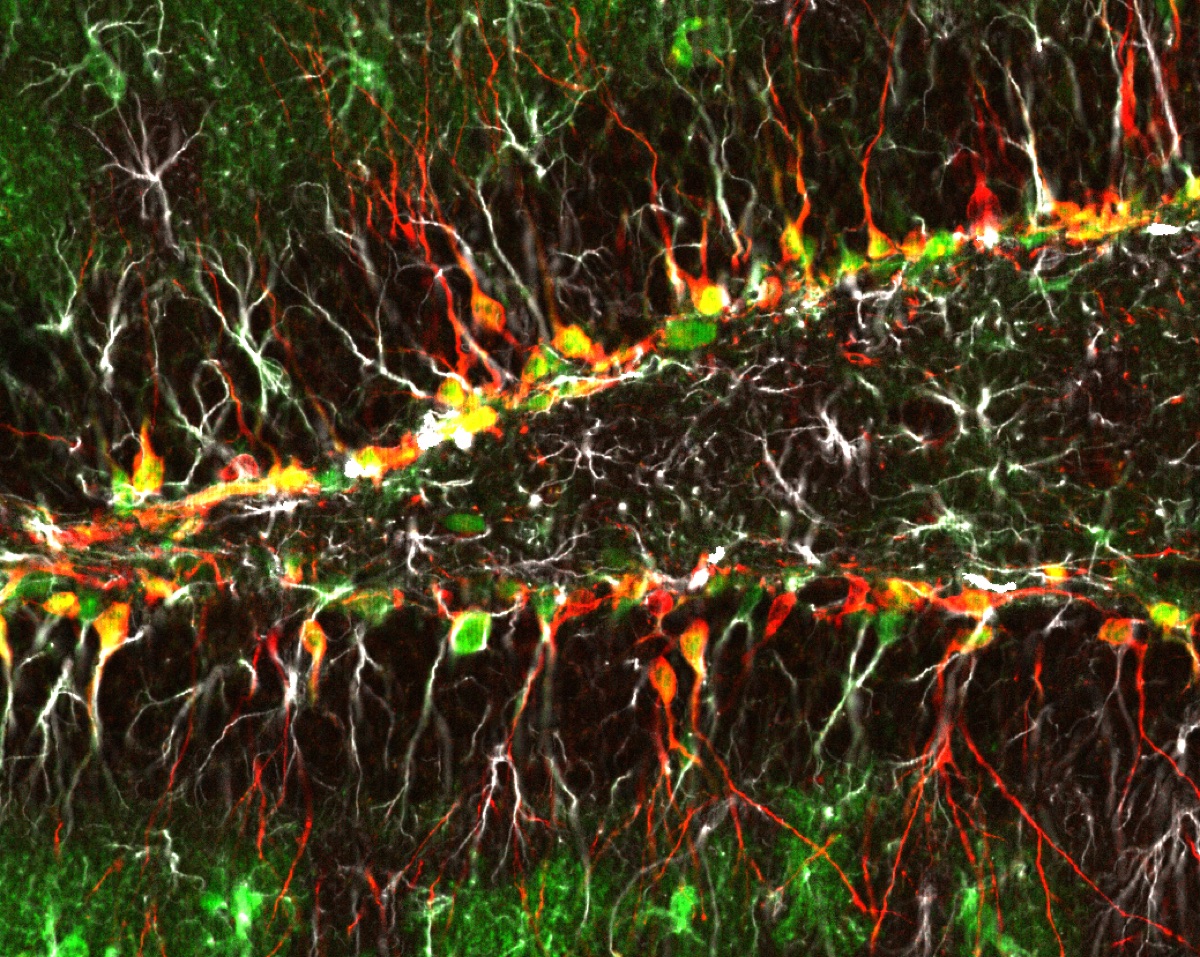
For most of the twentieth century, the textbooks were blunt: you are born with all the neurons you will ever have, and from there it is downhill. That gloomy dogma has been crumbling for years - and in 2026 two separate teams delivered some of the strongest, most hopeful evidence yet that the adult human brain keeps making brand-new neurons deep into old age. More striking still, the way those young cells behave may help explain one of neuroscience’s most tantalizing mysteries: why some people carry the hallmarks of Alzheimer’s in their brains and never lose their minds to it.
- The adult human hippocampus - the brain’s memory hub - still contains immature, newborn-style neurons even past age 80.
- In the ~30% of people who have Alzheimer’s changes but stay mentally sharp, the difference is not how many young neurons they have - it is how those neurons behave.
- Resilient brains’ immature neurons switch on survival programs, with lower signals of inflammation and cell death.
- A separate Nature study found cognitive superagers make at least twice as many new neurons as their typical elderly peers.
- Honest caveat: these are snapshots of donated tissue - they show association, not proof, and there is no treatment yet.
1. The 30% Who Defy Alzheimer’s
Start with the puzzle. When pathologists examine the brains of older adults, a surprising fraction are riddled with the amyloid plaques and tau tangles that define Alzheimer’s disease - yet those people sailed through their final decades with sharp, intact memories. Neuroscientist Evgenia Salta of the Netherlands Institute for Neuroscience frames it plainly: “Around 30 percent of older adults who develop Alzheimer’s disease never experience its symptoms.” They are called cognitively resilient, and understanding what protects them is a very different - and more hopeful - question than simply attacking the damage. “We really don’t know why,” Salta says. “That’s a big mystery, and a very important one.”
2. The Surprise: The Old Brain Is Still Building
To probe that mystery, Salta’s team - with PhD researcher Giorgia Tosoni as first author - turned to donated human brain tissue from the Netherlands Brain Bank and read out the activity of individual cells one by one. Their study, published in Cell Stem Cell on April 24, 2026, compared three groups whose average age was over 80: healthy controls, people who had Alzheimer’s dementia, and the resilient - people with Alzheimer’s pathology but no dementia.
The first headline is simply that the young cells are there at all. For years, researchers fiercely debated whether the adult human brain makes any new neurons - so-called adult neurogenesis. Tosoni and Salta found immature neurons in every single group. “Even at an average age of over 80, we still found these immature neurons in all groups,” Salta notes. The aging brain, in other words, has not closed the nursery.
3. It Is Not How Many - It Is How They Behave
Here is the twist that makes the study matter. The resilient brains did not simply carry more immature neurons than the others. Instead, the young cells in resilient people were running a fundamentally different molecular program. They switched on genes associated with survival and coping with stress, and showed lower signatures of inflammation and cell death. In people with dementia, those same cells’ programs and their conversations with neighboring cells were disrupted.
Salta’s image for what these cells might be doing is worth sitting with: “It might not be (only) about replacing lost neurons,” she says. “It could be that these cells support the surrounding tissue and help the brain stay functional and ‘youthful.’” Think of them less as spare parts swapped into a broken machine and more as fertilizer spread across a garden that has started to wilt - nourishing what is already there.
| Group (avg age 80+) | Alzheimer’s changes? | Immature neuron behavior |
|---|---|---|
| Healthy controls | No | Present, baseline |
| Resilient | Yes | Survival programs on; low inflammation and cell-death signals |
| Alzheimer’s dementia | Yes | Programs and cell-to-cell signaling disrupted |
4. A Second Study, Same Direction: Superagers Make Twice as Many
The Netherlands result does not stand alone. Earlier in 2026, a team led by Orly Lazarov at the University of Illinois Chicago - working with Northwestern University’s SuperAging Research Program - reported in Nature a complementary picture built from a different angle. Using multiomic single-cell sequencing, they analyzed more than 356,000 individual cell nuclei from 38 donors spanning young adults, healthy older adults, cognitive superagers, and people with early and advanced Alzheimer’s.
“Superagers” - people in their 80s whose memory matches adults decades younger - made at least twice as many new neurons as their typical elderly peers, and by some measures more than adults in their 30s and 40s. In Alzheimer’s, by contrast, this neuron-building machinery stalled. Lazarov called the work “a significant advance in understanding how the human brain processes memory and ages.”
Two independent teams, two continents, two top journals, one converging message: the capacity to build and sustain new neurons appears to track with a brain that stays sharp.
5. Why This Is Such Hopeful Science
Most Alzheimer’s research has focused, understandably, on removing the damage - clearing plaques, untangling tau. Resilience flips the lens: instead of only asking how to stop the harm, it asks how the brain already defends itself, and how we might strengthen that defense. If the adult brain retains a genuine capacity for renewal into our ninth decade, the target shifts from the impossible-sounding goal of replacing lost neurons wholesale to a far more tractable one: helping the young neurons we are still making switch on their protective, tissue-nourishing programs. It reframes the aging brain not as a machine running out of parts, but as a living system that never entirely stops rebuilding.
What We Still Don’t Know
- Association is not proof. Both studies read postmortem tissue at a single moment. They show that resilient brains and superager brains look different - not that the neurons caused the resilience. As Salta cautions, “We assume the cells’ function based on the data, but we cannot confirm it in this type of study.”
- How the cells actually help. The ‘fertilizer’ role is a hypothesis; the next step is mapping how immature neurons talk to the cells around them.
- No treatment yet. Nothing here is a pill or a protocol. It is a map of where to look, not a therapy.
- Individual variation is large. Human brains differ enormously, and the resilient and superager groups are precious but small - findings will need replication.
Those caveats are real. But so is the throughline, and it is quietly extraordinary: well past the age when we were once told the brain only declines, it is still making new neurons - and in the people who age best, those young cells seem to be working hardest to keep the whole garden alive.
Sources
- Tosoni, Salta et al., “Transcriptional profiles of immature neurons in aged human hippocampus track Alzheimer’s pathology and cognitive resilience,” Cell Stem Cell, April 24, 2026 (DOI 10.1016/j.stem.2026.04.002) · Netherlands Institute for Neuroscience press release
- Disouky, Lazarov et al., “Human hippocampal neurogenesis in adulthood, ageing and Alzheimer’s disease,” Nature, 2026 · Northwestern Feinberg: superagers make at least twice as many new neurons · NIH Research Matters
- Alzforum: In AD, Neurogenesis Stalls. In Superagers, It Ramps Up.
Curated by Jerry Cards - jerrycards.com. We research the week’s most consequential science, tech, and health news so you don’t have to. More at jerrycards.com/news.