
 العربية
 Español
 中文
中文 Deutsch
 Français
 Português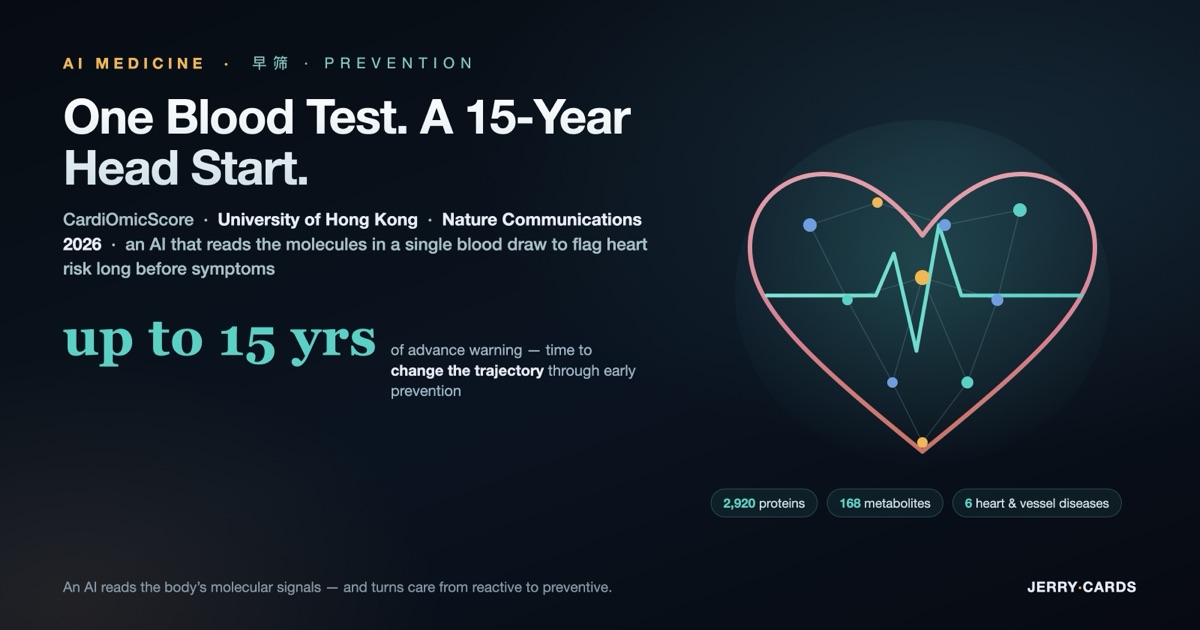
For most of medicine’s history, the heart has given its warning late - often at the moment of the heart attack or stroke itself. A new artificial-intelligence tool is trying to move that warning forward by more than a decade. Researchers at the University of Hong Kong have built a model called CardiOmicScore that reads the molecules in a single blood sample and estimates a person’s risk of six major cardiovascular diseases up to 15 years before symptoms appear - early enough that prevention still has room to work.
- What: CardiOmicScore, an AI model that predicts long-term risk of six cardiovascular diseases from a blood sample
- Who: a team led by Professor Zhang Qingpeng with first author Luo Yan, LKS Faculty of Medicine, University of Hong Kong (HKUMed)
- Published: Nature Communications, 19 July 2026
- What it reads: 2,920 blood proteins + 168 metabolites - a ‘multiomics’ molecular fingerprint
- Horizon: up to 15 years before symptoms, in higher-risk people
- The point: shift care from reactive treatment to proactive prevention
1. From treating disease to predicting it
Cardiovascular disease has long been managed reactively: we measure blood pressure and cholesterol, weigh a handful of risk factors, and often act in earnest only once trouble is already brewing. CardiOmicScore belongs to a different philosophy - predict first, then prevent. Instead of waiting for a clinical event, it looks for the faint molecular signature of risk building quietly in the blood, years or even decades ahead of time.
Crucially, this is framed as an opportunity, not a diagnosis. A high score is not a sentence; it is a head start - a prompt to lean on the well-established tools of prevention while there is still plenty of time for them to matter.
2. What a ‘multiomics’ blood test actually reads
Most risk calculators you may have heard of lean on a few numbers (age, blood pressure, cholesterol) or on genetics. Genetic - or ‘polygenic’ - risk scores are powerful, but they are fixed at birth: they describe the hand you were dealt, not how you are playing it today. CardiOmicScore adds two layers that change over your lifetime:
- Proteomics - the thousands of proteins circulating in your blood, the working machinery of the body. The model reads 2,920 of them.
- Metabolomics - the small molecules produced as your body burns fuel and runs its chemistry. The model reads 168 of these.
Using a multitask deep-learning framework trained on the UK Biobank, the system distils these signals into two disease-specific scores: a proteomic score the researchers call ProScore and a metabolomic score called MetScore. Together they form the combined CardiOmicScore.
‘Genes determine where we start — they define our baseline health risk. However, proteins and metabolites reflect our current physical health. Our AI tool is designed to decode these complex molecular signals, enabling doctors and patients to identify risks much earlier, which can potentially change the trajectory of disease through timely lifestyle modifications and early prevention.’
— Professor Zhang Qingpeng, University of Hong Kong
3. The six diseases it forecasts
Rather than a single yes/no answer, CardiOmicScore produces a tailored risk profile across six of the most consequential heart and blood-vessel conditions:
| Condition | In plain language |
|---|---|
| Coronary artery disease | Narrowing of the heart’s own arteries - the usual road to a heart attack |
| Stroke | A disruption of blood flow to the brain |
| Heart failure | When the heart struggles to pump enough blood for the body |
| Atrial fibrillation | An irregular heart rhythm that raises stroke risk |
| Peripheral artery disease | Narrowed arteries reducing blood flow to the limbs |
| Venous thromboembolism | Blood clots that form in veins |
4. How well does it work?
The researchers measured performance with the concordance index (C-index) - a standard yardstick for risk models. It runs from 0.5 (no better than a coin flip) to 1.0 (perfect ranking of who will develop disease and who will not). Here is what the two molecular scores achieved on their own, across the six diseases:
| Score | What it reads | C-index (six diseases) |
|---|---|---|
| ProScore | 2,920 blood proteins | 0.69 - 0.82 |
| MetScore | 168 metabolites | 0.64 - 0.74 |
Two findings stand out. First, the protein-based score was consistently the stronger of the two - proteomics carried more predictive signal than metabolomics for these conditions. Second, the omics scores are complementary to what clinics already measure: when the researchers added ProScore and MetScore on top of standard clinical factors, prediction improved further (raising the C-index by up to about 0.10), and the combined approach outperformed conventional genetic (polygenic) risk scores - all the way out to a 15-year horizon in higher-risk individuals. The paper’s own title captures the theme: multiomics profiling reveals complementary contributions to personalised prediction.
5. Why an early, molecular warning is such a gift
The value of a 15-year head start is simple: time. Cardiovascular disease is one of the most preventable categories of illness there is, and the earlier a risk is spotted, the more the ordinary, well-proven levers can do - the kind a clinician can help put in place long before any emergency.
- A snapshot of now, not just birth. Because proteins and metabolites shift with lifestyle, environment and health, the score can move - which means changes you make may be reflected in it.
- Six answers from one draw. A single blood sample yields a broad risk profile across several conditions at once, rather than a separate work-up for each.
- Prompting the right conversations earlier. An early flag is a reason to talk to a doctor about prevention while the runway is long.
‘We aim to leverage technology to identify and prevent diseases before they develop. By shifting health management from reactive treatment to proactive prediction and intervention, we aim to create a lasting impact for both public health and individual patient care.’
— Professor Zhang Qingpeng
What we still don’t know
- It needs testing beyond the UK Biobank. The model was built and validated on that cohort - large and richly detailed, but skewed toward middle-aged, predominantly European-ancestry participants. Broad clinical use will require validation in more diverse populations and age groups.
- Risk is a probability, not a prophecy. A high score signals elevated odds, not a certainty; a low score is reassuring but not a guarantee. The clinical value lies in guiding earlier prevention, not in labelling anyone.
- Cost and access matter. Measuring nearly 3,000 proteins at scale is still relatively expensive; whether such profiling becomes routine will depend on cost coming down and on how it fits into everyday care.
- It is a research advance, not yet a product. CardiOmicScore is a published model, not an approved clinical test - the next steps are prospective validation and the long road through real-world evaluation.
The takeaway
There is a quiet optimism running through this work. For a long time, fighting heart disease has meant reacting to it. CardiOmicScore is part of a broader shift toward listening to the body’s own molecular signals and acting years earlier - turning a single, familiar blood draw into a long-range forecast. If it holds up in wider testing, the payoff is not a scarier future but a more preventable one: the same tools we already trust, put to work with a decade or more of extra warning.
Sources
- Luo Y. et al., ‘AI-based multiomics profiling reveals complementary omics contributions to personalized prediction of cardiovascular disease,’ Nature Communications (2026): doi:10.1038/s41467-026-68956-6
- ScienceDaily: New AI blood test predicts heart disease 15 years early
- SciTechDaily: New AI blood test predicts stroke, heart failure, and more up to 15 years in advance
- MobiHealthNews: AI shifts non-communicable disease risk prediction beyond genetics
Curated by Jerry Cards - jerrycards.com. We research the week’s most consequential tech, science, and business news so you don’t have to. More at jerrycards.com/news.