
 العربية
 Español
 中文
中文 Deutsch
 Français
 Português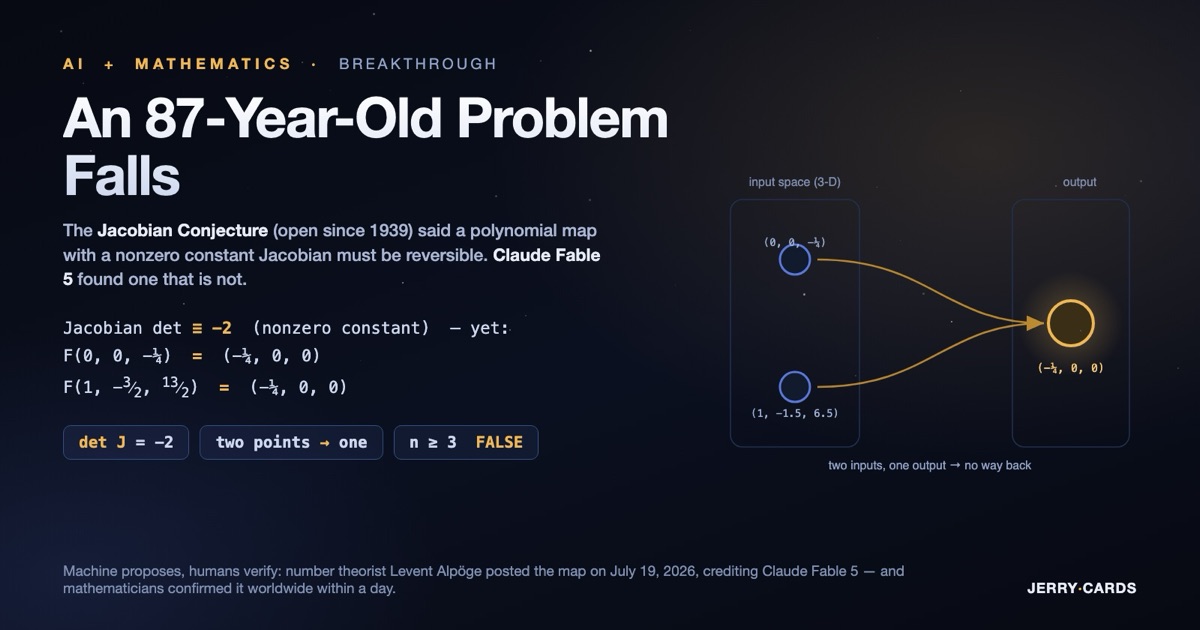
An 87-year-old mathematical conjecture was just proven false - and the counterexample arrived not in a journal, but in a casual, eight-word post on X sent while the World Cup final played in the background. On the night of Sunday, July 19, 2026, the number theorist Levent Alpöge wrote: ‘hello there the jacobian conjecture is false thanx.’ Beneath it sat a single polynomial map, and a note thanking his ‘close friend fable’ - Anthropic’s AI model, Claude Fable 5 - for finding it ‘during the world cup final.’ Within a day, mathematicians around the world had checked the math by hand and agreed. The remarkable part is not only that a decades-old problem fell, but how: a human mathematician used a frontier AI as a genuine research collaborator, and then everyone else verified the answer for themselves.
- The problem: the Jacobian Conjecture, open since 1939 (Ott-Heinrich Keller); on Stephen Smale’s list of important problems
- The claim it made: a polynomial map with a nonzero constant Jacobian determinant must be reversible (invertible)
- Who: number theorist Levent Alpöge (works at Anthropic; previously a Junior Fellow in Harvard’s Society of Fellows), with the problem suggested by Akhil Mathew
- The tool: Claude Fable 5, which produced the explicit counterexample
- The map: a polynomial map from 3-D space to itself with Jacobian determinant −2 everywhere - that is not one-to-one
- The result: the conjecture is false for every dimension ≥ 3; the 2-D case remains open
- Status: independently verified in public within a day; a formal paper has not yet appeared
1. Eight Words That Ended a Long Wait
At around 2 a.m. UTC on July 20 - Sunday evening in the United States, mid-broadcast of the 2026 World Cup final - Levent Alpöge posted his short message and, beneath it, an explicit polynomial map short enough to fit in a single post. Almost as an afterthought, he thanked two people: his ‘close friend akhil’ for asking about the problem, and his ‘other close friend fable’ - Claude Fable 5 - for working on it during the match. There was no press release and no preprint; just the object itself, handed to the world.
Alpöge is a number theorist who now works at the AI company Anthropic and previously held a Junior Fellowship in Harvard’s Society of Fellows; the problem was suggested to him by the University of Chicago mathematician Akhil Mathew. What they had, and shared, was a clean counterexample to a question that had stood since 1939.
2. What the Jacobian Conjecture Actually Says
Imagine a rule that takes each point of space and moves it to a new point, where every coordinate of the output is a polynomial in the input coordinates. Attached to such a map at every point is a number called the Jacobian determinant - loosely, how much the map stretches or squeezes tiny volumes there. A basic theorem of calculus says that wherever that number is nonzero, the map is reversible locally: zoom in far enough and you can always find your way back.
If a polynomial map F from n-dimensional space to itself has a Jacobian determinant that is a nonzero constant (the same value at every point), then F is globally reversible - it is one-to-one and onto, and its inverse is also a polynomial. Posed for two dimensions and generalized to all dimensions by Ott-Heinrich Keller in 1939, it is easy to state, maddeningly hard to settle, and has drawn dozens of flawed ‘proofs’ over the decades.
The intuition is seductive: if the map never collapses volume anywhere (the determinant is a fixed, nonzero number), surely it never folds space over onto itself, so it should be reversible everywhere at once. The conjecture is the bet that locally reversible everywhere forces globally reversible. Fable’s example is a crisp demonstration that this bet fails.
3. The Counterexample - and How to Check It Yourself
The map sends the point (x, y, z) in three-dimensional space to a new point (P, Q, R), where:
Q = y + 3x(1 + xy)2·z + 3xy2(4 + 3xy)
R = 2x − 3x2y − x3·z
Grind through the calculus and the Jacobian determinant of this map works out to exactly −2 - a nonzero constant, at every single point. So it satisfies the conjecture’s hypothesis perfectly. The conjecture therefore demands that the map be reversible. It is not.
Here is the whole disproof in two lines you can verify with nothing but arithmetic. Take these two different input points and run them through the map:
F(1, −3/2, 13/2) = (−1/4, 0, 0)
Two completely different starting points land on the same output. A map that merges distinct inputs can never be undone - given the output (−1/4, 0, 0), there is no way to know which point you came from. (In fact this map is generically three-to-one.) So it is not reversible, even though its Jacobian determinant is a perfectly well-behaved nonzero constant. That is the entire counterexample - finite, explicit, and checkable on the back of an envelope, which is precisely why it spread and was confirmed so fast.
4. Which Dimensions Fell
A counterexample in three dimensions immediately settles every higher dimension too: just carry the extra coordinates along unchanged, and the same collision reappears. The lone survivor is the two-dimensional case, which - in one of those quirks that makes mathematics fun - remains stubbornly open.
| Dimension | Status of the Jacobian Conjecture |
|---|---|
| n = 1 | True (long known, essentially trivial) |
| n = 2 | Still open - the last unsettled case |
| n = 3 | False - this counterexample |
| n > 3 | False - the same map, with extra coordinates carried along |
5. Machine Proposes, Humans Verify
Computers have assisted mathematics for decades - checking cases, running symbolic algebra, even formalizing proofs. What feels new here is the shape of the collaboration. A working mathematician pointed a frontier AI model at a specific, famous, decades-old question and asked it to hunt for a counterexample - and it returned one clean enough to fit in a social-media post. The human supplied the taste (which problem, which form of answer to look for); the model supplied the search; and then the entire community supplied the proof-checking.
A counterexample is the friendliest kind of mathematical claim to audit. You do not have to trust the AI, the mathematician, or anyone else: you plug in the numbers and watch two points collide. Unlike a long, delicate proof that might conceal an error for years, this object is either right or it is not - and everyone who has checked it, including mathematicians such as Will Sawin and David Speyer, reports that it is right. Machine proposes; humans verify.
What We Still Don’t Know
- The two-dimensional case - the original heart of the problem - is still unresolved, and may be genuinely different in character.
- No formal paper yet. The result lives, for now, in a post and in the public calculations of the mathematicians who reproduced it; a written-up account and conventional refereeing are still to come. (The counterexample’s concreteness makes this unusually low-risk.)
- How, exactly, the model found it. A full transcript of the search has not been published, so the discovery process itself cannot yet be independently retraced.
None of that dims the moment. An easy-to-state problem stood for 87 years; this week a person and an AI produced an answer so simple that anyone can confirm it in a few minutes. That is a wonderful thing for mathematics - and a preview of a way of working that is only going to get more common.
Sources
- The Conversation: ‘hello there the jacobian conjecture is false thanx’ · Fast Company: A Harvard mathematician and an AI model cracked an 87-year-old problem
- Fortune: AI cracks another century-old problem · The Next Web: An AI just broke an 87-year-old maths problem, in a tweet
- Secret Blogging Seminar: The new counterexample to the Jacobian conjecture · John D. Cook: Locally everywhere does not imply everywhere
Curated by Jerry Cards - jerrycards.com. We research the milestones behind the tech, science, and AI news that matters so you don’t have to. More at jerrycards.com/news.