
 العربية
 Español
 中文
中文 Deutsch
 Français
 Português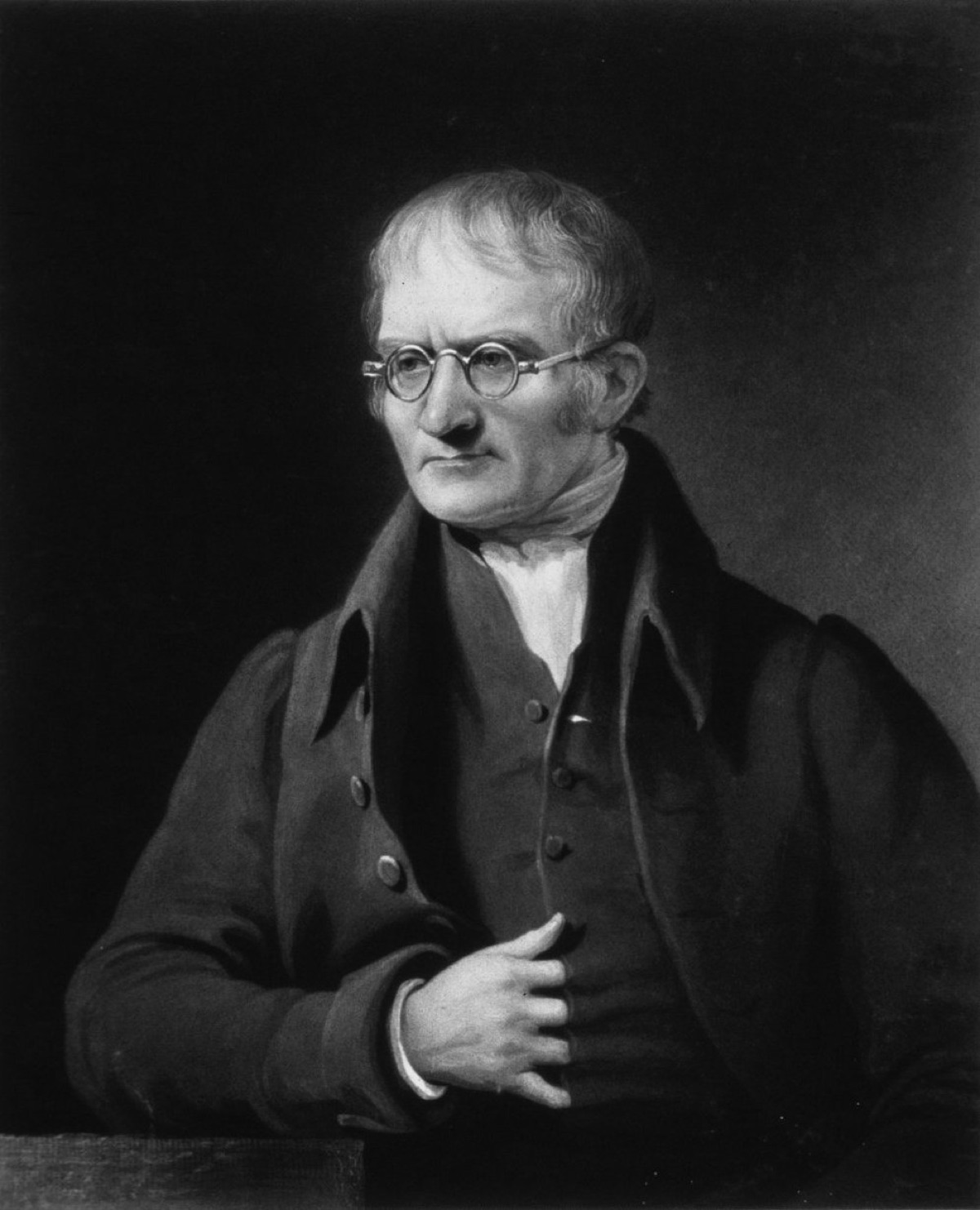
Pick up anything near you - a coffee cup, your phone, your own hand - and you are holding an unimaginable number of atoms. That everything is built from these tiny, identical building blocks is one of the first things we learn in school. It can feel obvious. It was not. For more than two thousand years the atom was a philosopher's hunch with no way to test it. The person who finally turned that hunch into a working science was not a famous professor but a self-taught Quaker schoolteacher named John Dalton - and he did it, quietly, in the north of England around 1808.
- Who: John Dalton (1766-1844), self-taught chemist, meteorologist and teacher
- Where / when: Manchester, England; first atomic weights read in 1803, full theory published 1808
- The work: A New System of Chemical Philosophy (Vol. 1, Part 1, 1808)
- The big idea: every element is made of identical atoms with a characteristic weight; compounds form when atoms combine in simple whole-number ratios
- Why it mattered: it made atoms measurable - the leap from philosophy to quantitative science
- Legacy: the foundation of the periodic table and all of modern chemistry, physics and materials science
“If, in some cataclysm, all of scientific knowledge were to be destroyed, and only one sentence passed on to the next generations of creatures, what statement would contain the most information in the fewest words? I believe it is the atomic hypothesis... that all things are made of atoms - little particles that move around in perpetual motion, attracting each other when they are a little distance apart, but repelling upon being squeezed into one another.”
- Richard Feynman, The Feynman Lectures on Physics (1963)
An unlikely revolutionary
Dalton was born in 1766 into a poor Quaker family in Eaglesfield, Cumberland. There was no path to Oxford or Cambridge for a Dissenter of modest means; he began teaching at his village school at the age of twelve and was largely self-educated. He settled in Manchester, where he made his living as a private tutor and became a fixture of the Manchester Literary and Philosophical Society.
His first love was the weather. Dalton kept a daily meteorological journal for 57 years, recording some 200,000 observations, and his study of gases and the atmosphere - including the law of partial pressures that still bears his name - is what led him to wonder what air, and matter itself, was actually made of. He was also the first to describe colour blindness scientifically, using his own eyes as the case study; the condition is still called Daltonism in many languages. In a fitting final experiment, he asked that his eyes be examined after his death - and in 1995, DNA analysis of a preserved eyeball confirmed his self-diagnosis.
A 2,200-year-old dream, finally made testable
The idea of the atom was ancient. Around 440 BC the Greek thinkers Leucippus and Democritus argued that matter could not be divided forever - that you would eventually reach an atomos, an “uncuttable” particle. But it was pure philosophy: there was no experiment that could confirm or deny it, and for two millennia it stayed that way.
By Dalton's time, chemistry had finally sharpened its tools. Antoine Lavoisier had established the law of conservation of mass (1789), and Joseph Proust had shown that a given compound always contains its elements in the same fixed proportion by weight (the law of definite proportions). The pieces were on the table. Dalton's genius was to see that atoms could explain all of it at once - and, crucially, to make the atom something you could put a number on.
The theory, in four ideas
Stripped to its essentials, Dalton's atomic theory said:
- All matter is made of atoms - tiny particles that cannot be created, destroyed, or subdivided.
- All atoms of a given element are identical in mass and properties; atoms of different elements differ, above all in weight.
- Compounds form when atoms of different elements combine in simple, whole-number ratios.
- A chemical reaction is simply a rearrangement of atoms - none are gained or lost.
That third point is the quiet masterstroke. If atoms are real, indivisible units, then you can only ever combine them in whole numbers - one to one, one to two, two to three - never in fractions. And that leaves a visible fingerprint in the lab.
The law of multiple proportions
Dalton's sharpest piece of evidence was the law of multiple proportions: when two elements combine to form more than one compound, the masses of one element that pair with a fixed mass of the other stand in ratios of small whole numbers. Carbon and oxygen are the classic example.
| Compound | Oxygen per fixed carbon | Ratio |
|---|---|---|
| Carbon monoxide (CO) | 1 part | 1 |
| Carbon dioxide (CO2) | 2 parts | 2 |
Exactly twice as much oxygen - not 1.9 times, not 2.1, but a clean doubling. Nature was combining things in lumps. To Dalton, those lumps were atoms. He compiled the first-ever table of relative atomic weights (read to the Manchester society in 1803, published from 1805), taking the lightest element, hydrogen, as 1 and measuring the others against it. He even invented a set of circular symbols - a dot for hydrogen, a circle for oxygen - to draw molecules on the page. As he wrote in 1803: “An enquiry into the relative weights of the ultimate particles of bodies is a subject, as far as I know, entirely new; I have lately been prosecuting this enquiry with remarkable success.”
What Dalton got wrong - and why it didn't matter
No first draft of a world-changing idea is perfect, and Dalton's had real flaws:
- Water is not HO. Lacking any way to know how many atoms were in a molecule, Dalton adopted a “rule of greatest simplicity” - if two elements form just one compound, assume one atom of each. So he wrote water as HO rather than H2O, which threw off several of his atomic weights.
- Atoms can be divided. The discovery of the electron (1897) and the nucleus (1911) revealed a whole world of particles inside the atom.
- Atoms of an element are not all identical. Isotopes, identified in the early 20th century, share an element's chemistry but differ in mass.
And yet the theory was so fundamentally right that it simply absorbed each correction. Amedeo Avogadro's 1811 insight fixed the formulas (water became H2O). Dmitri Mendeleev arranged the elements by atomic weight into the periodic table in 1869. And in 1905 Albert Einstein's analysis of Brownian motion, confirmed by Jean Perrin's experiments a few years later, finally proved beyond doubt that atoms are physically real - a full century after Dalton had started counting them.
The through-line to today
Every branch of the physical sciences runs back through Dalton. Chemistry is, at heart, the accounting of how atoms combine and recombine - the balanced equation on a whiteboard is Dalton's whole-number ratios in modern dress. Materials science, drug design, batteries and semiconductors all rest on knowing which atoms sit where. We have come so far that scientists can now image individual atoms with scanning tunnelling microscopes, and even nudge them one by one into position. The schoolteacher who could only draw atoms as little circles helped set all of it in motion.
It is worth remembering how the whole edifice began: not with a supercollider or a grand institute, but with a curious man, a home laboratory, careful weighing, and the conviction that the messy world of chemistry hid a simple, countable order underneath. Two centuries on, that order is still the first thing every chemist learns - and Dalton is the reason it can be written down in numbers.
Sources
- Science History Institute - John Dalton & the theory of atomism
- Encyclopaedia Britannica - John Dalton: Atomic theory
- Wikipedia - John Dalton · Law of multiple proportions
- The Royal Society - John Dalton FRS
- The Feynman Lectures on Physics, Vol. I, Ch. 1: Atoms in Motion
Curated by Jerry Cards - jerrycards.com. We tell the stories behind the science, technology and ideas that shaped our world. More at jerrycards.com/news.