
 العربية
 Español
 中文
中文 Deutsch
 Français
 Português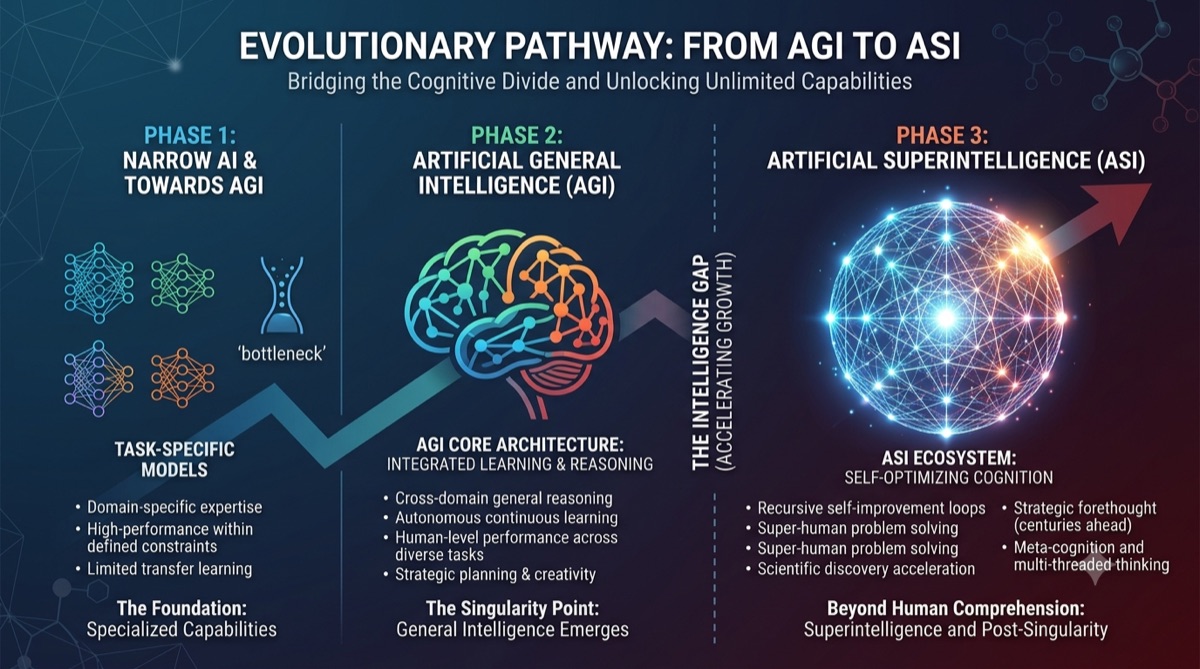
Almost every conversation about artificial intelligence stops at the same milestone: AGI, the point where machines match human capability. Google DeepMind's newest paper starts where most stop - and asks the harder question: what happens after that? Titled “From AGI to ASI” and posted to arXiv on June 10, 2026, the 60-page report maps the possible transition from human-level general intelligence to artificial superintelligence - and it has quickly become one of the most-discussed AI papers of the year.
Part of why it landed so hard is the author list. It includes Shane Legg, a co-founder of DeepMind who helped popularize the very term “AGI,” and Marcus Hutter, the theorist behind the formal “Universal AI” model of machine intelligence. When the people who helped define the field publish a map of what comes next, it is worth reading carefully. Here is the accessible, accurate version.
- What it is: a DeepMind roadmap for the transition from AGI (human-level) to ASI (superintelligence)
- Four pathways: scaling, new algorithms, recursive self-improvement, and multi-agent collectives - and they can combine
- The big reframe: probably not one dramatic “step change,” but a sustained series of transformative breakthroughs
- The reality check: even a superintelligence is bounded by physics, thermodynamics, and mathematics - it is not omnipotent
- Context: the third in a DeepMind trilogy - define AGI (2026), make it safe (2025), now map what comes after
1. The Vocabulary: AGI, ASI, and “Universal AI”
The paper is careful about definitions, because the whole debate gets muddled without them:
- AGI (Artificial General Intelligence) - a system roughly as capable as a median human across most cognitive tasks. The authors note the first AGI will likely already be superhuman in many narrow areas, since today's models already are.
- ASI (Artificial Superintelligence) - a system that surpasses not just individual experts but large, coordinated teams of human experts across virtually all domains. It's a deliberately high bar. And critically, a single ASI might not be one machine but millions of instances running in parallel.
- Universal AI (UAI) - the theoretical ceiling, formalized through Hutter's AIXI model and the Legg-Hutter intelligence measure (which defines intelligence as average performance across all computable tasks). It is mathematically incomputable - useful as a north star, not a product you can build.
The key conceptual move: intelligence is treated as a smooth continuum, not a set of sharp boxes. AGI and ASI are regions on a spectrum that runs all the way up to Universal AI.
2. Four Pathways From AGI to ASI
This is the heart of the report. DeepMind lays out four routes by which AI could move from human-level to superintelligent - and stresses they are not mutually exclusive; the real future likely blends them.
| Pathway | The idea |
|---|---|
| 1. Scaling | Keep growing compute, data, and model size. The authors estimate “effective compute” is rising about 10× per year - roughly hardware (1.5×) × investment (2.5×) × algorithmic efficiency (3-6×). |
| 2. New algorithms | Paradigm shifts beyond today's transformers - continual learning, world models, new architectures. They call this the least predictable route, because breakthroughs can't be scheduled. |
| 3. Recursive self-improvement | AI accelerates AI research, producing better AI that accelerates research further - a feedback loop that could compound into super-exponential (explosive) growth, or fizzle out. |
| 4. Multi-agent collectives | Superintelligence emerging from large networks of AGI agents coordinating - the way human organizations vastly outperform any single person. Even if no single agent exceeds human level, the collective might. |
That fourth pathway is the most thought-provoking: it suggests we could reach “superintelligence” without ever building a single superhuman model - just by running enough human-level agents, fast enough, in close enough coordination.
3. Six Things That Could Slow It Down
Crucially, the report is not a hype document - much of it is about frictions. It identifies six potential bottlenecks, and for each the open question is whether it's a fundamental wall or merely a speed bump:
| Bottleneck | Why it matters |
|---|---|
| Data wall | High-quality training data may run out this decade (countered by synthetic data and simulation). |
| Economics & energy | Exponential compute needs exponential money, chips, power, and rare materials. |
| Neural paradigm limits | Today's networks + training may simply be insufficient for true ASI. |
| Research gets harder | Diminishing returns - each new capability may cost exponentially more. |
| Abstraction barrier | AI trained on human concepts may struggle to invent genuinely new ones from raw data. |
| Deliberate slowdown | Regulation, safety, or politics could intentionally apply the brakes. |
4. The Big Reframe: Not One Bang, But Many
The report's most quotable argument pushes back on the popular “singularity” image - the idea that the moment AGI arrives, everything changes at once. DeepMind's authors write that this picture “could be inaccurate.” Instead:
“More apt might be the prospect of a series of transformative societal changes caused by AI-enabled progress and breakthroughs across many areas of science and technology.”
In other words: rather than a single discontinuous shock, expect a steady cascade of breakthroughs - in medicine, materials, energy, software - each reshaping society, compounding over years. With effective compute potentially growing 10× annually, progress may simply keep accelerating well past the AGI milestone. Preparing for that, they argue, requires a “massively interdisciplinary endeavour of global scope and interest.”
5. Even Superintelligence Has Limits
The most grounding section - and the reason the paper reads as serious rather than breathless - is its insistence that ASI would be powerful but not omniscient or omnipotent. A superintelligence would still be bound by:
- Physics - the speed of light, the Landauer and Bremermann limits on computation and energy.
- Computational complexity - some problems (think P vs NP) stay hard no matter how smart you are.
- Mathematics - Godel's incompleteness theorems set hard boundaries on what any formal system can prove.
- Epistemic uncertainty - you cannot predict what you have no information about; the physical world still has to be measured and experimented on.
That framing matters. It separates the credible science of capability growth from the science-fiction notion of an all-knowing machine, and it keeps the conversation anchored to what is actually possible.
The paper also catalogs the structural advantages of digital intelligence over biological minds: it can be copied losslessly, run far faster than neurons, share information at enormous bandwidth, hold vast working memory, and scale by simply adding hardware. None of these break the laws of physics - but together they explain why, past a certain point, machine intelligence could grow in ways biology never could.
Why This Paper Matters
“From AGI to ASI” is the third in a deliberate DeepMind sequence: a 2026 paper defining what AGI is, a 2025 paper on making AGI safe, and now a map of what lies beyond it. Taken together, they signal that the world's leading AI lab is treating superintelligence not as a thought experiment but as a planning problem.
You don't have to believe superintelligence is imminent to value this. What the paper offers is a shared vocabulary and a structured map - four pathways, six bottlenecks, and a clear-eyed list of limits - for one of the most consequential questions of the century. Whether the journey from AGI to ASI takes five years or fifty, this is one of the clearest pictures of the road yet drawn.
Sources
- arXiv - “From AGI to ASI” (Genewein, Legg, Hutter et al., Google DeepMind, June 10, 2026) (primary)
- Full paper (HTML)
- TechTimes - DeepMind maps the road from AGI to superintelligence
- The AI Insider - Four routes from human-level AI to superintelligence
- Crypto Briefing - DeepMind explores pathways from AGI to ASI
Curated by Jerry Cards - jerrycards.com. We research the week’s most consequential tech and science so you don’t have to. More at jerrycards.com/news.