
 العربية
 Español
 中文
中文 Deutsch
 Français
 Português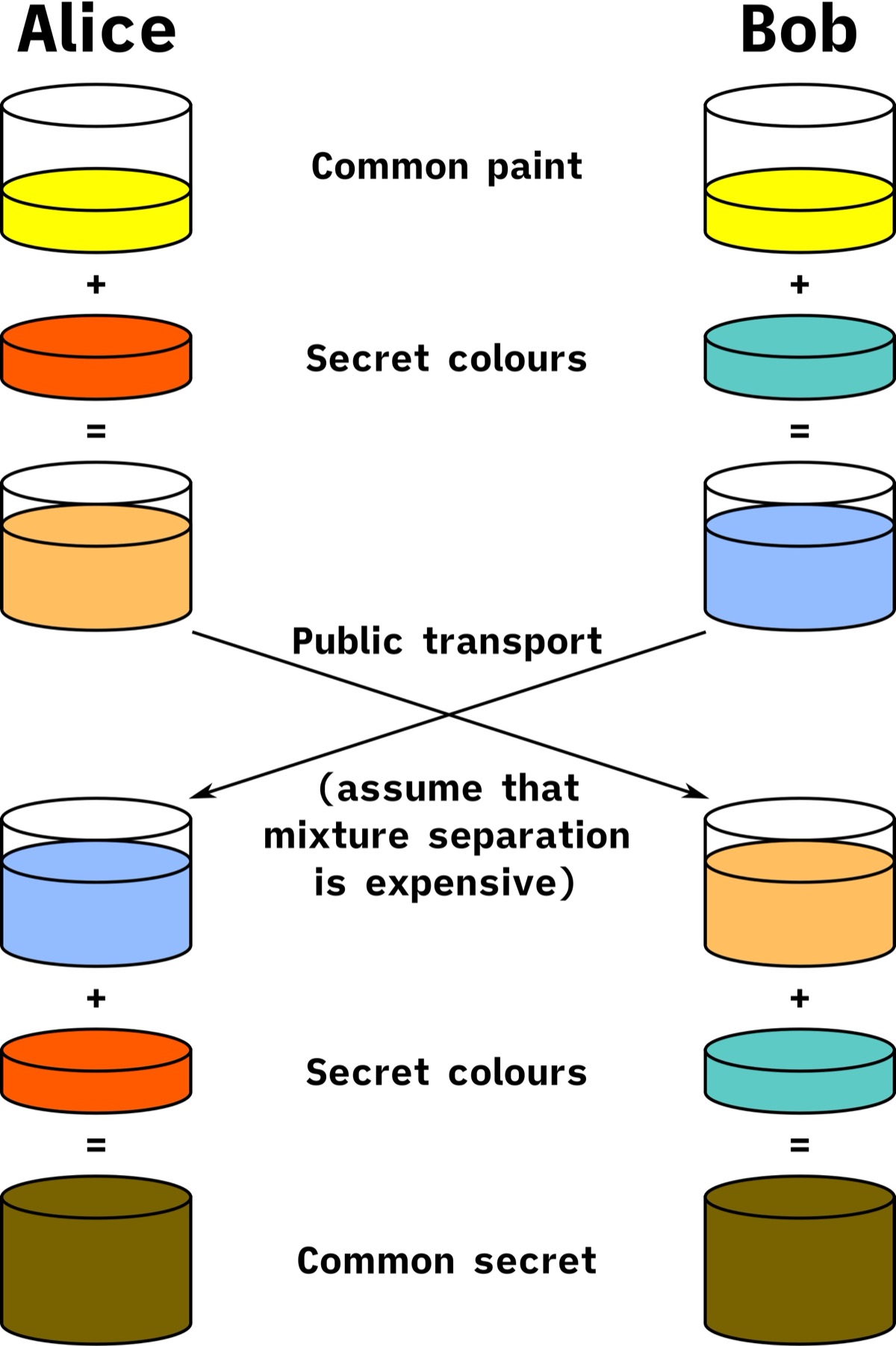
Every time you see the little padlock in your browser, buy something online, or send a private message, you are trusting an idea that two researchers set down on paper in 1976. That autumn, Stanford’s Whitfield Diffie and Martin Hellman published a paper in the IEEE Transactions on Information Theory and opened it with one of the boldest sentences in the history of science:
They were not exaggerating. “New Directions in Cryptography” answered a question people had assumed was unanswerable for three thousand years — and in doing so it quietly laid the foundation for secure online life. This is a tribute to what it proposed, the ancient problem it cracked, the honest story of who else discovered it, and why it now protects almost everything you do on the internet.
- Title: New Directions in Cryptography
- Authors: Whitfield Diffie and Martin E. Hellman
- Published: IEEE Transactions on Information Theory, vol. IT-22, no. 6, November 1976, pp. 644–654 (DOI 10.1109/TIT.1976.1055638)
- What it introduced: public-key cryptography — the Diffie–Hellman key exchange (a shared secret agreed in public) and the concept of the digital signature
- Why it matters: it is the handshake behind HTTPS, the browser padlock, secure messaging, and the trillions of dollars in online transactions made every day
- Honoured with: the 2015 ACM A.M. Turing Award (presented June 2016)
1. A three-thousand-year-old problem
For most of history, cryptography had one crippling catch. To exchange secret messages, two people first had to share a secret key — the codebook, the cipher setting, the password. But how do you share that key safely? You had to meet in person, or trust a courier who might be bribed, captured, or careless. This is the key-distribution problem, and it had shadowed secret writing since antiquity.
By the 1970s it had become a practical crisis. Banks were beginning to move money electronically; computers were starting to talk to other computers. If every pair of parties that wanted to communicate privately first had to exchange a key by hand, the whole enterprise would collapse under its own logistics. Almost everyone assumed there was simply no way around it: to share a secret, you first needed a secret. Diffie and Hellman refused to accept that.
2. The revolution: a secret agreed in the open
Their answer sounds impossible when you first hear it. Two people who have never met can agree on a shared secret in full public view — while an eavesdropper listens to every word exchanged — and that eavesdropper still cannot work out the secret.
The key insight is a one-way function: a calculation that is easy to perform but extraordinarily hard to reverse. Multiplying two huge prime numbers is quick; splitting the result back into those primes is not. Raising a number to a power and taking the remainder (modular exponentiation) is fast; running that operation backwards (the discrete logarithm) is, for large numbers, hopeless with today’s machines. That gap between easy-forwards and hard-backwards is the whole trick.
3. The idea in one picture: mixing paint
The cleanest way to feel how it works is to forget the algebra and think about paint, exactly as the diagram above lays out.
- Alice and Bob publicly agree on a common colour — everyone, including the eavesdropper, can see it.
- Each of them secretly adds a private colour of their own and stirs.
- They swap the mixed paints out in the open, for anyone to intercept.
- Each now adds their own private colour a second time — and both jars end up the exact same final shade.
The eavesdropper is left holding both public mixtures but cannot “un-mix” them to recover the private colours, so cannot reach the final shade. Alice and Bob now share a secret they never actually transmitted. Swap paint for numbers and stirring for modular exponentiation, and you have the Diffie–Hellman key exchange.
Alice and Bob agree publicly on a large prime p and a base g. Alice picks a secret number a and sends ga mod p; Bob picks a secret b and sends gb mod p. Alice raises Bob’s value to her secret, Bob raises Alice’s to his — and both compute the same shared key, gab mod p. An eavesdropper who sees g, p, ga and gb still has to solve the discrete logarithm to recover a or b — and no one knows a fast way to do that.
4. The other half: the digital signature
The same paper introduced a second idea that turned out to be just as important: the digital signature. A public-key scheme, Diffie and Hellman realised, could run in reverse. If only you hold your private key, you can transform a message in a way that anyone can check with your public key — proving the message truly came from you and was not tampered with in transit.
That is the piece that makes trust possible between strangers. It is what lets your device confirm a software update really came from Apple, that a website really is your bank, and that a signed document has not been altered. Public keys let strangers keep a secret; digital signatures let them prove who they are.
5. The third name: Ralph Merkle
Honest history makes the story richer. A third researcher, Ralph Merkle — then an undergraduate at Berkeley — had independently been chasing the same impossible-sounding goal, sketching a scheme (later called “Merkle’s Puzzles”) for two strangers to establish a secret over an open channel. His work is cited in the 1976 paper, and Hellman himself later insisted the method should be known as the Diffie–Hellman–Merkle key exchange, writing that Merkle’s contribution deserved equal billing.
6. The secret that was invented twice
Then there is one of the great twists in the history of science. Years before Diffie and Hellman published, a small team at GCHQ, Britain’s signals-intelligence agency, had quietly reached the same ideas — and told no one.
| Who | When | What they found (in secret) |
|---|---|---|
| James Ellis | 1969 | Argued secure communication without a pre-shared key was possible — he called it “non-secret encryption” |
| Clifford Cocks | 1973 | Described a working public-key scheme — in effect what the world would later call RSA |
| Malcolm Williamson | 1974 | Worked out a key exchange essentially identical to Diffie–Hellman |
Because it was classified, none of it could be published, patented, or used to help build the open internet — that was left to Diffie, Hellman and Merkle, who found it independently and shared it with the world. GCHQ’s parallel discovery was only declassified in 1997. James Ellis, who started the thread, died just weeks before the acknowledgement he had waited decades for — but the three are now openly honoured as pioneers. It is a rare and lovely case of the same beautiful idea being discovered twice, and a reminder that ideas do their real work only when they are shared.
7. How it secures your world right now
Public-key cryptography stopped being a theory and became infrastructure. Diffie and Hellman’s paper gave the concept and a working key exchange; a year later, in 1977, Ron Rivest, Adi Shamir and Leonard Adleman turned the vision into the first complete public-key cryptosystem, RSA. Together they made the modern secure internet possible.
| Where it runs | What it protects |
|---|---|
| HTTPS & TLS (the padlock) | Every secure web page, login and online payment |
| Secure messaging | End-to-end encrypted chats and calls |
| Software updates & app stores | Proving code really comes from the maker, unaltered |
| Digital signatures & certificates | Trusting that a site or document is genuine |
The next time you buy a gift card, check your bank, or tap “pay,” a version of that 1976 handshake fires off in a fraction of a second, invisibly, to make sure the conversation is yours alone. According to the ACM, the ideas in this one paper now protect daily communications and trillions of dollars of transactions.
8. A prize-winning idea
The world eventually caught up with what it owed them. In 2016 the ACM — computing’s leading professional society — awarded Whitfield Diffie and Martin Hellman its A.M. Turing Award for 2015, the honour often called the Nobel Prize of computing, “for fundamental contributions to modern cryptography.” The prize, a million dollars funded by Google, recognised a paper whose central idea now underwrites the security of the entire connected world.
Why it still matters
Diffie and Hellman did more than invent a clever protocol. They overturned an assumption so old no one had thought to question it — that sharing a secret required first having one. By showing that trust can be built between strangers in the open, they made possible an internet where billions of people who will never meet can still transact, message and prove who they are, safely. It is the quiet handshake beneath the modern world.
Some papers describe the world. A rare few make the modern one possible. New Directions in Cryptography is one of them.
Sources & further reading
- W. Diffie and M. E. Hellman, ‘New Directions in Cryptography’, IEEE Transactions on Information Theory 22(6), 644–654 (1976), DOI 10.1109/TIT.1976.1055638
- ACM: 2015 A.M. Turing Award — Whitfield Diffie & Martin Hellman (‘for fundamental contributions to modern cryptography’)
- Wikipedia: Diffie–Hellman key exchange · Public-key cryptography
- NSA / GCHQ history: Cocks, Ellis and Williamson (the secret prior discovery, declassified 1997)
- Image: Diffie–Hellman key-exchange paint analogy — original schema by A.J. Han Vinck (University of Duisburg-Essen), SVG by Flugaal, via Wikimedia Commons, released into the public domain
Curated by Jerry Cards - jerrycards.com. Our 致敬 (tribute) series celebrates the landmark papers and discoveries that quietly built the modern world. More at jerrycards.com/news.