
 العربية
 Español
 中文
中文 Deutsch
 Français
 Português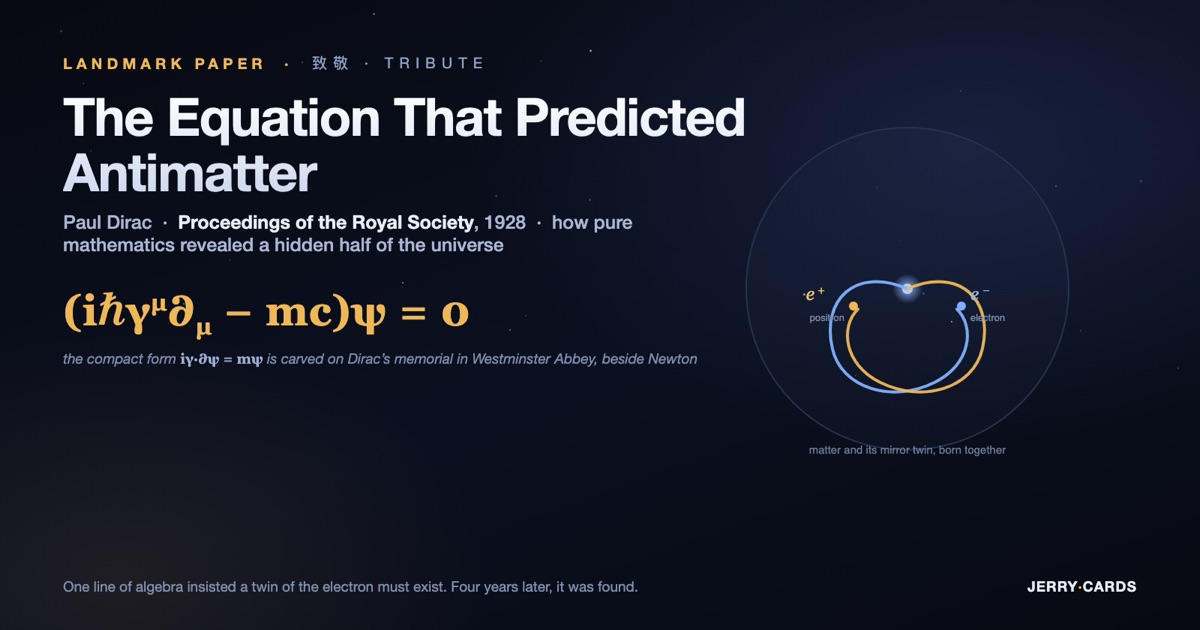
In the winter of 1928, a shy 25-year-old at Cambridge wrote down a single line of algebra - and, without meaning to, doubled the known contents of the universe. Paul Dirac was trying to fix a technical flaw: quantum mechanics, barely two years old, still ignored Einstein's relativity. His answer, published in a paper he called simply ‘The Quantum Theory of the Electron,’ did far more than patch the gap. It explained mysteries he had not even set out to solve, and then it made a prediction so strange that Dirac himself hesitated over it: that somewhere out there, waiting to be found, was a mirror-image twin of the electron - a particle of antimatter. Four years later, it turned up in a cloud chamber.
This is a tribute to the equation that revealed the other half of matter - and to a physicist who trusted his mathematics more than his own eyes.
- Who: Paul Adrien Maurice Dirac (1902–1984), English theoretical physicist, then 25
- The paper: ‘The Quantum Theory of the Electron,’ Proceedings of the Royal Society A, vol. 117, pp. 610–624 - received 2 January, published 1 February 1928
- The goal: one equation for the electron that obeys both quantum mechanics and special relativity
- The free gifts: the electron’s spin, its magnetism (a ‘g-factor’ of 2) and hydrogen’s fine structure all emerged on their own
- The prediction: negative-energy solutions led Dirac (1931) to predict the anti-electron - antimatter
- The proof: Carl Anderson found the particle in cosmic rays in 1932 and named it the positron
- The honour: the 1933 Nobel Prize in Physics, shared with Erwin Schrödinger
1. The electron that broke the rules
By 1927, quantum mechanics could describe the atom beautifully - but only at low speeds. Erwin Schrödinger’s famous wave equation was built on the old, pre-Einstein rule that energy and momentum combine the Newtonian way. Electrons inside atoms, though, move fast enough that Einstein’s special relativity matters, and the theory had no clean way to include it. Worse, physicists had been forced to add a property called spin to the electron by hand - Samuel Goudsmit and George Uhlenbeck had proposed in 1925 that the electron behaves like a tiny spinning magnet - because nothing in the equations required it, yet the atom’s spectrum demanded it. And even then a stubborn factor-of-two mismatch in hydrogen’s finest spectral details refused to resolve.
Dirac set himself a purist’s task: find the one equation for a single electron that is fully consistent with relativity and with quantum mechanics, and that is mathematically clean - first-order in both space and time. Others had tried and produced equations plagued by nonsensical probabilities. Dirac’s way through was audacious: he allowed his wavefunction to have not one component but four, knitted together by a new set of mathematical objects (today called the gamma matrices). It looked odd. It worked.
2. One equation, three gifts for free
In the compact notation physicists still use, the Dirac equation reads:
(iℏγμ∂μ − mc)ψ = 0
What made it miraculous was everything it gave back unasked. When Dirac worked out how his electron behaves in a magnetic field, the spin that others had bolted on appeared automatically - the electron simply had to carry exactly one-half a unit of it. The precise strength of its magnetism came out too, with a ‘g-factor’ of almost exactly 2 - the measured value, which no one had been able to derive. And the troublesome fine structure of hydrogen fell into place, factor of two and all. Three deep facts about the electron, previously separate puzzles, turned out to be different faces of one relativistic equation.
Dirac’s g-factor of 2 was only the beginning. Quantum electrodynamics later refined it to 2.00231930436…, the tiny excess coming from the electron’s constant interaction with a sea of virtual particles. Theory and experiment for the electron’s magnetism now agree to roughly twelve decimal places - the most precisely verified prediction in the whole of physical science. It all traces back to the equation of 1928.
3. The shadow in the mathematics
There was, however, a catch that would not go away. Because it respected Einstein’s energy-momentum relation - which involves a square, and square roots come with a ± sign - Dirac’s equation had twice as many solutions as expected. Half described ordinary electrons with positive energy. The other half had negative energy, and by the rules of quantum mechanics every electron should have cascaded down into them, releasing infinite energy. The stable matter of the world should have been impossible.
Most physicists would have treated the negative-energy solutions as a meaningless artefact. Dirac refused. In 1930 he proposed an extraordinary fix: perhaps the vacuum is not empty at all but a filled sea of negative-energy electrons, invisible because it is everywhere and uniform. The Pauli exclusion principle - no two electrons in the same state - then keeps ordinary electrons from falling in, because every seat is already taken. Empty space, in this picture, is an ocean.
His first guess at what a hole in that sea would be - a missing negative-energy electron, which would look like a positive charge - was that it must be the proton, the only positive particle then known. But Hermann Weyl and J. Robert Oppenheimer quickly showed this could not be: the hole was obliged to have the same mass as the electron, and a proton is nearly 2,000 times heavier. The bookkeeping was pointing at something genuinely new.
4. ‘A new kind of particle’
In 1931, in a paper titled ‘Quantised Singularities in the Electromagnetic Field,’ Dirac stopped hedging and stated the conclusion plainly. A hole in the sea would be a new particle, unknown to experiment, with the same mass as the electron and the opposite charge - an ‘anti-electron.’ He went further, arguing that protons must have their own antiparticle too, and predicted a second exotic object, the magnetic monopole, for good measure. It was one of the boldest bets in the history of physics: an entire category of matter, deduced from the internal logic of an equation, asserted to exist before anyone had ever detected a trace of it.
“Dirac’s discovery of antimatter… was perhaps the biggest jump of all the big jumps in physics of our century.”
— Werner Heisenberg, 1973
5. Vindication in a cloud chamber
The proof came from an unlikely direction, and from someone who was not looking for it. At the California Institute of Technology, Carl Anderson was photographing cosmic rays - particles raining down from space - as they curved through the magnetic field of a cloud chamber. On 2 August 1932 he caught a track that made no sense: a particle bending the way a positive charge must, yet as light and nimble as an electron. It was a positive electron. Anderson coined its name in his 1933 write-up in the Physical Review: the positron. Within a year Patrick Blackett and Giuseppe Occhialini had confirmed it and shown these positrons being created in matched pairs, exactly as Dirac’s theory required.
Dirac had reasoned his way to a new form of matter with a pencil; Anderson had photographed it with a camera; the two accounts matched. Anderson received the Nobel Prize in Physics in 1936. Dirac, together with Schrödinger, had already been honoured with the 1933 Nobel Prize ‘for the discovery of new productive forms of atomic theory.’ He was 31.
6. What one equation made possible
The Dirac equation did not just add antimatter to the catalogue; it changed what physics was about. The idea that particles can be created and destroyed in pairs became the seed of quantum field theory, and from there the Standard Model - our single deepest, most tested description of nature. And antimatter long ago stopped being exotic. Here is a little of what Dirac’s 1928 line of algebra now underwrites:
| Where it lives now | What Dirac’s work gave it |
|---|---|
| The Standard Model | Every particle of matter has an antiparticle; the electron, quarks and the rest are all described by Dirac equations |
| Hospital PET scanners | Positron Emission Tomography maps the living body by detecting antimatter annihilating inside it |
| Precision tests of nature | The electron’s g-factor, matched to ~12 decimal places, is science’s most exact prediction |
| CERN’s antimatter labs | Physicists now create and magnetically trap whole atoms of antihydrogen to compare matter with its twin |
A PET scan is Dirac’s prediction at work on a Tuesday afternoon. The patient receives a mild radioactive tracer - usually fluorine-18 attached to a sugar - that emits positrons. Each positron travels a millimetre or two, meets an ordinary electron, and the pair annihilate, converting their mass into two gamma-ray photons of 511 keV that fly out in exactly opposite directions. A ring of detectors catches the pairs, and a computer traces the lines back to reveal where in the body they were born - lighting up tumours, brains and beating hearts. The other half of matter, predicted on a blackboard in 1928, now saves lives.
7. The physicist who trusted beauty
Dirac is often described as the purest theorist of the twentieth century - a man of famously few words who let mathematics do the talking. His guiding conviction, which he stated many times, was that the equations of physics should be beautiful, and that beauty is a reliable guide to truth:
“It is more important to have beauty in one’s equations than to have them fit experiment.”
— Paul Dirac, Scientific American, 1963
It sounds like heresy, and Dirac did not mean that data can be ignored. He meant that when a theory is deep and beautiful and almost fits, the mismatch is more likely to be an experimental error or a missing piece than a fault in the idea. His own equation was the proof: he trusted its strange negative-energy solutions over common sense, and the universe rewarded him with antimatter. When he died in 1984, he had held Newton’s old chair, the Lucasian Professorship at Cambridge. In 1995 his equation was carved onto a memorial stone in Westminster Abbey, a few steps from Newton’s grave - in the compact form iγ·∂ψ = mψ, short enough to fit on a slab of green slate, deep enough to hold half the universe.
What we still don’t know
- Why there is anything at all. The Big Bang should have made matter and antimatter in equal amounts, and they should have annihilated back into pure light. Instead, for roughly every billion pairs, one extra particle of matter survived - and that tiny surplus is every star, planet and person. Why the balance tipped toward matter is one of the great open questions in physics.
- The missing monopole. The same 1931 paper predicted a lone magnetic pole. Searches from deep mines to the Large Hadron Collider have not found one yet - but the idea remains theoretically compelling.
- Does antimatter fall down? Recent experiments at CERN say yes, antihydrogen falls under gravity just as matter does - but physicists are still measuring, because any difference would rewrite the rulebook.
Sources & further reading
- Original paper: P. A. M. Dirac, ‘The Quantum Theory of the Electron’, Proc. R. Soc. Lond. A 117, 610-624 (1928)
- Dirac’s prediction: ‘Quantised Singularities in the Electromagnetic Field’, Proc. R. Soc. Lond. A 133, 60-72 (1931)
- American Physical Society: January 1928 - the Dirac equation unifies quantum mechanics and special relativity · August 1932 - the discovery of the positron
- Carl Anderson, ‘The Positive Electron’, Physical Review 43, 491 (1933) · The Nobel Prize in Physics 1933 (Schrödinger & Dirac)
- Westminster Abbey: Paul Dirac memorial · Dirac equation (overview) · Positron emission tomography
Curated by Jerry Cards - jerrycards.com. Our 致敬 (tribute) series celebrates the landmark papers and discoveries that quietly built the modern world. More at jerrycards.com/news.