
 العربية
 Español
 中文
中文 Deutsch
 Français
 Português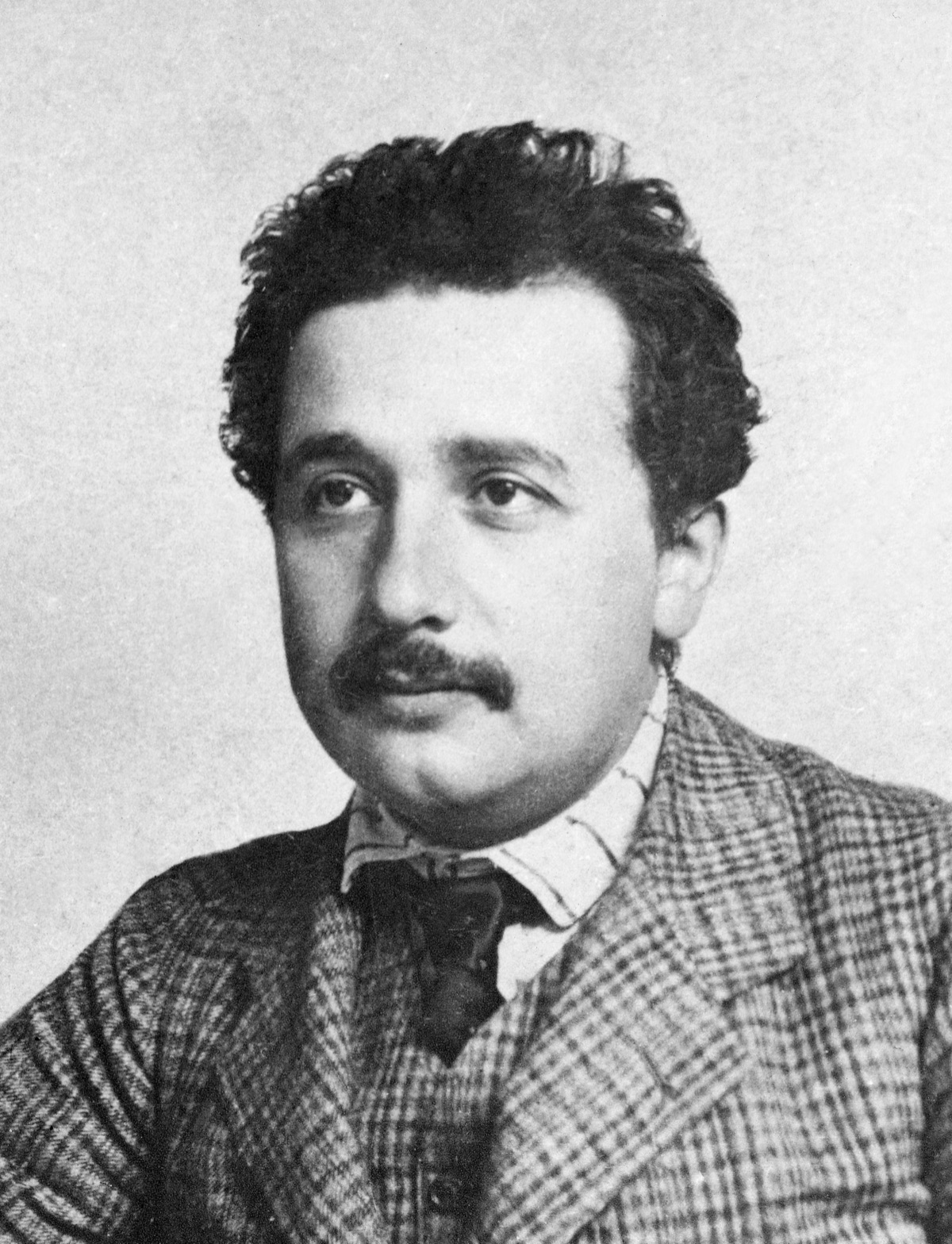
In the space of a single year - 1905 - a 26-year-old clerk at the Swiss Patent Office in Bern published four papers, in his spare time, that each changed physics forever. He had no university post, no laboratory, and no famous mentors looking over his shoulder. He had a steady day job assessing patent applications, a young family, and a handful of friends to argue with in the evenings. And in that one year he explained the photoelectric effect, proved that atoms are real, overturned Newton’s absolute space and time, and discovered that mass is a form of energy. His name was Albert Einstein, and posterity has given those twelve months a name of their own: his Annus Mirabilis - his miracle year.
This is a tribute to what he wrote, why each paper mattered, and how ideas jotted down at a patent-office desk still power the phone in your pocket, the satellites overhead, and the panels on the roof.
- Author: Albert Einstein, aged 26, technical expert (third class) at the Swiss Federal Patent Office, Bern
- Where: all four published in Annalen der Physik, the leading physics journal of the day
- Paper 1 - light quanta: the photoelectric effect; light comes in packets (received 18 March, published 9 June 1905)
- Paper 2 - Brownian motion: the motion of suspended particles; proof that atoms exist (received 11 May, published 18 July 1905)
- Paper 3 - special relativity: On the Electrodynamics of Moving Bodies (received 30 June, published 26 September 1905)
- Paper 4 - mass-energy: Does the Inertia of a Body Depend Upon Its Energy Content? - the seed of E = mc2 (received 27 September, published 21 November 1905)
1. An unlikely setting: the patent office in Bern
In 1905 Einstein was not yet Einstein. He had struggled to find an academic job after graduating, and a friend’s father had helped him land a modest civil-service post examining patent applications in Bern. He was good at it - the work sharpened his knack for stripping an idea down to its physical essentials - but it left him, gloriously, alone with his thoughts. His physics was done at his desk between applications, at home, and in long evening conversations with two friends, Maurice Solovine and Conrad Habicht, in a half-joking reading group they called the Olympia Academy.
That spring, Einstein wrote to Habicht in high spirits, promising him four papers. The first, he said, was “very revolutionary.” It is one of the rare moments in science where a person correctly sensed, in real time, that they were about to change the world - and understated it.
2. Paper one: light comes in packets (the photoelectric effect)
Five years earlier, Max Planck had found that he could only explain the glow of hot objects by assuming energy came in tiny discrete lumps, or quanta - a trick he regarded almost as an accounting device. Einstein took the idea literally and pushed it further than Planck dared: light itself, he proposed, travels as a stream of discrete energy packets, each carrying an amount of energy set by its frequency. Those packets are what we now call photons.
The payoff was an elegant explanation of the photoelectric effect - the way certain metals kick out electrons when light shines on them. Puzzlingly, dim blue light could free electrons while intense red light could not; the wave picture of light had no good answer. Einstein’s packets did: only a packet with enough energy (high enough frequency) can knock an electron loose, no matter how faint the beam. It was a bold, almost heretical claim in an age that had spent a century proving light was a wave.
This was the paper Einstein himself called “very revolutionary” - and the only specific discovery named in his 1921 Nobel Prize citation, “for his discovery of the law of the photoelectric effect.”
It is also, quietly, one of the most useful ideas ever written down. The same physics - light delivering energy one packet at a time to knock electrons free in a material - is exactly how a solar cell turns sunlight into electricity, and how the image sensor in your phone camera turns photons into a picture. And the light-quantum was the spark that helped ignite the whole of quantum mechanics, the theory underneath every microchip and laser on Earth.
3. Paper two: the proof that atoms are real (Brownian motion)
It is strange to remember that in 1905 many serious scientists still doubted that atoms physically existed; to skeptics they were a useful bookkeeping fiction, not real objects. Einstein ended the argument almost as a side project.
He turned his attention to Brownian motion: the ceaseless, random jitter of tiny particles - pollen grains, dust motes - suspended in a still liquid, first noted under the microscope decades earlier. Einstein argued the dance was caused by countless invisible molecules colliding with each particle from all sides, and - crucially - he made it quantitative, predicting exactly how far a particle should wander over time. Those predictions could be measured. When Jean Perrin carefully did so a few years later, the numbers matched, and even the last holdouts had to concede: matter really is made of atoms and molecules. Perrin later received a Nobel Prize for the work that confirmed Einstein’s.
4. Paper three: space and time are relative
The third paper, On the Electrodynamics of Moving Bodies, is the crown jewel - special relativity. Einstein built it on two disarmingly simple postulates:
- The laws of physics are the same for everyone moving at a steady speed (no experiment can tell you whether you are ‘really’ moving or standing still).
- The speed of light in empty space is the same for every observer - no matter how fast the source or the observer is moving.
Those two innocent-looking rules cannot both be true in Newton’s universe of absolute space and time - so Einstein gave up absolute space and time instead. The consequences are famous and deeply strange: moving clocks run slow (time dilation), moving objects contract along their direction of travel, and two events that are simultaneous for one observer need not be for another. There is no universal now. Remarkably, he needed no new experiment to get there - only ruthless logic applied to what was already known about light and motion.
This is not abstract poetry. The GPS in your phone works only because the satellites overhead correct their clocks for relativity; without Einstein’s 1905 insight (and its 1915 sequel, general relativity), satellite navigation would drift into uselessness within hours.
5. Paper four: mass is energy (E = mc2)
Almost as an afterthought, in a paper barely three pages long, Einstein drew out the most famous consequence of relativity. If a body gives off energy, he reasoned, its mass must decrease by a precise amount. Turned around, that means mass and energy are the same thing, related by the most famous equation in science. He first wrote it not as E = mc2 but as m = L/V2, using L for energy and V for the speed of light - but the meaning is identical.
Because the speed of light is enormous, and it is squared, the equation says a tiny amount of matter is equivalent to a colossal amount of energy. That single line explains where the Sun and the stars get their power - by converting a sliver of their mass into light - and it underlies our understanding of the energy locked inside matter itself. A three-page appendix to a longer paper became one of the most consequential sentences ever written.
What the miracle year made possible
| 1905 idea | What it underpins today |
|---|---|
| Light quanta / photons | Quantum mechanics, solar cells, digital camera sensors, lasers, LEDs |
| Brownian motion | Definitive proof of atoms and molecules; foundations of physical chemistry and diffusion science |
| Special relativity | GPS and satellite navigation, particle accelerators, modern electromagnetism |
| E = mc2 | Our understanding of how stars shine and the energy bound up in matter |
6. And a fifth, for good measure
Tucked into the same year was a fifth work: Einstein’s doctoral dissertation, A New Determination of Molecular Dimensions, which gave yet another way to estimate the size of molecules. Unshowy next to relativity, it quietly became one of his most-cited papers, useful everywhere from cement to pharmaceuticals. Even his ‘minor’ 1905 output would have made a fine career.
7. The mind behind the miracle
Why 1905? There is no tidy answer - only a rare alignment of a prepared, fearless mind and the freedom to follow it. Einstein was steeped in the open problems of physics, unafraid to take strange ideas literally, and blessed with a job that paid the bills while leaving his imagination free. The parallel that physicists love to draw is to Isaac Newton, who did his own foundational work during the plague years of 1665-66, his personal annus mirabilis. Great science, it seems, sometimes needs less a grand institution than a quiet room and an untamed curiosity.
Recognition came, though not always where you would expect. When the Nobel Committee honoured Einstein with the 1921 Prize in Physics, it pointedly cited the photoelectric-effect paper rather than the relativity that had made him a household name. A full century later, in 2005, the world celebrated the anniversary as the World Year of Physics - a global thank-you note to twelve months of work by a 26-year-old with a day job.
Why it still matters
More than a century on, the reach of Einstein’s miracle year is almost hard to overstate. Quantum theory, which his light-quantum paper helped set in motion, is the operating manual for the entire semiconductor age - every processor, every memory chip, every Apple device draws on it. Relativity keeps the world’s clocks and maps honest. The reality of atoms he nailed down is the ground floor of chemistry, biology, and medicine. And E = mc2 is how we understand the light of every star in the sky.
What makes the story endure, though, is its shape: not a lone genius handed the truth, but a curious young person, outside the establishment, thinking hard and honestly about how the world really works - and getting it right. Some papers describe the world. A rare few rebuild the one we live in. Einstein wrote four of them in a single year.
Sources & further reading
- Wikipedia: Annus mirabilis papers · Photoelectric effect · Brownian motion
- Wikipedia: Special relativity · Mass-energy equivalence · Albert Einstein
- Library of Congress: The 1905 Papers - Annus Mirabilis of Albert Einstein
- The Nobel Prize: Albert Einstein, Nobel Prize in Physics 1921
- Image: young Albert Einstein at the Bern patent office, c. 1905, attributed to Lucien Chavan; public domain (ETH-Bibliothek Zurich, Bildarchiv, via Wikimedia Commons)
Curated by Jerry Cards - jerrycards.com. Our 致敬 (tribute) series celebrates the landmark papers and discoveries that quietly built the modern world. More at jerrycards.com/news.