
 العربية
 Español
 中文
中文 Deutsch
 Français
 Português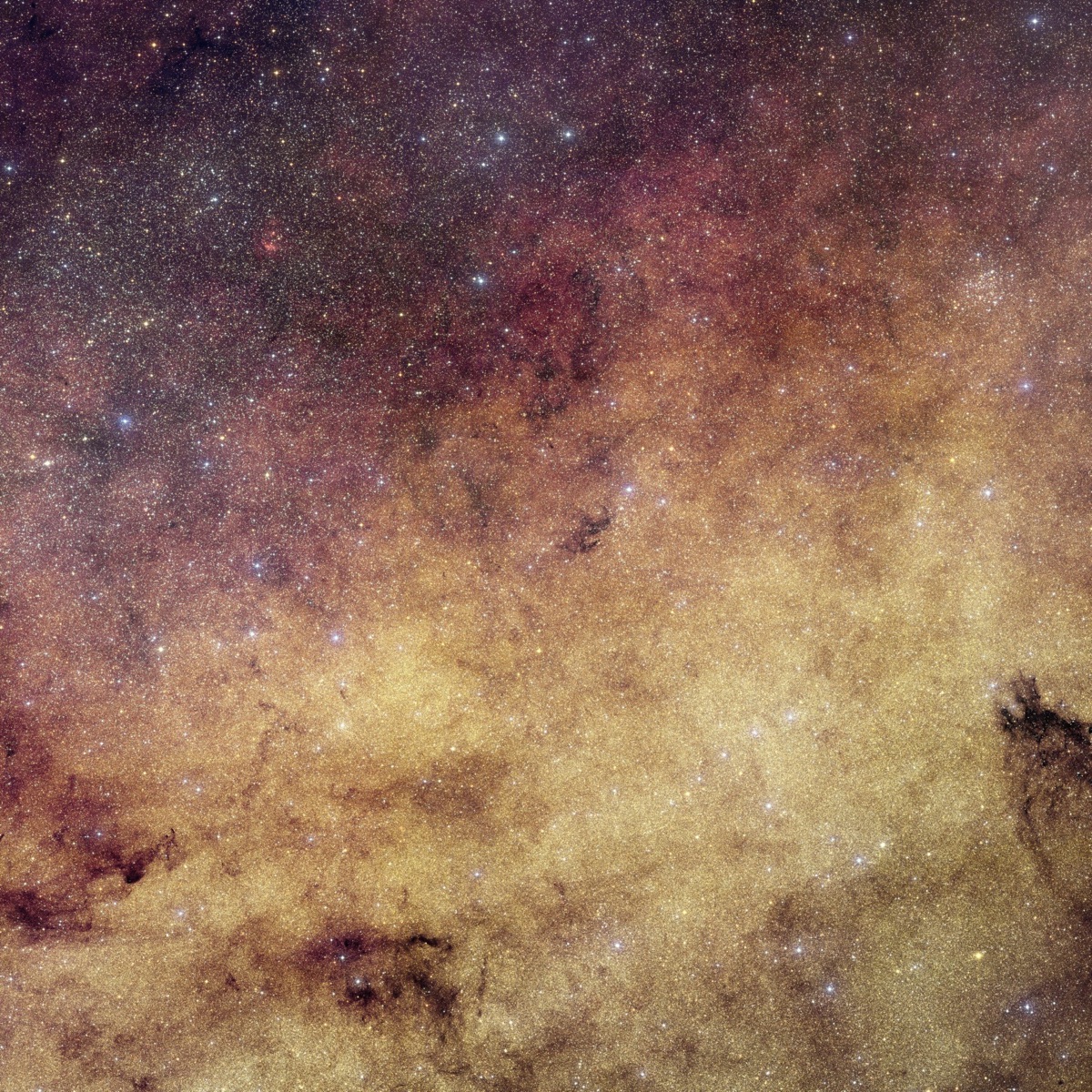
Euclid was built to look past our galaxy, not into it. Europe's ‘dark universe’ telescope normally spends its time mapping faint, distant galaxies billions of light-years away, tracing the invisible scaffolding of dark matter and dark energy. But for one 26-hour stretch on 23 March 2025, scientists aimed it somewhere far closer to home — the crowded, blazing center of the Milky Way. The result, unveiled by the European Space Agency on 24 June 2026, is the largest and most detailed visible-light image ever taken of our galaxy's heart: a single mosaic holding more than 60 million stars.
It is a postcard from the one place we can never photograph from the outside — and, tucked inside those 60 million points of light, a hunting ground for new worlds.
- Released: 24 June 2026, by the European Space Agency (ESA)
- Captured: a single ~26-hour observation on 23 March 2025
- What: the largest, most detailed visible-light image of the Milky Way's center (the galactic bulge), about 26,000 light-years away
- Scale: a mosaic of nine ‘pointings’, 18,000 x 18,000 pixels (324 megapixels), more than 60 million stars
- Hidden inside: 51 known planetary systems already sit within the frame
- The point: a dress rehearsal for hunting cold, distant exoplanets by gravitational microlensing - and a reference map for NASA's upcoming Roman Space Telescope
A Single Frame, 60 Million Stars
The numbers are difficult to hold in your head. Each of Euclid's nine ‘pointings’ covers a patch of sky larger than the full Moon, and a single pointing spans an area roughly 270 times wider than the field of view of Hubble's main camera. Stitched together, they form an 18,000-by-18,000-pixel mosaic — about 324 megapixels — sharp enough to pick out individual stars in a region so dense that most telescopes see only a smeared glow.
| The image by the numbers | Value |
|---|---|
| Stars captured | 60+ million |
| Known planetary systems in frame | 51 |
| Observation date / length | 23 Mar 2025 / ~26 hours |
| Mosaic | 9 pointings, 18,000 x 18,000 px (324 MP) |
| Field of view (per pointing) | ~270x Hubble's wide camera; larger than the full Moon |
| Distance to the region | ~26,000 light-years (the galactic bulge) |
Why This Picture Is So Hard to Take
The center of the Milky Way is one of the hardest targets in astronomy. Pack hundreds of millions of stars into a small patch of sky and most instruments are overwhelmed — their light blurs into an indistinct haze. Euclid's visible-light camera (VIS) is sharp and sensitive enough to keep the stars apart, resolving them one by one even in the galaxy's most congested quarter. That clarity is exactly what makes the image scientifically useful, not just beautiful.
When one star drifts almost exactly in front of a more distant star, the nearer star's gravity bends and magnifies the background star's light — a brief, predictable brightening. If the foreground star has a planet, that planet adds its own tiny, telltale blip on top of the flare. Because the method relies on gravity rather than on a planet's own light or the wobble it tugs into its star, it can find cold, faraway worlds that other techniques miss - including planets orbiting far from their stars, where it is otherwise nearly impossible to look.
The Real Prize: New Worlds
“To catch microlensing, you need to observe parts of the sky that are crowded with stars, such as close to the centre of our galaxy,” says Jean-Philippe Beaulieu of the Institut d'Astrophysique de Paris. In roughly two decades, microlensing has turned up close to 300 exoplanets — among them OGLE-2005-BLG-390Lb, a frigid super-Earth that Beaulieu's team discovered 20 years ago and that he likes to compare to the ice world Hoth from Star Wars. Euclid's view of the bulge is, in effect, a proving ground for finding many more.
A Head Start for NASA's Roman Telescope
The timing is deliberate. NASA's Nancy Grace Roman Space Telescope will soon run a dedicated survey of this same crowded region to hunt planets by microlensing, and Euclid's mosaic already blankets the entire patch Roman will watch. “In 24 hours, Euclid has already captured the stars involved in all the future microlensing events that the Roman space telescope will detect,” says Natalia Rektsini of the Institut d'Astrophysique de Paris, who led the data release. Because Euclid recorded the field before those stellar alignments happen, anyone who later spots a microlensing event here can reach back to Euclid's image as a 'before' snapshot. “This technique is unbiased,” Rektsini adds. “We discover whatever is out there.”
A Dark-Universe Mission, Looking Homeward
Euclid launched in July 2023 and began its main science survey in February 2024. Over six years it aims to chart billions of galaxies across more than a third of the sky and out to 10 billion light-years, measuring how dark matter and dark energy have shaped the cosmos. Against that sweeping backdrop, this galactic-center image is a kind of joyful detour — the same instrument, turned for a single day on the one galaxy we can never see from the outside. “This result shows what a relatively small, dedicated team can achieve within a large international mission,” says ESA Euclid project scientist Valeria Pettorino.
What Comes Next
The picture is a demonstration as much as a discovery: the planet-hunting payoff arrives as researchers and future surveys mine crowded fields like this one for the fleeting flickers of microlensing. But it already does two things at once — it hands astronomers a practical tool and a reference map, and it gives the rest of us a breathtaking new look at the city of stars we live in. Not a bad day's work for a telescope built to look the other way.
Sources
- ESA: ESA's Euclid captures the Milky Way's crowded heart
- NASA: Euclid view of Milky Way heart previews core survey by NASA's Roman
- Phys.org: Euclid captures 60 million stars in sharpest broad view of the Milky Way's core · Space.com · Live Science
- ESA Cosmos: Euclid Galactic Bulge Survey
- Image: ESA/Euclid/Euclid Consortium/NASA, CFHT; image processing by J.-C. Cuillandre and E. Bertin (CEA Paris-Saclay), CC BY-SA 3.0 IGO
Curated by Jerry Cards - jerrycards.com. We research the week's most consequential tech, science, and business news so you don't have to. More at jerrycards.com/news.