
 العربية
 Español
 中文
中文 Deutsch
 Français
 Português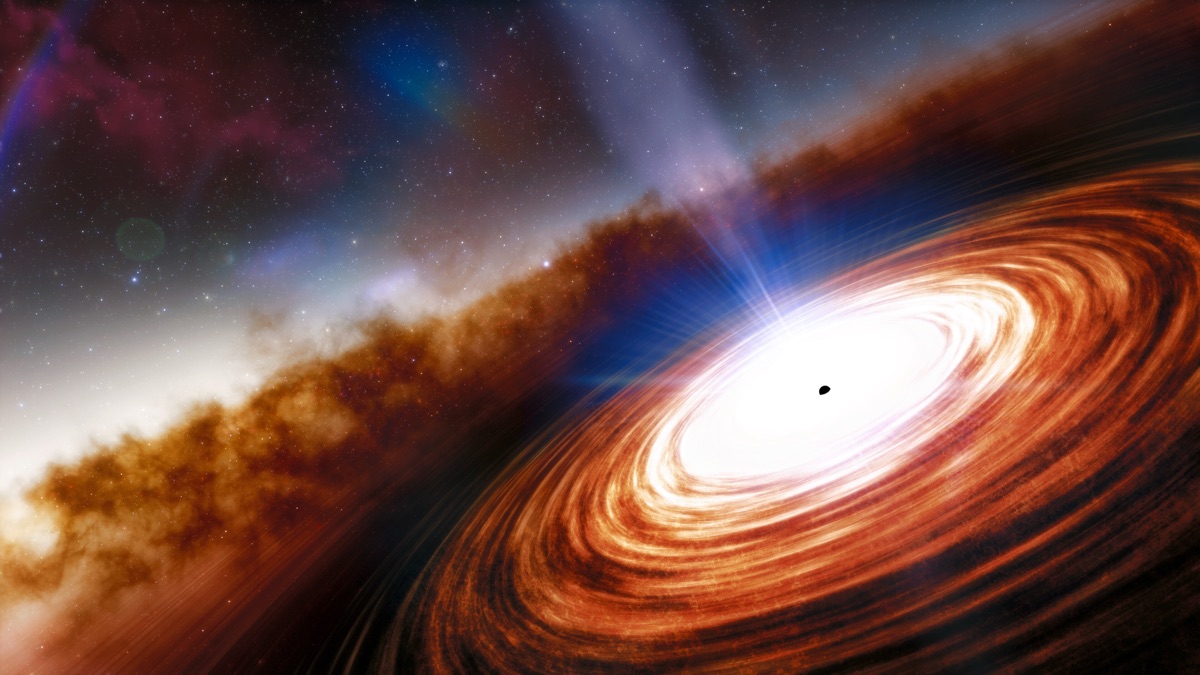
Europe built a telescope to hunt the invisible - dark matter and dark energy - and along the way it just spotted the most distant blazing black hole humanity has ever seen. On July 6, 2026, the Euclid Consortium announced that ESA's Euclid space telescope has discovered 31 quasars from the first billion years of cosmic history, including a new record-holder that beams to us from a time when the universe was barely a toddler. It is a striking bonus from a mission whose day job is mapping the dark universe - and it more than doubles humanity's catalogue of these ancient cosmic lighthouses in a single stroke.
- What: 31 newly discovered quasars from the early universe (redshift 6.6 to 7.8)
- The record: EUCL J172902.75+641018.1 at redshift 7.77 - the most distant quasar ever observed
- How far back: its light left roughly 670 million years after the Big Bang - about 5% of the universe's current age
- Margin: edges out the previous record (the 2021 quasar J0313-1806, z = 7.64) by about 15 million years
- Scale of the leap: the first ~10 quasars at z > 7 took over a decade to find; Euclid found more than that in one year
- Published: Astronomy & Astrophysics, July 6, 2026 - lead author Daming Yang (Leiden Observatory)
1. What Is a Quasar, and Why Do Astronomers Chase Them?
A quasar - short for ‘quasi-stellar radio source’ - is the brilliant core of a young galaxy powered by a supermassive black hole, one weighing millions to billions of times the mass of our Sun. As the black hole devours surrounding gas, that gas piles into a superheated, whirling disk that can outshine every star in the host galaxy combined. The result is one of the most luminous objects in the cosmos - a beacon bright enough to be seen clear across the observable universe.
That brightness is exactly why quasars are prized. Because their light takes billions of years to reach us, the most distant quasars are effectively time capsules: we see them as they were in the infant universe. Finding them lets astronomers study how the very first galaxies and their central black holes assembled themselves out of the primordial darkness.
As the universe expands, it stretches the wavelength of light travelling through it toward the red end of the spectrum. The more the light is stretched, the farther - and further back in time - it has travelled. Astronomers measure this stretch as redshift (z). A redshift of 7.77 means the light we now collect left its source when the universe was only about 670 million years old, roughly 5% of its present 13.8-billion-year age. Higher z = older light = a deeper look into cosmic history.
2. The New Record - and the Ones It Beat
The standout object, EUCL J172902.75+641018.1, now holds the title of the most distant quasar ever observed. Its runner-up in the same survey, EUCL J125308.55+705432.3, is not far behind. Both light up an era astronomers had barely been able to probe.
| Quasar | Redshift (z) | Status |
|---|---|---|
| EUCL J172902.75+641018.1 | 7.77 | New record: most distant quasar ever observed |
| EUCL J125308.55+705432.3 | 7.69 | Second most distant in the survey |
| J0313-1806 | 7.64 | Previous record-holder (announced 2021) |
The jump from z = 7.64 to z = 7.77 sounds small, but it pushes the frontier back by roughly 15 million years of cosmic history - and, more importantly, it comes packaged with 30 companions. The 31 quasars span redshift 6.6 to 7.8, and the discovery more than doubles the number of quasars known from this early epoch. For perspective: it took the global astronomy community more than a decade to confirm the first ten or so quasars at redshift 7 and above. Euclid turned up more than that in its first year of surveying.
3. How a Dark-Universe Mission Found Them
Euclid, launched in 2023, was designed to chart the shapes and distances of billions of galaxies to map dark matter and probe dark energy. That same design - a very wide field of view, sharp optics, and sensitive near-infrared vision - turns out to be ideal for finding rare, red, distant quasars. Their light is redshifted out of the visible band into the infrared, precisely where Euclid's instruments excel.
The needle-in-a-haystack problem is real: quasars this distant are vanishingly rare among billions of ordinary sources. The team used machine-learning algorithms to sift Euclid's imaging (from its VIS visible camera and NISP near-infrared instrument) for promising candidates, cross-checked them against complementary surveys, and then confirmed the true distances with spectroscopy from ground-based giants including the Keck, Magellan and Large Binocular Telescopes. The work is published in Astronomy & Astrophysics (DOI 10.1051/0004-6361/202658883), led by PhD researcher Daming Yang of Leiden Observatory with collaborators across Europe and the United States.
Lead author Daming Yang describes Euclid as “a true game-changer” that “lets us search far more efficiently” for these distant beacons. Co-author Antonio La Marca framed the achievement as taking “a true ‘census’ of quasars at the dawn” of the universe - not just spotting one record-breaker, but beginning to map an entire hidden population.
4. Why It Matters: Lighthouses of the Cosmic Dawn
These quasars shine out of a pivotal chapter called the epoch of reionization - the stretch of early time when the first luminous objects flooded the cosmos with energetic light and stripped electrons from the neutral hydrogen fog that had filled space since the Big Bang. Bright, distant quasars act as backlights for this era, letting astronomers gauge how and when the universe transitioned from darkness to transparency.
They also deepen one of modern cosmology’s most delicious puzzles. A black hole weighing hundreds of millions of Suns should take a long time to grow - yet here are several already blazing less than 700 million years after the Big Bang. How did they get so big so fast? Every new early-universe quasar is a fresh data point on that question, and a population of 31 is far more powerful than a lone outlier. With Euclid still early in a survey planned to cover roughly a third of the sky, this catalogue is expected to keep growing - potentially into the thousands.
The Honest Caveats
- Records are provisional. ‘Most distant ever’ is a title that, by design, is made to be broken - Euclid itself is likely to top it as its survey deepens.
- Black-hole masses need more data. Pinning down exactly how massive each of these black holes is - central to the ‘too big, too soon’ puzzle - requires further follow-up observations.
- The extreme edge is still thin. Even after doubling the count, the number of confirmed quasars at the very highest redshifts remains small, so individual objects carry a lot of weight until the sample grows.
Sources
- ESA: Euclid discovers the most ancient quasar in the Universe
- Euclid Consortium: The two most distant quasars ever observed
- Yang et al., Astronomy & Astrophysics (2026), DOI 10.1051/0004-6361/202658883
- University of Arizona News: astronomers help shatter cosmic record · Phys.org: Euclid discovers the most ancient quasars
Curated by Jerry Cards - jerrycards.com. We research the week's most consequential tech, science, and space news so you don't have to. More at jerrycards.com/news.