
 العربية
 Español
 中文
中文 Deutsch
 Français
 Português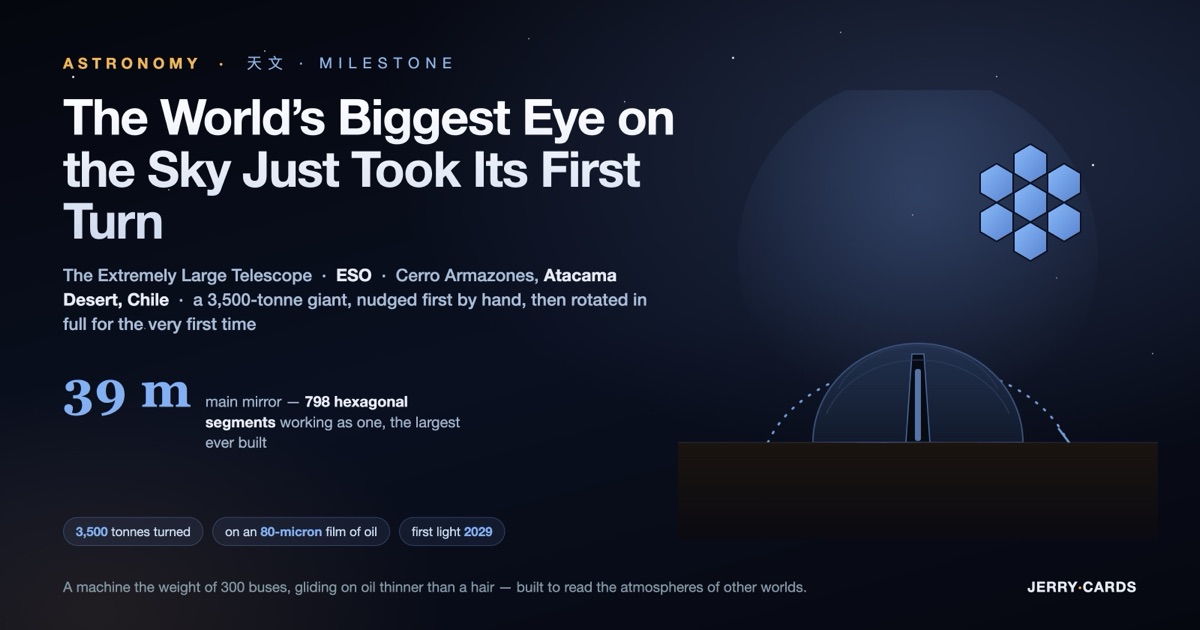
High in the Chilean desert, the largest telescope humanity has ever built just moved for the first time. In July 2026, engineers at the European Southern Observatory (ESO) gently rotated the Extremely Large Telescope (ELT) around its vertical axis - the first time the giant structure has ever turned. They did it the way you would handle anything precious: first by hand, coaxing some 3,500 tonnes of steel a few centimetres at a time, and then, with the auxiliary motors engaged, all the way through a full rotation. It is a quiet milestone, but a real one - the moment a mountain-top machine took its first step toward chasing the stars.
- What: the Extremely Large Telescope, the world’s largest optical/near-infrared telescope
- Who: built by the European Southern Observatory (ESO), with the dome and main structure by the Ace/Cimolai consortium
- Where: Cerro Armazones, 3,046 m up in Chile’s Atacama Desert
- The milestone: in July 2026 the ~3,500-tonne main structure completed its first full rotation - nudged by hand, then driven by motors
- The main mirror: 39 metres across, made of 798 hexagonal segments working as one
- First light: targeted for 2029
Moving 3,500 tonnes on a film of oil
The number that makes this milestone feel like magic is not the weight - it is the gap. The ELT’s enormous structure rests on a layer of oil just 80 microns thick, thinner than a human hair. That hydrostatic film lets thousands of tonnes float almost frictionlessly, so the whole telescope can be swung across the sky smoothly enough to hold a distant star steady in view.
Testing that motion is exactly why the first rotation matters. A telescope is only useful if it can point at any part of the sky and then track its target as the Earth turns beneath it. Proving that the main structure rotates cleanly around its vertical (azimuth) axis is a key step toward that goal. The team began by hand - literally pushing the structure a few centimetres to confirm it moved freely - before letting the auxiliary motors complete a full turn.
“For me, this is a beautiful reminder of what can be achieved when people push in the same direction, literally and figuratively.”
- Roberto Tamai, ELT Programme Manager, ESO
The machine itself
Even half-built, the ELT is a study in superlatives. Its centrepiece is a 39-metre main mirror - far too large to cast as a single piece of glass, so it is assembled from 798 hexagonal segments that must be aligned to within tens of nanometres to behave as one flawless surface. Light bounces through a five-mirror optical design built from roughly 140 tonnes of Zerodur, a specialist glass-ceramic that barely changes shape with temperature.
| Detail | Figure |
|---|---|
| Main mirror diameter | 39 metres |
| Mirror segments | 798 hexagons, aligned to tens of nanometres |
| Structure weight (now) | ~3,500 tonnes (rising to ~4,600 t with mirrors and instruments) |
| Oil-bearing film | 80 microns (thinner than a hair) |
| Site / altitude | Cerro Armazones, Atacama, Chile - 3,046 m |
| First light | Targeted for 2029 |
What a 39-metre eye will let us see
Size, for a telescope, is destiny. A larger mirror gathers more light and resolves finer detail, and the ELT’s 39-metre aperture is in a class of its own. That collecting power is meant to answer some of the biggest open questions in astronomy:
- Other worlds: directly studying the atmospheres of planets orbiting other stars - and searching those atmospheres for signs of the conditions that could support life.
- Cosmic dawn: looking back to the first stars and galaxies as they switched on in the early Universe.
- Black holes: probing the behaviour of matter and light around them with new precision.
- The expanding Universe: measuring how the cosmos is stretching, and how that expansion is speeding up.
The road to 2029
The ELT is a roughly €1.45-billion project more than a decade in the making, designed to observe the sky for well over 30 years once it opens. Each new test - the casting of segments, the raising of the dome, and now the first rotation of the structure - brings that opening a little closer. First light is targeted for 2029.
There is something fitting about how this milestone was reached: a machine roughly the weight of 300 city buses, set turning first by human hands and then by its own motors, gliding on a film of oil thinner than a hair. The heaviest, most precise eye we have ever built has learned to turn. Soon it will turn toward the stars.
Sources
- ESO Picture of the Week - “And yet it moves!” (ELT first rotation)
- ESO - ELT in numbers (39 m mirror, 798 segments, five-mirror design, first light 2029)
- ESO - The Extremely Large Telescope
Curated by Jerry Cards - jerrycards.com. We tell the stories behind the science, technology and ideas that shape our world. More at jerrycards.com/news.