
 العربية
 Español
 中文
中文 Deutsch
 Français
 Português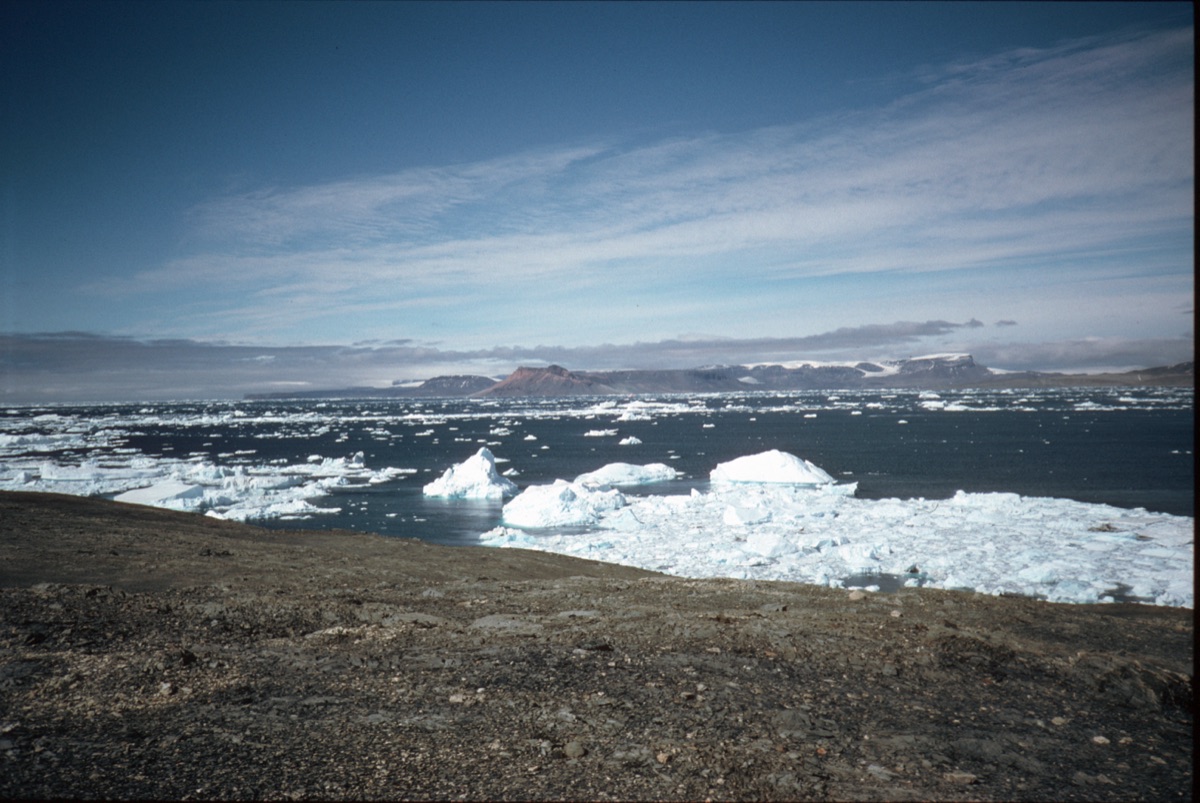
In December 1985, a British geologist working on a wind-scoured Antarctic island picked up a fist-sized fossil, scribbled four words in his field notebook - ‘vertebra of large reptile’ - and packed it away. The bone then did what a lot of museum specimens do: nothing. It sat in a drawer for almost 40 years. Now, after a fresh look by a new generation of palaeontologists, it has been confirmed as a piece of a titanosaur - and recognised as the first dinosaur bone ever collected from the continent of Antarctica.
It is a small fossil with an outsized story: a four-decade wait, a single tail bone, and a window onto an Antarctica that was once warm, green, and walked by giants. Here is exactly what was found, what it tells us, and what it does not.
- What: a single caudal (tail) vertebra, about 10 cm long, from a titanosaur (a long-necked sauropod)
- Collected: 9 December 1985, James Ross Island, Antarctic Peninsula, by British Antarctic Survey geologist Mike Thomson
- Identified: only now - after roughly 40 years in museum storage
- Age: Late Cretaceous, about 82 million years old
- Status: the first dinosaur bone ever collected from Antarctica, and only the second sauropod body fossil known from the continent
- Size of the animal: an estimated 6-7 metres (~23 ft) - small for a titanosaur
- Published: Acta Palaeontologica Polonica, June 2026 (British Antarctic Survey & Natural History Museum, London)
1. The Bone That Waited 40 Years
The specimen was collected on 9 December 1985, during a British Antarctic Survey expedition to James Ross Island, off the tip of the Antarctic Peninsula. The geologist who found it, the late Mike Thomson, recorded it simply as a ‘vertebra of large reptile’ - an accurate but cautious note that stopped short of the word ‘dinosaur.’ The fossil entered the collections and stayed there, unremarkable on the shelf, for the better part of four decades.
Its second life began not on an expedition but in a museum store-room. Palaeontologist Dr Mark Evans came across the bone while reviewing British Antarctic Survey holdings. ‘When I first spotted this bone in our collections a few years ago, I suspected it was a dinosaur,’ he said. Working with Professor Paul Barrett of the Natural History Museum in London - and colleagues including the Carnegie Museum of Natural History’s Matt Lamanna - the team compared its anatomy with sauropods worldwide and confirmed the hunch.
2. What It Actually Is
The fossil is a single tail vertebra, roughly 10 centimetres long. Its shape places the animal among the titanosaurs - a wildly successful group of plant-eating, long-necked sauropods that included the largest land animals that ever lived, some topping 15 tonnes. This Antarctic individual, though, was no record-breaker: the team estimates it at a relatively petite 6 to 7 metres (about 23 feet) long. Details of the vertebra most closely resemble certain South American titanosaurs, the family’s heartland.
Titanosaurs were the last great lineage of sauropod dinosaurs - four-legged plant-eaters with long necks and tails. They thrived right up to the end of the Cretaceous and were especially common across the southern continents. The group spans the spectrum from a few metres long to colossi like Argentina’s Patagotitan. The Antarctic animal sat at the small end of that range.
3. Why ‘First’ - With the Honest Footnote
Antarctica has the sparsest dinosaur record of any continent, for the obvious reason that almost all of its rock is buried beneath ice. Only a dozen or so dinosaur species have ever been described from the entire landmass, all from a couple of windows of exposed rock. So what makes this bone a ‘first’?
The precise claim, in the British Antarctic Survey’s own words, is that this is the first dinosaur bone to be collected from the continent - and only the second sauropod body fossil known from Antarctica. Because Thomson picked it up in 1985, it predates other Antarctic dinosaur discoveries by collection date; it simply waited far longer to be identified. (Other Antarctic dinosaurs - including an armoured ankylosaur from the same island - were found and named in the years that followed.) In short: first into the collections, last to be recognised.
| Detail | This fossil |
|---|---|
| Element | Tail (caudal) vertebra, ~10 cm |
| Group | Titanosaur (sauropod) |
| Age | ~82 million years (Late Cretaceous) |
| Collected | 9 Dec 1985, James Ross Island |
| Animal length | Estimated 6-7 m (~23 ft) |
4. An Antarctica You Would Not Recognise
The most evocative part of the story is the world this animal lived in. Eighty-two million years ago, Antarctica was not the frozen desert of today. As Evans describes it, ‘At the time this animal lived, Antarctica would have been covered in lush temperate forest, warmed by heavy volcanic activity that pumped CO₂ into the atmosphere.’ A warm, wet, forested polar continent - green enough to feed a plant-eating dinosaur the size of a bus.
5. How a Land Animal Ended Up in the Sea
There is a nice puzzle buried in the geology. The vertebra came from the Santa Marta Formation - a marine rock layer, laid down on an ancient seabed. So how did a land-dwelling dinosaur’s bone get there? The likeliest answer is the simplest: after the animal died, its carcass floated out to sea, drifted, and eventually sank to be buried in seafloor sediment, where it fossilised. It is the only dinosaur fossil yet recovered from this particular formation - a reminder that some land animals are preserved only because the ocean happened to swallow them.
6. Filling In the Map of a Lost Supercontinent
In the Late Cretaceous, Antarctica was not isolated. It was a central hinge of Gondwana, the southern supercontinent, with land connections toward South America and, by way of the Antarctic Peninsula, on toward New Zealand and Australia. A titanosaur in Antarctica therefore helps explain how the group dispersed across the southern world.
As Barrett puts it: ‘The find sheds further light on how dinosaurs spread across the southern continents. To date no titanosaurs have been found in Australia and there is only limited evidence of them in New Zealand. Confirmation of the presence of these animals in Antarctica makes it seem likely that they travelled on to these areas which were connected.’ Antarctica, in other words, may have been a doorway.
What We Still Don’t Know
- Which titanosaur, exactly. A single tail bone constrains the family but not the species; it cannot be tied to a named animal with confidence.
- How representative it is. Antarctica’s record is built from a tiny number of exposed outcrops; one bone is a data point, not a fauna.
- What else is down there. With most of the continent under ice, the dinosaur record is almost certainly far richer than the handful of fossils so far recovered - more may surface as ice retreats and old collections get a second look.
If there is a lesson beyond the science, it is this: discovery is not only something that happens in the field. Sometimes it is waiting, quietly labelled and slightly underestimated, in a drawer - until the right person opens it.
Sources
- British Antarctic Survey: Antarctica’s first dinosaur fossil confirmed from 1985 Antarctic expedition
- Natural History Museum, London: First dinosaur fossil from Antarctica identified as a titanosaur
- Smithsonian Magazine: A fossil that sat in a drawer for 40 years
- Study: Evans, Barrett, Lamanna et al., ‘A titanosaurian sauropod dinosaur from the Late Cretaceous of Antarctica,’ Acta Palaeontologica Polonica (2026), DOI 10.4202/app.01315.2025
Curated by Jerry Cards - jerrycards.com. We research the week’s most fascinating science, tech, and business news so you don’t have to. More at jerrycards.com/news.