
 العربية
 Español
 中文
中文 Deutsch
 Français
 Português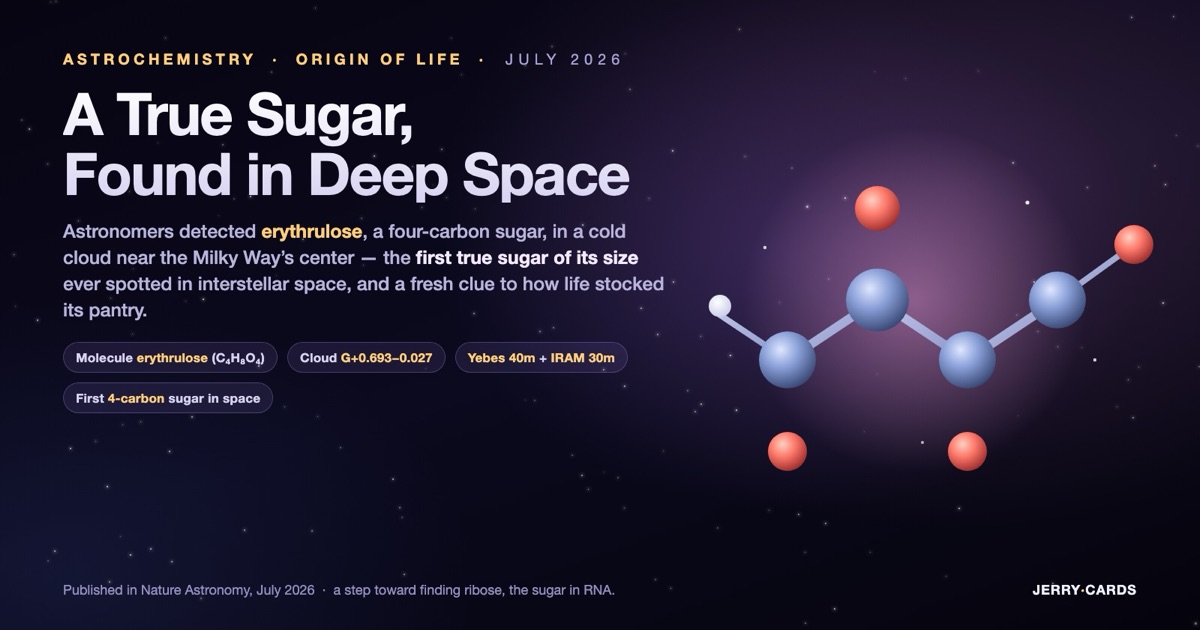
There is sugar between the stars. Astronomers have detected erythrulose - a genuine four-carbon sugar - drifting inside a cold cloud of gas near the center of the Milky Way, some 26,000 light-years from Earth. It is the largest true sugar ever identified directly in interstellar space, and it lands on one of the oldest questions in science: where did the raw ingredients for life come from? The answer, increasingly, seems to be that some of them were floating in space long before the Earth was born.
- What: the first detection of a four-carbon sugar, erythrulose (C₄H₈O₄), in interstellar space
- Where: the molecular cloud G+0.693-0.027, near the center of the Milky Way (~26,000 light-years away)
- How: radio spectroscopy with the Yebes 40-m and IRAM 30-m telescopes in Spain, matched to a laboratory fingerprint
- Who: a team led by Izaskun Jimenez-Serra, Centro de Astrobiologia (CAB), Madrid
- Published: Nature Astronomy, July 2026
- Why it matters: sugars are the backbone of RNA and DNA - and this one can turn into a possible pre-RNA building block
1. What they actually found
The molecule is erythrulose, a chiral four-carbon ketose - a small sugar with the formula C₄H₈O₄. On Earth it is an ordinary substance: it is the sugar used in many sunless-tanning lotions. In space, it is anything but ordinary. An international team led by Izaskun Jimenez-Serra of the Centro de Astrobiologia (CAB) in Madrid spotted its signature in G+0.693-0.027, a cold, dense cloud near the heart of our galaxy that has become one of astrochemistry's richest hunting grounds for complex molecules.
They did it with two of Spain's big dishes - the 40-metre Yebes radio telescope in Guadalajara and the 30-metre IRAM telescope near Granada - which listen for the faint radio hum that molecules emit as they tumble in space. About a dozen distinct spectral lines of erythrulose were identified in the data.
Every molecule spins at a set of characteristic rates, and each rate corresponds to a precise radio frequency - a molecular barcode. The trick is that you have to know the barcode before you can read it. So the researchers first measured erythrulose's exact rotational spectrum in a laboratory on Earth, then went looking for that same pattern in the radio light of the distant cloud. When the laboratory lines and the telescope lines lined up, the identification was secure. It is chemistry and astronomy working as one instrument.
2. What ‘first’ really means here
Headlines about ‘the first sugar in space’ deserve a careful footnote. Simpler, sugar-related molecules have been seen in the cosmos before - glycolaldehyde, often called the simplest sugar, was detected in space years ago - and full-blown sugars have even been found tucked inside meteorites that fell to Earth. What makes this result new is the size and status of the molecule: erythrulose is a bona fide four-carbon sugar, and this is the first time a true sugar of that size has been identified directly in an interstellar cloud, rather than inferred from a rock. It is a genuine step up the ladder of complexity, in the wild, in space.
3. Two genuine surprises
The detection came with a pair of twists that intrigued the team:
- It builds itself from the bottom up. The evidence suggests erythrulose forms on icy dust grains within the cloud, assembled from simpler two-carbon alcohols and aldehydes. Complex, life-relevant chemistry can happen on frozen specks of dust in the cold and the dark, without a planet, a star, or an ocean.
- The big sugar beat the small ones. Erythrulose turned out to be at least eight times more abundant than the analogous three-carbon sugars in the same cloud - which have not been detected at all. Nature does not always make the smallest thing first.
| Detail | What the study reports |
|---|---|
| Molecule | Erythrulose - a four-carbon ketose sugar (C₄H₈O₄) |
| Location | Cloud G+0.693-0.027, near the Milky Way’s center (~26,000 ly) |
| Telescopes | Yebes 40-m (Guadalajara) + IRAM 30-m (near Granada), Spain |
| Evidence | ~12 spectral lines matched to a laboratory fingerprint |
| Abundance | ≥ 8× the analogous 3-carbon sugars (undetected) |
| Formation | On icy dust grains, from 2-carbon alcohols & aldehydes |
| Published | Nature Astronomy, July 2026 (led by I. Jimenez-Serra, CAB) |
4. Why a sugar in space matters for life
Sugars are not just for sweetening. They are the structural backbone of RNA and DNA: ribose forms the rails of the RNA molecule that every living cell relies on. So finding sugars pre-assembled in space speaks directly to how life’s chemistry could have gotten started.
Erythrulose is especially interesting because of what it can become. In liquid water it can rearrange into threose and erythrose - and threose is the sugar in TNA (threose nucleic acid), a simpler genetic polymer that some scientists propose as a stepping-stone before RNA in the story of life’s origins. Laboratory chemists have even synthesized RNA building blocks from mixtures that include erythrulose. In other words, this is not a dead-end molecule; it sits upstream of the machinery of life.
And there may have been a lot of it. Models cited by the team suggest that somewhere between hundreds of thousands and tens of millions of tonnes of such sugars could have been delivered to the young Earth by comets, asteroids and dust during its first few hundred million years - an exogenous ‘care package’ of prebiotic feedstock. As co-author Carlos Briones put it, the detection is exciting because ‘it opens up the possibility of discovering in space other sugars such as ribose, which is part of RNA.’
What this does – and does not – show
- It is a molecule, not life. Detecting a sugar in a cloud shows the ingredients exist in space; it says nothing about whether life formed there.
- The pre-RNA link is a hypothesis. The threose-to-TNA-to-RNA pathway is a leading idea about life’s origins, not an established fact.
- The delivery estimate is a broad model. The tonnage that reached early Earth spans a wide range and depends on modeling assumptions.
- The chemistry needs water for the next step. The sugar in the cloud is frozen and dry; turning it into threose requires liquid water, which means a planet or an icy parent body.
The takeaway
Strip away the caveats and something quietly wonderful remains: a real sugar, a cousin of the molecules that encode life, assembling itself on frozen dust in a cloud near the center of our galaxy. It suggests that the pantry for life’s chemistry may be stocked across the cosmos, ready and waiting wherever a world happens to form. The next course is already on the menu: the same team hopes to hunt for ribose - the sugar that builds RNA itself - somewhere out among the stars.
Sources
- Nature Astronomy: Detection of a four-carbon sugar in interstellar space (Jimenez-Serra et al., July 2026)
- Nature (news): First ‘true sugar’ molecule found in space - offering hints to life’s origins
- Chemical & Engineering News (ACS): Astronomers detect first sugar in interstellar molecular clouds
- Phys.org: Study reports the first detection of a sugar in interstellar space
- Preprint: arXiv:2606.03313 - Detection of a four-carbon sugar in interstellar space
Curated by Jerry Cards - jerrycards.com. We research the week’s most consequential tech, science, and business news so you don’t have to. More at jerrycards.com/news.