
 العربية
 Español
 中文
中文 Deutsch
 Français
 Português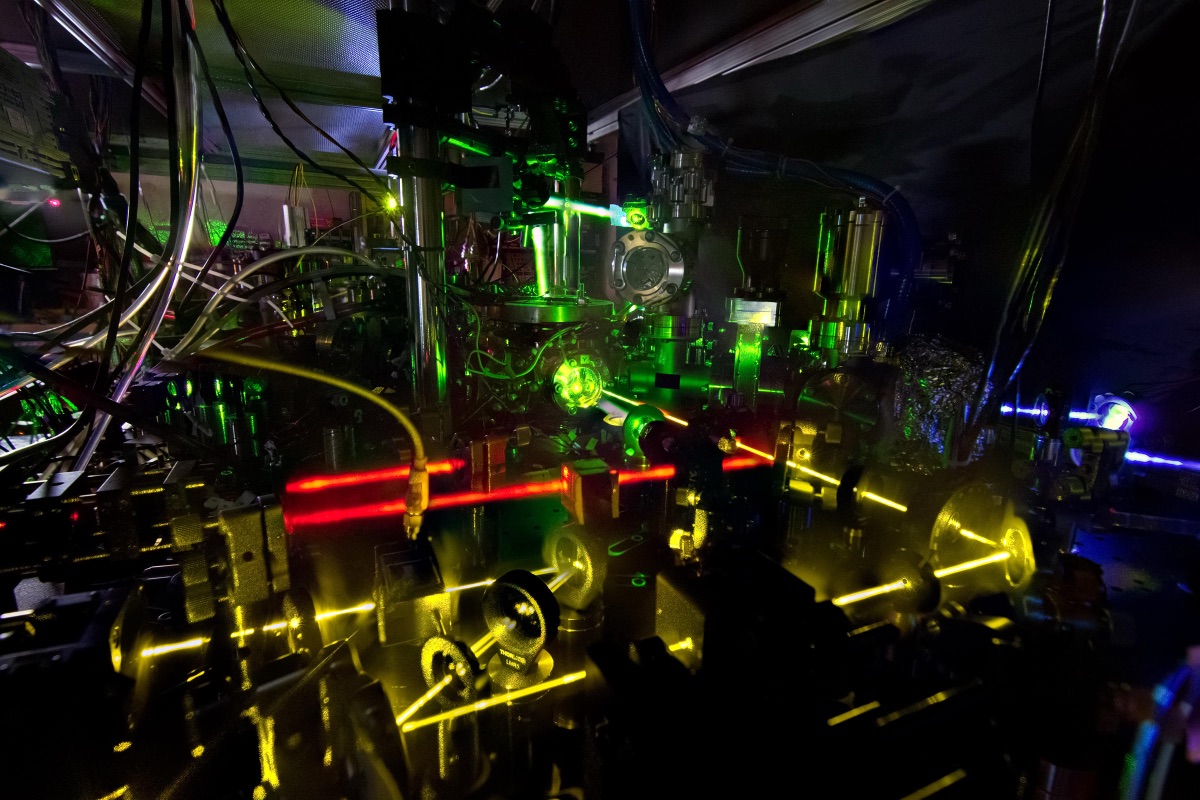
For the first time, a clock is keeping time by listening to the heart of an atom. In June 2026, two independent teams - one led by Thorsten Schumm at TU Wien in Vienna, the other by Shiqian Ding at Tsinghua University in Beijing - reported the first working nuclear clocks: timekeepers that read the energy of an atomic nucleus instead of the electrons that every atomic clock has used since the 1950s. It is a goal physicists have chased for more than 20 years, and it opens the door to clocks that are not just more precise but fundamentally tougher - and to a remarkably sensitive new way of testing the laws of nature themselves.
Here is what was actually built, why a single isotope made it possible, and what a clock run by an atom's core could change.
- What: the first clocks that keep time using an atomic nucleus (thorium-229) rather than electrons
- Who: Thorsten Schumm's team at TU Wien (Vienna) and Shiqian Ding's team at Tsinghua University (Beijing), independently
- When: preprints posted to arXiv on June 3 and June 7, 2026
- The key: thorium-229's nucleus has a uniquely low energy step (~8.4 electron-volts, about 148-nanometre ultraviolet light) - the only nuclear transition a laser can drive
- The last piece: a feedback loop that locks the laser to the nucleus - the difference between a measurement and a running clock
- Why it matters: potentially rugged, portable timekeeping, plus a powerful new probe for dark matter and shifting fundamental constants
1. What Just Happened
Within four days of each other, two groups posted results describing a thorium-229 nuclear clock that actually runs. Earlier experiments had found and measured the thorium nuclear transition; the new work did the harder thing - it locked a laser onto that transition and held it there, continuously, using a feedback loop. That is precisely the step that separates a one-off reading from a clock that ticks.
As physicist Lars von der Wense, a longtime leader in the field, framed the milestone: locking the laser to the nucleus with feedback was “the final missing step before calling it an actual clock.” Both teams cleared it.
2. Why Thorium-229 Is the One Nucleus That Works
Every atomic clock - the cesium standard that defines the second, and the optical clocks that have surpassed it - works by tuning electromagnetic radiation to a jump between electron energy levels. Nuclei are far more stable timekeepers in principle, because they are tiny and tightly bound. The problem: nudging a nucleus between energy levels almost always demands X-rays or gamma rays, far beyond any laser.
Thorium-229 is the lone known exception. Its nucleus has an excited state (an isomer, written 229mTh) sitting only about 8.4 electron-volts above the ground state - a freakishly low energy that corresponds to roughly 148-nanometre vacuum-ultraviolet light. That is just barely within reach of precision laser technology, which is why this one isotope, out of thousands, became the entire field's target.
3. How They Built It
Both teams embedded thorium-229 atoms inside a transparent calcium fluoride (CaF2) crystal at room temperature - so instead of trapping a single ion in vacuum, they had trillions of nuclei held in place by the crystal lattice. A finely tuned ultraviolet laser excites the nuclei; by watching how strongly the light is absorbed, the experiment senses when the laser is perfectly on resonance, and the feedback loop keeps it there.
| Vienna - TU Wien | Beijing - Tsinghua | |
|---|---|---|
| Led by | Thorsten Schumm (Luca Toscani De Col, lead author) | Shiqian Ding (Beichen Huang, lead author) |
| Preprint | arXiv:2606.04997 (Jun 3, 2026) | arXiv:2606.08870 (Jun 7, 2026) |
| Medium | Thorium-229 in a room-temperature CaF2 crystal | Thorium-229 in a CaF2 crystal |
| Stability (1 day) | approaching ~1 part in 1015 (a thousand trillion) | ~1 part in 1013 (ten trillion) |
To put those figures in human terms: a clock stable to a part in 1015 would stray by well under a second over tens of millions of years. And both numbers are starting points, with the teams expecting to push them much further.
4. Why a Nuclear Clock Could Beat an Atomic One
The advantage is physical, not just incremental. An atom's nucleus is roughly 10,000 times smaller than the cloud of electrons around it, and those very electrons act as a shield. So the nucleus barely feels the stray electric and magnetic fields that nudge an electron-based clock off-beat. Less sensitivity to its surroundings means a clock that can, in principle, be made dramatically more robust and portable - even operated as a solid chip of doped crystal rather than a room full of trapped atoms, lasers, and vacuum hardware.
Schumm notes that on raw timekeeping the best optical atomic clocks are still ahead - but for certain specialized measurements, the nuclear clock is already competitive or better. In his words: “In some types of measurements, we're already outperforming all atomic clocks.” The thorium transition is unusually sensitive to subtle shifts in the constants of physics, which turns the clock into a detector as much as a timepiece.
5. What It Unlocks
- A tougher definition of the second. The official second still rides on 1950s cesium technology; optical clocks already do better in the lab. A nuclear clock points toward a standard that is not only ultra-precise but rugged enough to travel.
- A dark-matter and new-physics detector. Because its tick depends so delicately on fundamental constants, a nuclear clock can hunt for ultralight dark matter and test whether quantities like the fine-structure constant truly stay fixed - even hints of a possible new force. The Vienna group has already used its setup to place constraints on ultralight dark-matter models.
- Relativistic geodesy and navigation. Clocks this good measure gravity itself: time runs slightly faster higher up, so a portable nuclear clock could map tiny changes in altitude and underground mass, sharpen GPS, and sense gravitational shifts.
6. A 20-Year Road
The idea dates to 2003, when Ekkehard Peik and Christian Tamm at Germany's national metrology institute (PTB) proposed using the thorium nucleus as a clock. The decisive groundwork came in 2024, when Jun Ye's group at JILA in Colorado used a vacuum-ultraviolet laser frequency comb to measure the thorium transition with extraordinary precision - pinning its frequency near 2,020,407,384,335 kilohertz and confirming the long-lived excited state - roughly a million times sharper than any earlier measurement. That gave everyone the exact note to tune to. The clocks of June 2026 are what happens when the orchestra finally plays it.
What We Still Don't Know
- Peer review is pending. Both results are arXiv preprints; independent referees have not yet vetted them, though they build on years of confirmed, published groundwork.
- Still lab-scale. These are laboratory instruments. The dream of a rugged, portable, chip-scale nuclear clock is the destination, not yet the reality.
- Not yet the most precise clock on Earth. The best optical atomic clocks still lead on raw stability; the nuclear clock's edge today is its robustness and its sensitivity to new physics, with room to climb.
None of that dims the headline. The hard part - getting a nucleus to keep time at all - has been done, twice, on two continents, in the same week.
Sources
- Nature (news): The first ticking 'nuclear clocks' are here - what can they do?
- Science News: Clocks made from an atomic nucleus just ticked on for the first time · Scientific American: The first ticking nuclear clocks are here
- Preprints: Toscani De Col et al., 'A thorium-229 optical nuclear clock with feedback loop' (arXiv:2606.04997) · Huang et al., 'A nuclear clock based on 229Th' (arXiv:2606.08870)
- Background (2024 milestone): Zhang et al., Nature (2024): frequency ratio of the 229mTh nuclear transition and the 87Sr clock · NIST: Major Leap for Nuclear Clock
Curated by Jerry Cards - jerrycards.com. We research the week's most consequential science, tech, and business news so you don't have to. More at jerrycards.com/news.