
 العربية
 Español
 中文
中文 Deutsch
 Français
 Português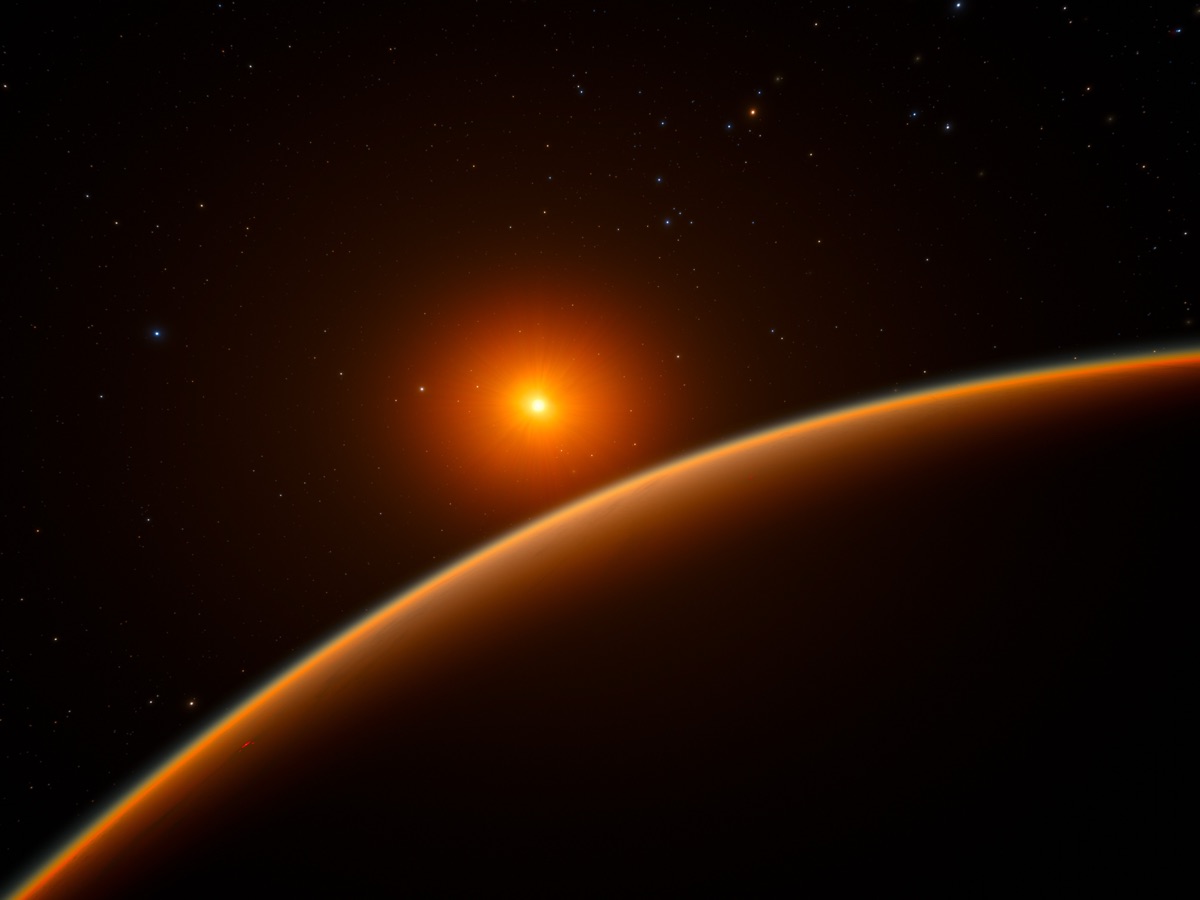
One of the closest potentially habitable worlds we know of just came into sharper focus - and it is practically in our cosmic backyard. A team led by astronomer Paul Robertson of the University of California, Irvine has refined the measurements of GJ 3378 b (also written Gliese 3378 b), a super-Earth circling a small red dwarf star only about 25 light-years away in the northern constellation Camelopardalis, the Giraffe. The new data make the planet lighter, its orbit tighter, and its place in the star’s habitable zone more convincing than before. It is a genuinely uplifting result - and, told honestly, it comes with one big open question.
Above: an artist’s impression of a super-Earth orbiting a red dwarf star, shown as a representative illustration of a world like GJ 3378 b (depicted: the exoplanet LHS 1140 b). It is an artist’s concept, not a photograph of GJ 3378 b itself. Credit: ESO/spaceengine.org.
- What: a super-Earth (a rocky-class planet heavier than Earth) in its star’s habitable zone
- Where: ~25 light-years away, constellation Camelopardalis
- Host star: GJ 3378 - a small, cool red dwarf (also cataloged LHS 1805)
- Mass: revised down from ~5 to about 2.3 Earth masses
- Year: one orbit every 21.45 days
- Starlight received: about 90% of what Earth gets from the Sun
- The open question: whether it has an atmosphere - unknown for now
1. A next-door neighbor, on galactic terms
Twenty-five light-years is an enormous distance by any human yardstick - roughly 235 trillion kilometers. But the galaxy is vast, and by that measure GJ 3378 b sits almost on our doorstep. “It’s one of our closest cosmic neighbors,” Robertson explains. “Twenty-five light-years sounds like a long way, but the Milky Way is about 100,000 light-years across, so in that respect it’s our next-door neighbor.” That proximity is the whole point: nearby planets are the ones future telescopes have the best chance of studying in detail.
2. The mass revision that changed the story
GJ 3378 b was already known, but its earlier portrait was fuzzier. A 2024 analysis pegged it at roughly 5 Earth masses on a 24.7-day orbit. The new study, drawing on a longer and more precise campaign, revises the planet down to about 2.3 Earth masses and refines the orbit to 21.45 days.
Why does shaving off mass matter so much? Because mass is a strong hint about what a planet is made of. A world of ~5 Earth masses could plausibly be a small, gas-shrouded “mini-Neptune.” At ~2.3 Earth masses, GJ 3378 b sits much more comfortably in the range of rocky, terrestrial worlds - the kind with a solid surface, the kind we are actually looking for. The lighter mass and tighter orbit also place it more squarely inside the star’s habitable zone.
Sometimes called the “Goldilocks zone,” it is the band of orbits around a star where a planet with the right atmosphere could hold liquid water on its surface - not so hot that it boils away, not so cold that it all freezes. It is a necessary condition for life-as-we-know-it, not a guarantee of it.
3. Just-right starlight: about 90% of Earth’s
Red dwarfs are small and dim compared with the Sun, so their habitable zones sit much closer in - which is why a 21-day orbit can still be temperate here. The key number is how much energy the planet actually receives, and GJ 3378 b lands strikingly close to home: about 90% of the sunlight Earth gets. In the arithmetic of habitability, that is almost uncannily Earth-like.
4. How you find a planet you cannot see
No telescope photographed GJ 3378 b. It was found the same way many of the nearest exoplanets are: by the radial-velocity method. As a planet orbits, its gravity tugs the star into a tiny back-and-forth wobble; that wobble stretches and squeezes the star’s light by an almost imperceptible amount, which ultra-stable spectrographs can measure. The team combined data from two of the best:
- the Habitable-zone Planet Finder (HPF) on the Hobby-Eberly Telescope at McDonald Observatory in Texas, and
- the NEID spectrometer on the WIYN Telescope at Kitt Peak National Observatory in Arizona.
One consequence is worth stating plainly: because the planet was detected by its gravitational pull rather than by crossing in front of its star, astronomers have measured its mass but not its diameter. We know how heavy GJ 3378 b is; we do not yet have a direct measurement of how big it is.
5. The honest caveat: does it have an atmosphere?
Here is where scientific candor matters. “Potentially habitable” is a statement about a planet’s orbit and energy budget - not a claim that anyone lives there, or even that the surface is wet. The single biggest unknown for GJ 3378 b is whether it has held onto an atmosphere at all. Liquid water exposed to the vacuum of space simply sublimates away; without an atmospheric blanket, a world in the habitable zone can still be bone-dry.
Red dwarfs complicate the picture further: young ones can be flare-prone, and their eruptions can erode the atmospheres of close-in planets over time. So GJ 3378 b sits at what astronomers call the “cosmic shoreline” - the fuzzy boundary between worlds that keep their air and worlds that lose it. Which side of that line it falls on is exactly what we cannot yet tell.
Key numbers
| Property | Earlier estimate (2024) | New value |
|---|---|---|
| Mass | ~5 Earth masses | ~2.3 Earth masses |
| Orbital period | ~24.7 days | 21.45 days |
| Starlight received | - | ~90% of Earth’s |
| Distance | - | ~25 light-years |
| Habitable zone | near the edge | more squarely inside |
Why this one is worth getting excited about
Thousands of exoplanets are now known, and a fair number sit in habitable zones. What makes GJ 3378 b stand out is the combination: close, light, and temperate. Proximity is the currency of follow-up astronomy - the nearer a planet, the more feasible it becomes for observatories to hunt for the fingerprint of an atmosphere in the star’s light. A rocky-mass world receiving nearly Earth’s dose of starlight, just 25 light-years away, is precisely the kind of target the next decade of telescopes was built to interrogate.
What we still don’t know
- Its size. Radial velocity gives mass, not diameter; without a transit we cannot yet measure the planet’s radius or confirm its density directly.
- Its atmosphere. The decisive habitability question - is there an atmosphere, and what is it made of - awaits future observations.
- Its surface. Temperate starlight is encouraging, but actual surface conditions depend on that unknown atmosphere.
None of that dims the headline. A little more than a year ago, GJ 3378 b looked like a heavier, more ambiguous world. Today it looks like a rocky-class, temperate super-Earth on our galactic doorstep - and a prime place to point our best instruments next.
Sources
- Robertson et al., The Astrophysical Journal (DOI 10.3847/1538-4357/ae732b) - the peer-reviewed study
- Space.com: a potentially habitable planet just 25 light-years away
- ScienceAlert: potentially habitable super-Earth found just 25 light-years away
- Sci.News: potentially habitable super-Earth GJ 3378 b
Curated by Jerry Cards - jerrycards.com. We research the week’s most consequential tech, science, and space news so you don’t have to. More at jerrycards.com/news.