
 العربية
 Español
 中文
中文 Deutsch
 Français
 Português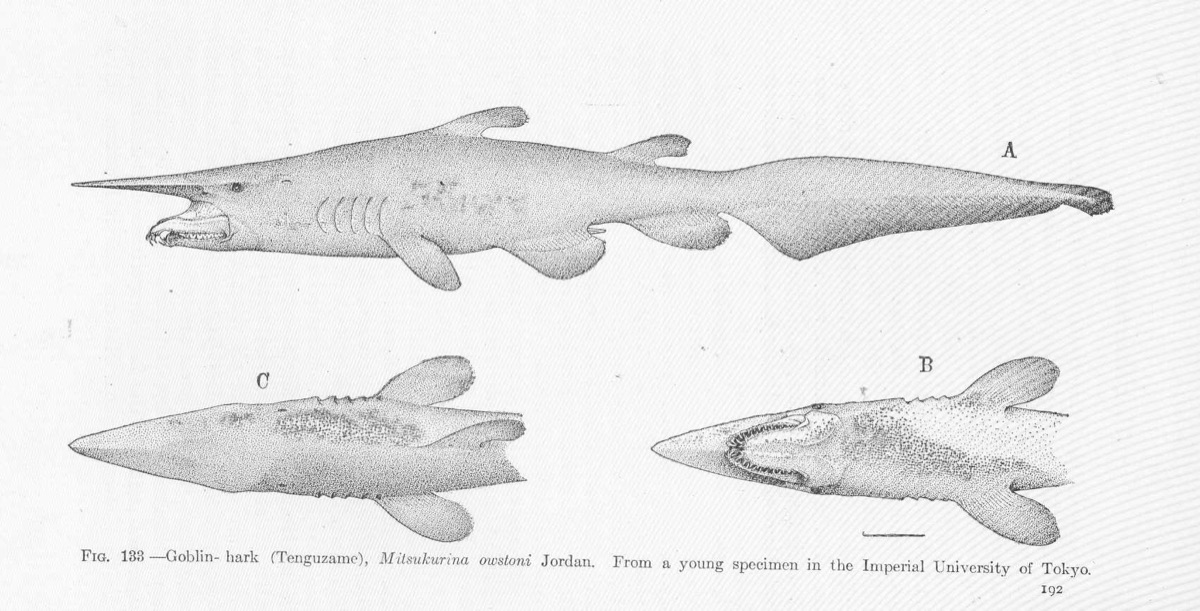
For nearly 125 million years, the goblin shark has drifted through the deep ocean - and in all that time, no human had ever watched a living one in the place it calls home. Until now, every confirmed sighting of a live goblin shark (Mitsukurina owstoni) came only after the animal had been accidentally caught on a fishing line and pulled to the surface, where it quickly died. Two deep-sea expeditions have finally changed that, capturing the first footage of this elusive creature alive, healthy, and at home in the dark - and roughly 700 metres deeper than it had ever been recorded.
The encounters were described in the Journal of Fish Biology and led by researchers at the University of Hawaiʻi at Mānoa and the Minderoo-University of Western Australia Deep-Sea Research Centre. Here is what they saw, what makes this shark so strange, and why a brief glimpse of one healthy animal is a genuine milestone in ocean exploration.
- What: the first-ever footage of a living goblin shark in its natural deep-sea habitat
- Why it is a first: every prior live sighting was of an animal hauled to the surface as bycatch, where it soon died
- Encounter 1 (2019): 1,237 m (~4,058 ft), seamount near Jarvis Island, central Pacific
- Encounter 2 (2024): 1,997 m (~6,552 ft), Tonga Trench - about 700 m deeper than the species had ever been recorded
- The animal: Mitsukurina owstoni, the sole living member of a shark family ~125 million years old - a true “living fossil”
- Published in: Journal of Fish Biology (2026), DOI 10.1111/jfb.70505
1. Two Encounters in the Dark
The footage came from two separate deep-sea expeditions, years and thousands of kilometres apart.
The first was recorded in 2019, when a camera aboard the remotely operated vehicle Hercules - deployed from the exploration vessel E/V Nautilus (Ocean Exploration Trust) - caught a goblin shark gliding past at 1,237 metres (about 4,058 feet) on an unnamed seamount northwest of Jarvis Island in the central Pacific.
The second came in 2024, during the Inkfish Open Ocean Expedition aboard the research vessel R/V Dagon. A baited camera resting on the seafloor filmed a goblin shark at 1,997 metres (about 6,552 feet) on the slope of the Tonga Trench - roughly 700 metres deeper than the species had ever been documented.
| Encounter | Location | Depth | How it was filmed |
|---|---|---|---|
| 2019 | Seamount near Jarvis Island, central Pacific | 1,237 m (~4,058 ft) | ROV Hercules, E/V Nautilus (Ocean Exploration Trust) |
| 2024 | Tonga Trench slope | 1,997 m (~6,552 ft) | Baited seafloor camera, Inkfish Open Ocean Expedition (R/V Dagon) |
For context, goblin sharks had previously been recorded down to about 1,300 metres. The Tonga Trench sighting pushes that boundary meaningfully deeper - a small but real expansion of where we know this animal can live.
2. Why a Brief Glimpse Is a Big Deal
It is easy to underestimate why this matters. Goblin sharks are not unknown to science - museum specimens exist, and fishers occasionally pull one up by accident. But there is a world of difference between studying a dead animal on a boat deck and observing a healthy one behaving naturally in its own environment.
Every earlier “live” observation was of a goblin shark that had been dragged up from the deep on a fishing line, where the pressure and temperature changes killed it within a short time. Seeing one in situ - moving, unharmed, kilometres beneath the waves - lets researchers begin to understand how it actually swims, hunts, and uses its habitat. It also extends the known geographic range and depth of the species, filling in blanks on a map that is still mostly empty.
“Seeing the most iconic of all the deep-sea sharks alive and looking healthy in its natural habitat is a unique honor. New discoveries like this demonstrate that there is still so much to explore in our deep ocean home.”
- Aaron Judah, lead author, University of Hawaiʻi at Mānoa
3. Meet the Living Fossil
Few animals look as otherworldly as the goblin shark - and much of that strangeness is beautifully adapted engineering for life in the lightless deep.
- A living fossil: it is the only surviving member of the family Mitsukurinidae, a lineage that reaches back nearly 125 million years to the age of the dinosaurs.
- An electric-sensing snout: its long, flattened, blade-like snout is studded with electroreceptors (the ampullae of Lorenzini) that detect the faint electrical fields given off by prey in total darkness.
- Slingshot jaws: its jaws are among the most protrusible of any shark, launching forward in a fraction of a second to snatch fish and squid that stray too close.
- Pink for a reason: its pinkish colour comes not from pigment but from blood vessels showing through skin so thin it is semi-transparent.
- Size: most are a few metres long, though the species is thought to reach roughly 6 metres (about 20 feet).
These traits are exactly what you would design for an ambush predator living where sunlight never reaches: sense prey electrically, then strike with a jaw that can reach out beyond the head. What the new footage adds is the chance to watch that body actually at work in the wild, rather than inferring it from a specimen.
4. The Bigger Picture: An Ocean We Have Barely Seen
The deep sea is the largest living space on Earth, and it remains overwhelmingly unexplored - the vast majority of the seafloor has never been mapped in detail, let alone observed with a camera. Encounters like these are possible only because deep-sea robotics, baited landers, and long-duration expeditions are steadily opening a window onto a world that used to be entirely out of reach.
Senior co-author Alan Jamieson, who directs the Minderoo-UWA Deep-Sea Research Centre, has spent a career visiting the ocean’s deepest places. Even for him, the goblin shark remains a near-total mystery.
“It’s not only seeing it alive that was fascinating, but also the fact the Tonga Trench goblin shark was 700 metres deeper than previously known. We actually know virtually nothing about them.”
- Alan Jamieson, Minderoo-University of Western Australia Deep-Sea Research Centre
That is the quietly thrilling part of a story like this. It is not that we have finished learning about the goblin shark - it is that, more than a century after the species was first described, we are only just beginning.
Honest Caveats
- Two encounters, two individuals. This is a pair of remarkable observations, not a population study - each clip shows a single animal for a short time.
- Behaviour still largely unknown. The footage tells us the shark was there and looked healthy; it does not yet reveal how it hunts, mates, or ranges over a lifetime.
- The deep sea is hard to study. Goblin sharks are naturally rare and live where few expeditions ever go, so sightings will remain precious and infrequent.
None of that dims the achievement. If anything, it underlines it: we caught a fleeting, honest look at one of the ocean’s most enigmatic animals, exactly as it lives - and it points to how much wonder is still waiting in the deep.
Sources
- Judah, A. B., et al. “First observations of the goblin shark (Mitsukurina owstoni) in its natural habitat.” Journal of Fish Biology (2026), DOI 10.1111/jfb.70505
- ScienceDaily / University of Hawaiʻi at Mānoa: Rare goblin shark filmed alive for the first time in the deep sea
- Live Science: Elusive goblin shark captured on camera for the first time
- Smithsonian Magazine: The elusive goblin shark, filmed for the first time in its deep-sea habitat
- Oceanographic: Goblin shark filmed alive in the deep ocean for the first time
Curated by Jerry Cards - jerrycards.com. We research the week’s most fascinating science, tech, and discovery stories so you don’t have to. More at jerrycards.com/news.