
 العربية
 Español
 中文
中文 Deutsch
 Français
 Português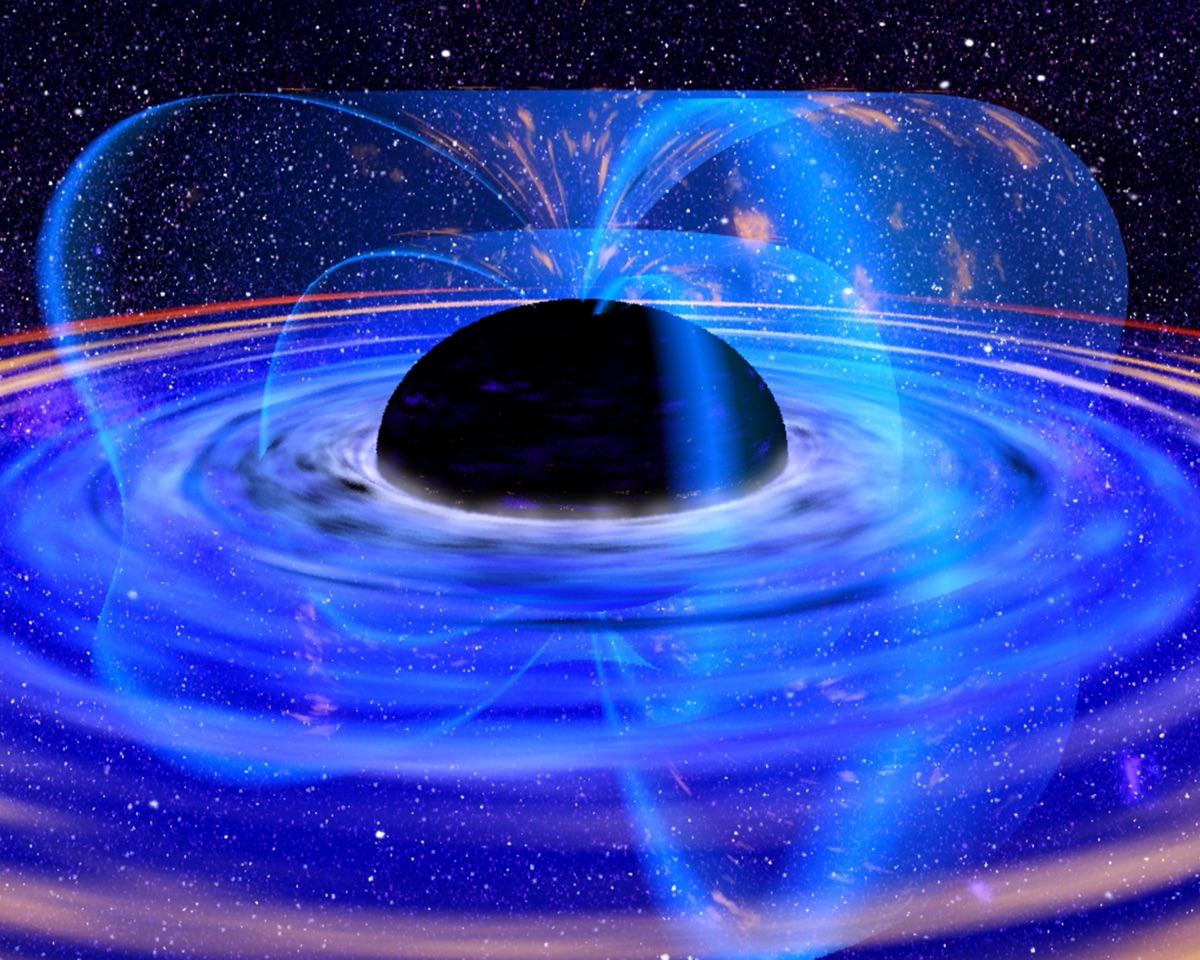
For decades, the textbook ending for a heavy collapsing star has had only one plot: a black hole. When a massive star burns through its fuel and gravity wins, the matter is supposed to crush down to a singularity - a point of infinite density where the laws of physics stop making sense - sealed behind an event horizon, a one-way membrane from which not even light returns. It is one of the most successful predictions in all of science. It is also, quietly, one of the most uncomfortable: physicists have never liked the singularity (it is where Einstein's equations break down) or the event horizon (it sits at the heart of the black-hole information paradox).
A new paper from Goethe University Frankfurt sketches a different ending - and, crucially, writes down the math for it. In this version, the collapse never quite finishes. Deep inside the dying star, a speck of dark-energy-filled vacuum switches on, expands like a miniature Big Bang, and pushes back against gravity until the two forces lock into a standstill. What remains is not a black hole at all, but a gravastar: just as massive, just as compact - yet with no singularity and no event horizon.
- Who: Daniel Jampolski (Master's student) and Prof. Luciano Rezzolla, Goethe University Frankfurt - Rezzolla is part of the Event Horizon Telescope collaboration that captured the first image of a black hole
- What: the first dynamical solution of Einstein's general relativity showing how a collapsing star could form a gravastar instead of a black hole
- How: a de Sitter (dark-energy) region nucleates at the center with zero size and expands - a tiny Big Bang - until it balances the infalling matter near the Schwarzschild radius
- The payoff: an ultra-compact object with no singularity and no event horizon
- Published: as a Letter in Physical Review D 113, L121502 (DOI 10.1103/c6lw-nx7k), June 11, 2026; preprint arXiv:2509.15302
- The honest caveat: it needs idealized, fine-tuned conditions, its stability is unproven, and there is no observational evidence real black holes are gravastars
1. The two things physicists secretly dislike about black holes
Black holes are real - we have now photographed the shadows of two of them, in galaxy M87 and at the center of our own Milky Way. But the standard mathematical black hole hides two features that keep theorists up at night.
The first is the singularity: a central point where density and spacetime curvature blow up to infinity. Infinities in a physical theory are usually a sign that the theory has been pushed past its limits - here, that general relativity and quantum mechanics need to be stitched together in a way nobody has managed. The second is the event horizon: the boundary of no return. It is what makes a black hole black, but it also creates the famous information paradox - the puzzle of what happens to the information about everything that falls in.
For half a century, the working assumption has been that we are simply stuck with both. A landmark 1939 calculation by J. Robert Oppenheimer and Hartland Snyder - the model this new paper starts from - showed that a simple collapsing ball of matter marches inexorably toward exactly that singular fate.
2. So what is a gravastar?
The escape hatch was proposed in 2001 by physicists Pawel Mazur and Emil Mottola, who coined the term gravastar - short for gravitational vacuum condensate star. The idea: instead of collapsing all the way to a point, matter could transition into an exotic state and leave behind an object with a very different interior.
| Region | What it is | Why it matters |
|---|---|---|
| Core | A de Sitter vacuum - the same kind of repulsive dark-energy pressure that accelerates the expansion of our universe | Its outward push replaces the singularity; there is no infinite-density point |
| Shell | A thin layer of ordinary (very stiff) matter | Holds the dark-energy core and the outside world apart |
| Exterior | Normal Schwarzschild spacetime - what you would see from far away | From a distance it looks almost exactly like a black hole |
On paper, a gravastar gets you the best of both worlds: an object so compact it mimics a black hole from the outside, but with a smooth, finite interior and a surface instead of a horizon. The problem - the one that stumped physicists for about 25 years - was that nobody could show how nature would ever build one. A static blueprint is not the same as a construction process.
3. The new idea: a Big Bang inside a dying star
This is where Jampolski and Rezzolla come in. Rather than assuming a finished gravastar and checking that it holds together, they asked the harder question: can you start from a collapsing star and watch a gravastar emerge, using nothing but standard general relativity - no exotic high-curvature corrections bolted on?
Their answer, for the first time, is yes - under the right conditions. Starting from the Oppenheimer-Snyder collapse of a uniform dust sphere, they show that a de Sitter region can nucleate at the very center with initially zero size and then expand outward. Mazur and Mottola's dark-energy core, in other words, is not placed there by hand - it is born, mid-collapse, as a tiny inflating bubble of vacuum.
As that internal region expands, its dark-energy pressure pushes outward against the collapsing matter falling inward. The expansion naturally slows down as it approaches the Schwarzschild radius - the would-be event horizon - and meets the infalling dust surface there. Instead of a runaway to a singularity, the system settles into a static equilibrium: a permanent standoff between an outward-pushing baby universe and an inward-crushing star.
Daniel Jampolski put the picture vividly: “The Big Bang of the emerging universe can unfold once the star has already collapsed almost to the point of becoming a black hole.” The collapse gets right up to the brink - and then a new, expanding pocket of spacetime catches it.
There is even a clean cutoff. The authors find a maximum initial compactness - a measure of how tightly the starting matter is packed - of 3/8. Squeeze the initial configuration tighter than that, and the rescue fails: the collapse proceeds to an ordinary black hole. Stay below it, and a gravastar is on the table.
4. Why it matters
The headline is not that black holes are wrong - it is that they may not be the only mathematically consistent ending. For the first time, there is an explicit, dynamical demonstration, entirely inside Einstein's theory, that gravitational collapse can stop short of a singularity. That is a meaningful crack in what looked like an airtight conclusion.
It also matters for how we test gravity. A gravastar has no horizon, so in principle it could leave subtly different fingerprints - in the gravitational waves from merging compact objects, or in the precise shape of a shadow imaged by the Event Horizon Telescope. Knowing what a formable horizonless alternative looks like tells observers what kinds of tiny deviations to hunt for.
5. The honest caveats - and the authors lead with them
This is a beautiful theoretical result, not a discovery about the real sky. The limits are real and the authors are upfront about them:
- Fine-tuned and idealized. The model assumes a perfectly uniform, pressureless, spherical sphere of dust. Real stars are lumpy, spinning, and full of pressure. The solution exists, but the conditions to reach it look special - formation appears possible, not probable.
- Stability is unproven. A configuration that balances on a knife-edge may not survive a nudge. A small perturbation could still tip the object over into a standard black hole, which would make gravastars - at best - rare or fleeting intermediate states.
- No observational evidence. Nothing here says the black holes we have imaged or detected are secretly gravastars. The behavior of matter at such extreme compression is genuinely not understood.
Rezzolla frames the spirit of the work carefully: “Looking for alternatives to black holes should not suggest a skepticism towards black holes, which still represent the most natural and simplest solution to the fate of gravitational collapse.” And on why you do it anyway: “As scientists in general, and as theoretical physicists in particular, it is essential to maintain an unbiased approach towards what we do not know and hence explore both the accepted wisdom and the more exotic interpretations.”
What we still don't know
- Can a gravastar form without fine-tuning? Whether realistic, messy, rotating collapse can ever reach this equilibrium is the next big question.
- Is it stable over time? Long-term and perturbed stability needs to be worked out before gravastars can be taken seriously as lasting objects.
- Could we ever tell the difference? Pinning down the observational signatures - in gravitational waves or horizon-scale images - that would distinguish a gravastar from a black hole.
- What sets the dark-energy core? The physics that would actually trigger and sustain a de Sitter region inside collapsing matter remains an open, deeply quantum question.
None of that diminishes the charm of the result. Sometimes the most exciting moment in physics is not a new image or a new particle - it is the discovery that the equations we have trusted for a century are quietly willing to tell a story we never thought to ask them for.
Sources
- Goethe University Frankfurt press release: Big Bang inside a star: how a gravastar forms
- Daniel Jampolski and Luciano Rezzolla, “Formation of gravastars,” Physical Review D 113, L121502 (2026) (DOI 10.1103/c6lw-nx7k) · preprint arXiv:2509.15302
- Universe Today: An alternative to black holes - gravastars with Big Bangs inside · Phys.org: Collapsing stars could spawn mini-universes · SciTechDaily: A new universe could form inside a dying star
- Background: P. O. Mazur and E. Mottola, “Gravitational vacuum condensate stars” (2001 / PNAS 2004), the original gravastar proposal
Curated by Jerry Cards - jerrycards.com. We research the week's most fascinating science, tech, and business stories so you don't have to. More at jerrycards.com/news.