
 العربية
 Español
 中文
中文 Deutsch
 Français
 Português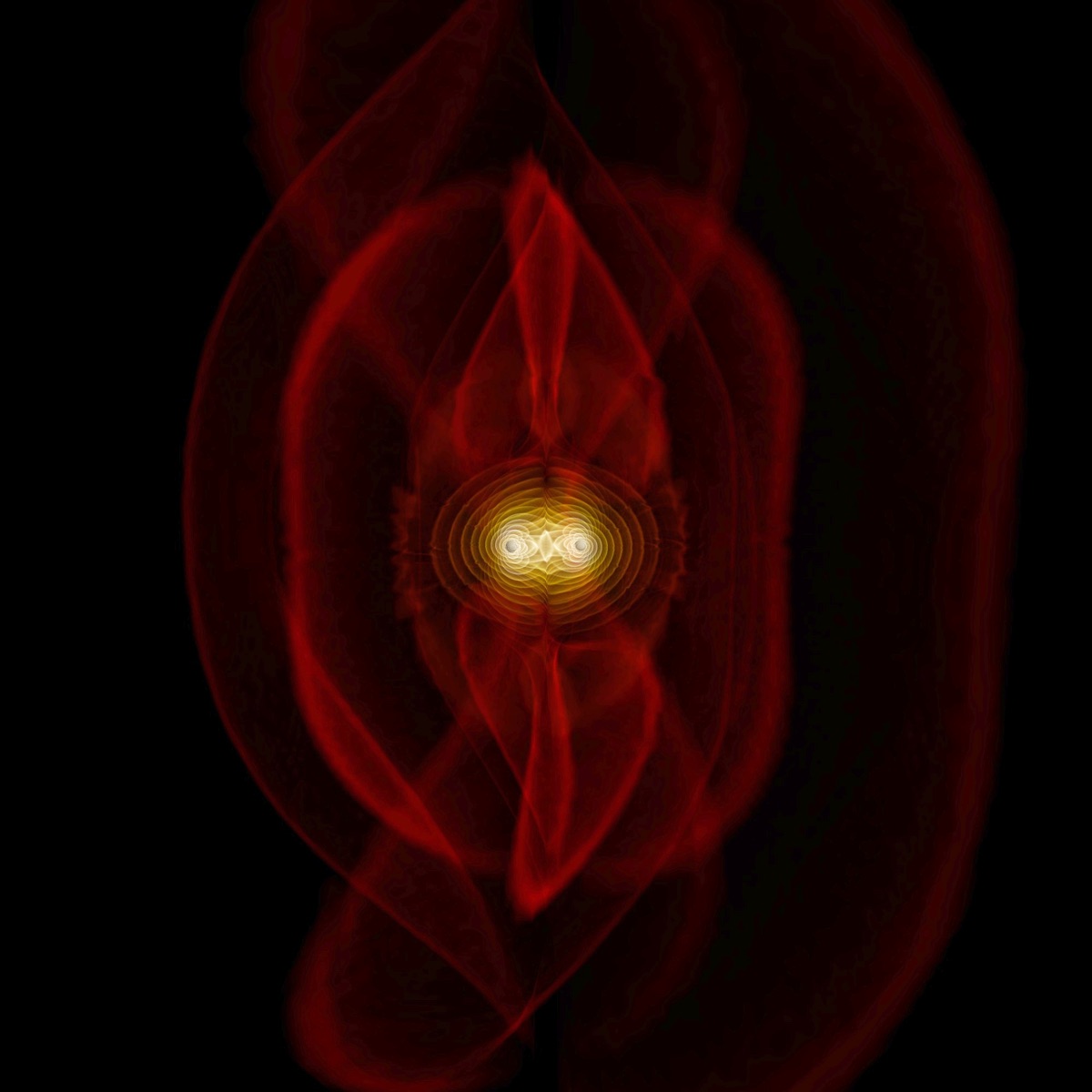
Ten years ago, hearing a single collision between two black holes was a once-in-a-lifetime, Nobel-Prize-winning event. On May 26, 2026, the international LIGO-Virgo-KAGRA collaboration published a catalog containing 161 of them at once - and quietly marked the moment gravitational-wave astronomy stopped being an experiment and became a science. The new release, called GWTC-5.0, is the largest catalog of cosmic collisions ever assembled, and buried inside it is a signal so clean it delivered the sharpest test of Einstein's general relativity yet performed and confirmed a 55-year-old prediction by Stephen Hawking.
Here is what was released, the record-breaking events inside it, and why physicists are calling this a coming-of-age.
- What: Gravitational-Wave Transient Catalog 5.0 - a catalog of black-hole and neutron-star collisions detected as ripples in spacetime
- Released: May 26, 2026, by the LIGO-Virgo-KAGRA (LVK) collaboration
- New events: 161, recorded between April 2024 and late January 2025 (the run's second half, O4b)
- Running total: 390 confirmed detections since the first, in September 2015
- Detectors: two LIGO instruments (USA), Virgo (Italy), and KAGRA (Japan)
- Headline signal: GW250114 - the clearest ever recorded; confirmed Hawking's black-hole area theorem and gave the most precise test of general relativity to date
1. From One Ripple to a Library of 390
A gravitational wave is a stretching and squeezing of spacetime itself, set off when two extraordinarily dense objects - black holes or neutron stars - spiral together and merge. The waves are almost unimaginably faint by the time they reach Earth: the detectors measure a change in length thousands of times smaller than a proton across their multi-kilometer arms.
The first-ever detection, GW150914, arrived in September 2015 and earned the 2017 Nobel Prize in Physics. What was once a singular triumph is now routine: during the current observing run the network catches roughly three to four events every week. GWTC-5.0 gathers the harvest from the second half of the fourth observing run (O4b) - 161 new events - and brings the all-time tally to 390. Nearly all are pairs of merging black holes.
2. GW250114: The Clearest Signal Ever Heard
One event towers over the rest. GW250114, detected on January 14, 2025, is the loudest, cleanest gravitational-wave signal ever recorded, with a signal-to-noise ratio of 76.9. It came from two black holes of almost identical mass merging about 1.3 billion light-years away.
| GW250114 | Value |
|---|---|
| Black-hole masses | ~34 and ~32 solar masses |
| Distance | ~1.3 billion light-years |
| Signal-to-noise ratio | 76.9 (clearest ever) |
| Detected | January 14, 2025 |
That clarity is not just a bragging right - it turned one collision into a physics laboratory. When two black holes merge, the newborn remnant vibrates and rings down like a struck bell, radiating gravitational waves at specific frequencies - its tones, or quasinormal modes. General relativity says those tones depend on nothing but the black hole's mass and spin (the famous no-hair theorem). For the first time, researchers cleanly measured and constrained multiple tones from a single black hole, and they matched Einstein's predictions - the most precise test of general relativity ever performed.
In 1971, Stephen Hawking proved a striking rule of classical general relativity: the total area of a black hole's event horizon can never decrease. When two black holes merge, the horizon of the final black hole must be at least as large as the two original horizons combined. It is the gravitational cousin of the second law of thermodynamics - entropy never decreases - and it later gave birth to the whole field of black-hole thermodynamics.
GW250114 was clean enough to measure the horizon areas before the merger (from the inspiral) and after it (from the ringdown) - and the final area was indeed larger than the sum of the two. Hawking's theorem, confirmed by listening to spacetime.
3. The Other Record-Setters
GW250114 headlines, but it has company:
- The best-pinpointed source yet. An event designated GW240615 (June 15, 2024) was localized to just about 6 square degrees of sky - the most accurately located gravitational-wave source on record - from black holes of roughly 26 and 30 solar masses more than 3 billion light-years away. Sharper localization is what makes it possible for optical telescopes to chase a source and catch any accompanying flash of light.
- Second-generation black holes. A handful of events (including GW241011, ~700 million light-years away, and GW241110, ~2.4 billion) carry spin signatures suggesting the black holes were themselves built from earlier mergers - hierarchical pile-ups in dense, crowded star clusters. It is direct evidence that black holes can grow by repeatedly eating their own kind.
4. What 390 Collisions Reveal About Black Holes
The real payoff of a big catalog is statistics. With hundreds of mergers in hand, scientists can study black holes as a population rather than one-off curiosities. A companion analysis of 267 confident sources (104 of them new to this release) found that black holes in different mass ranges tend to spin differently - a fingerprint that they form through more than one channel: some from the collapse of massive stars, others assembled through the hierarchical mergers seen above.
“We have found evidence for the existence of second-generation black holes, have pinpointed the sky position of a gravitational-wave source more precisely than ever before, and have for the first time measured or constrained three gravitational-wave tones from a black hole in the clearest gravitational-wave signal observed to date.”
- Alessandra Buonanno, Director, Max Planck Institute for Gravitational Physics (LVK collaboration)
5. Why Scientists Are Calling It a Coming-of-Age
The story of GWTC-5.0 is not any single discovery - it is the sheer abundance. A phenomenon that took a century to detect after Einstein predicted it, and a global effort to observe even once, is now cataloged by the hundred. That shift - from headline event to steady census - is what turns a technique into an observatory, and an observatory into a new way of seeing the universe.
“We are now detecting so many of these signals that we are not just learning about collisions - it is the astronomical equivalent of uncovering an ancient civilisation.”
- Dr. Daniel Williams, Institute for Gravitational Research, University of Glasgow
What We Still Do not Know
- They are fingerprints, not photographs. Gravitational waves reveal masses, spins and distances with exquisite precision, but no telescope can image the merging black holes themselves - the picture is reconstructed from the wave.
- The network is still growing. KAGRA in Japan is continuing to ramp toward full sensitivity; as all detectors improve, both the detection rate and the sky-localization will keep getting better.
- The population is still filling in. Rare cases - very light or very heavy black holes, and neutron-star mergers with a visible counterpart - remain precious, and each new one can reshape the statistics.
Sources
- LIGO Laboratory / Caltech: GWTC-5.0 - Updated LIGO-Virgo-KAGRA catalog sets new records in precision gravitational-wave astronomy
- Max Planck Society: The new LIGO-Virgo-KAGRA catalog sets records in precision gravitational-wave astronomy
- Caltech: Gravitational-wave observatories release new catalog of detections - ScienceDaily: 390 gravitational-wave detections reveal a hidden population of black holes
Curated by Jerry Cards - jerrycards.com. We research the week's most consequential tech, science, and business news so you do not have to. More at jerrycards.com/news.