
 العربية
 Español
 中文
中文 Deutsch
 Français
 Português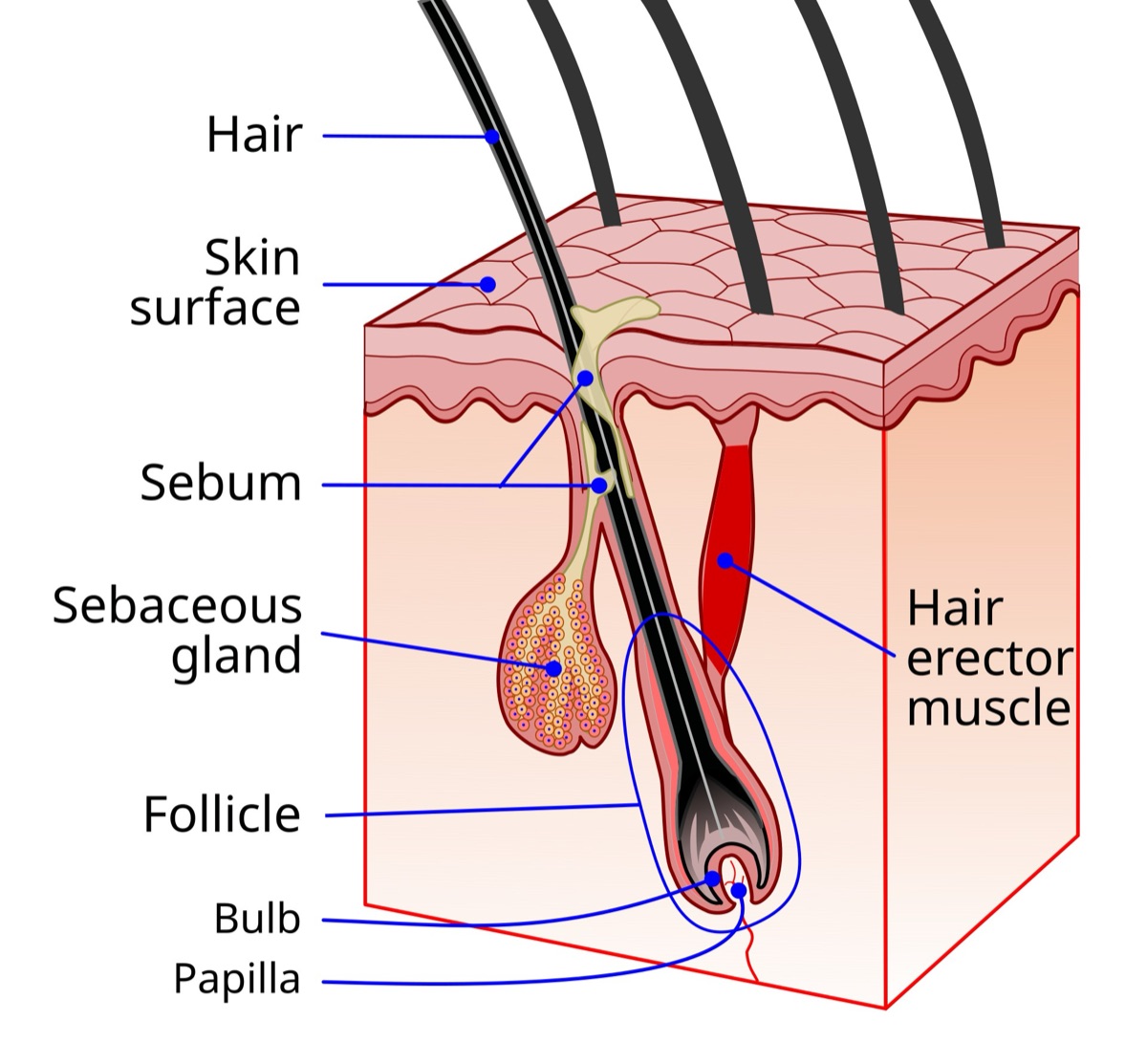
Ask a biologist how your hair grows and, until very recently, the answer was almost comforting in its simplicity: deep in the follicle, cells divide furiously at the root and shove the strand upward, a little like toothpaste squeezed from a tube. It is the picture in the textbooks, the one taught for more than a hundred years. A study published in Nature Communications now argues that it is, in a fundamental way, backwards. Hair is not pushed out of your head. It is pulled.
The distinction sounds like a technicality. It is not. It changes how we picture one of the most familiar processes in the human body - and, the researchers argue, where we should look for the next generation of treatments for hair loss.
- The claim: human hair grows by being actively pulled upward, not pushed from the root.
- The engine: cells in the outer root sheath move in a coordinated downward spiral, generating a mechanical force that draws the hair shaft up - like a tiny living motor.
- Key proof 1: block cell division and the hair keeps growing at nearly the same rate.
- Key proof 2: disrupt actin (the protein that lets cells move) and growth drops by more than 80%.
- How they saw it: 3D live-imaging of living human hair follicles kept alive in culture, tracked cell by cell.
- Who / where: L'Oreal Research & Innovation + Queen Mary University of London, Nature Communications (DOI 10.1038/s41467-025-65143-x).
1. The 100-year-old picture
At the base of every hair follicle sits the hair bulb, wrapped around a small cluster of cells called the dermal papilla. The matrix cells around that papilla are some of the fastest-dividing cells in the human body. The classic explanation followed intuitively: those cells divide, harden into the hair shaft, and the sheer volume of new cells from below pushes the finished strand up and out through the skin. Growth, in this view, is a consequence of proliferation - more cells at the bottom means more length at the top.
It is a clean story, and it has been the standard account for generations. The problem was that nobody had ever actually watched it happen. Follicle biology has long relied on fixed, sliced, stained snapshots - frozen moments, not motion. And a snapshot cannot tell you which cells are pushing, which are being carried along, and which are doing something else entirely.
2. What happens when you actually press play
The team - a collaboration between L'Oreal Research & Innovation and Queen Mary University of London - did something deceptively hard. They kept whole human hair follicles alive ex vivo (outside the body, in culture) and used 3D live-imaging to film individual cells moving in real time as the hair grew.
The choreography they recorded did not match the textbook. Instead of a simple upward shove from the dividing root, the cells of the outer root sheath - the outer layer of tissue that wraps around the growing hair shaft - were moving in a coordinated downward spiral. That collective, corkscrewing motion generates a mechanical pulling force in exactly the region from which the hair is drawn upward. The shaft is not being pushed from below; it is being reeled up from the sides.
“Our results reveal a fascinating choreography inside the hair follicle,” said Dr Ines Sequeira of Queen Mary University of London, describing how the strand is “actively being pulled upwards by surrounding tissue acting almost like a tiny motor.”
3. Two experiments that flipped the textbook
A surprising film is not proof. To test whether the pulling was really driving growth - rather than just accompanying it - the researchers ran two decisive interventions.
| What they did | Old ‘push’ model predicts | What actually happened |
|---|---|---|
| Blocked cell division at the root | Growth should stop - no new cells, no push | Hair kept growing at nearly the same rate |
| Disrupted actin (cell-movement protein) | Little effect - division is what matters | Growth fell by more than 80% |
The pairing is the whole argument. If growth were driven by cells dividing and pushing, halting division should have stopped the hair. It did not. But actin - the cytoskeletal protein that lets cells contract, crawl and generate force - turned out to be essential: switch it off and the pulling engine stalls, taking more than four-fifths of the growth with it. Finally, computer simulations of the moving cells reproduced the real-world growth speed, confirming that the coordinated motion generates enough force to do the job on its own.
“This reveals that hair growth is not driven only by cell division,” explained Dr Thomas Bornschlogl of L'Oreal's Advanced Research team. “Instead, the outer root sheath actively pulls the hair upward.”
4. Why a hair-biology footnote could matter for baldness
Here is the practical stakes. For decades, most hair-loss research has aimed at the biochemistry of the root - the hormones, signalling molecules and stem cells that switch a follicle between growing and resting. This work adds an entirely different lever: the follicle is also a piece of machinery, and its mechanics - how cells physically move and pull - directly set how fast a hair grows.
That opens targets no one was aiming at. A drug that supports the follicle's pulling mechanism, or a tissue-engineered follicle built to move correctly, becomes a plausible avenue. As Dr Bornschlogl put it, understanding the mechanics “opens fresh opportunities for studying hair disorders, testing drugs, and advancing tissue engineering.” Because the follicles were studied alive and human, they also make a better testbed for screening future treatments than fixed tissue ever could.
Honest caveats
- This is mechanism, not a therapy. No new hair-loss treatment exists because of it - the value is a new map of where to look.
- The follicles were studied ex vivo, in culture. Living scalp is more complex, and the findings will need confirmation in that fuller context.
- The old picture is not entirely wrong: cell division still builds the hair shaft. The shift is about what moves it - pulling, not pushing, appears to dominate.
What makes the result quietly delightful is how ordinary its subject is. Hair is about as everyday as human biology gets, something we cut and comb and take completely for granted - and it turns out we had the basic physics of it inside-out. It is a small, human reminder that watching living things in motion, rather than freezing them for a photograph, is still one of the most powerful things science can do.
Sources
- Tissot, N., Bornschlogl, T., Sequeira, I., et al. “Mapping cell dynamics in human ex vivo hair follicles suggests pulling mechanism of hair growth,” Nature Communications (DOI 10.1038/s41467-025-65143-x; PubMed 41271712).
- ScienceDaily: Textbooks were wrong - scientists reveal how human hair really grows · SciTechDaily coverage
- Phys.org: Human hair grows through pulling not pushing · Newsweek: a discovery that challenges decades of textbook biology
Curated by Jerry Cards - jerrycards.com. We research the week's most fascinating tech, science, and health stories so you don't have to. More at jerrycards.com/news.