
 العربية
 Español
 中文
中文 Deutsch
 Français
 Português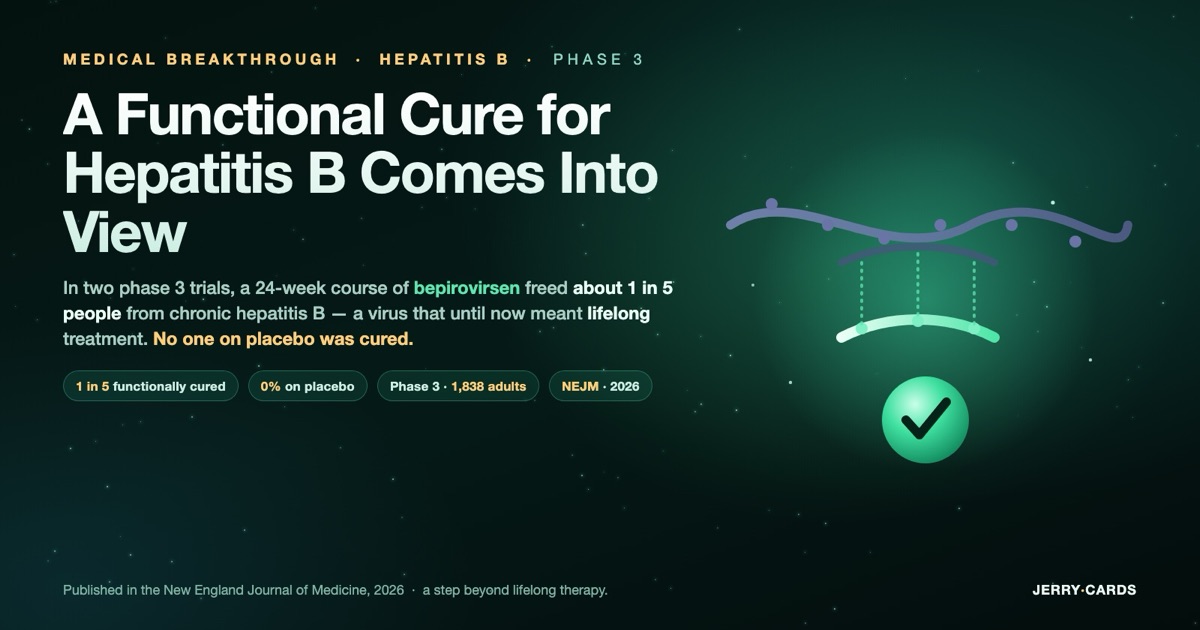
For the first time, a finite course of treatment has freed a meaningful share of people from chronic hepatitis B — a virus that, until now, has almost always meant taking medication for life. In two large phase 3 trials published in the New England Journal of Medicine, GSK’s investigational drug bepirovirsen produced a functional cure in about one in five patients after just a 24-week course — while not a single person who received placebo was cured. For a disease that infects an estimated 254 million people worldwide, that is a genuine turning point in what medicine can offer.
Here is exactly what happened in the trials, what a ‘functional cure’ really means, how the drug works, and the honest caveats that come with an experimental therapy still awaiting approval.
- Drug: bepirovirsen (GSK; licensed from Ionis) — an antisense oligonucleotide given as weekly injections for 24 weeks
- Trials: B-Well 1 and B-Well 2 — 1,838 adults with non-cirrhotic chronic hepatitis B across 29 countries
- Functional cure: ~1 in 5 patients (19% overall; up to 26% in those with lower baseline virus) vs 0% on placebo
- Published: New England Journal of Medicine, May 28, 2026
- Status: under priority / breakthrough review by the FDA, EMA, Japan, and China; first decisions expected in 2026
1. What a ‘Functional Cure’ Actually Means
Chronic hepatitis B is caused by a virus (HBV) that hides inside liver cells. Today’s standard treatment — daily nucleos(t)ide analogue pills such as tenofovir or entecavir — is very good at suppressing the virus, but it rarely clears it. Stop the pills and the virus usually rebounds, so most patients stay on therapy for the rest of their lives.
A functional cure is the loss of the hepatitis B surface antigen (HBsAg — a protein the virus sheds into the blood) together with undetectable viral DNA, sustained after all treatment has stopped. In these trials it was defined strictly: HBsAg not detected (below 0.05 IU/mL) and HBV DNA below the limit of quantification (below 20 IU/mL), measured 24 weeks after the patient had come off every hepatitis B medicine. It is not the same as eradicating the virus entirely, but it means the immune system is holding HBV in check on its own — the closest thing to a cure the field has, and the goal set by the World Health Organization.
2. The Trials and the Numbers
B-Well 1 and B-Well 2 were double-blind, randomized, placebo-controlled phase 3 trials that together enrolled 1,838 adults with non-cirrhotic chronic hepatitis B across 29 countries, recruited between December 2022 and May 2025. Participants already on stable antiviral therapy were randomized to add bepirovirsen 300 mg by weekly subcutaneous injection for 24 weeks or placebo; their background pills were then continued to week 48 and eligible patients stopped all treatment, with the functional-cure endpoint judged at week 72 — a full 24 weeks off every medication.
| Trial | Bepirovirsen | Placebo |
|---|---|---|
| B-Well 1 | 127 of 650 (20%) | 0 of 328 (0%) |
| B-Well 2 | 106 of 570 (19%) | 0 of 286 (0%) |
The overall functional-cure rate was 19%, rising to 26% among patients who began treatment with lower levels of surface antigen (HBsAg at or below 1,000 IU/mL) — 25% in B-Well 1 and 28% in B-Well 2. Even beyond the strict cure endpoint, about 49% of treated patients had driven their surface antigen down to very low levels (at or below 100 IU/mL) a year after treatment. The single most striking figure is the comparison: across both trials and every subgroup, the placebo cure rate was zero. The benefit is unambiguously the drug’s.
3. How Bepirovirsen Works
Bepirovirsen is an antisense oligonucleotide — a short, lab-made strand of genetic material designed to be the mirror image of a specific piece of the virus’s messenger RNA. When it finds its match, it binds and flags that RNA for destruction, so the cell stops manufacturing viral proteins, including the HBsAg that pours into the blood and keeps the immune system worn down.
Lowering that antigen load appears to do two things at once: it starves the virus of the proteins it needs, and it lifts the brake on an immune response that chronic infection had exhausted, letting the body’s own defenses re-engage. That is why a finite, 24-week course can produce a durable result that outlasts the drug — the aim is to hand control back to the immune system rather than to keep suppressing the virus forever. It is the same class of ‘gene-silencing’ medicine now being used against a growing list of previously hard-to-treat diseases.
4. Why This Is a Big Deal
The World Health Organization estimates that about 254 million people are living with chronic hepatitis B, and it remains one of the most common chronic infections on Earth — the reason a true cure has been a decades-long goal for researchers. Because current pills control the virus without clearing it, treatment is typically lifelong, with all the cost, monitoring, and adherence that implies.
A therapy that lets even one in five patients stop treatment entirely — with a clean 0% in the placebo arm to prove the effect is real — changes the conversation from ‘manage it forever’ to ‘a defined course, then freedom’ for a meaningful group of people. And because the effect is strongest in patients with lower starting virus levels, it points to a clear strategy: identify who is most likely to respond, and treat them toward a cure.
5. Safety, Honestly
Bepirovirsen is an active drug, and side effects were more common than with placebo. Most were injection-site reactions and transient rises in liver enzymes (ALT) — and notably, some of those enzyme rises are thought to reflect the very immune response that drives the cure, as the body clears infected cells. Serious (grade 3 or higher) events occurred in about 16% of treated patients versus 3% on placebo, the most common being an ALT increase (about 6%), and roughly 3% of patients stopped treatment because of side effects. These are real considerations, but they are the kind of manageable, mostly self-limited effects clinicians weigh against the prospect of ending lifelong therapy.
6. What Happens Next
Bepirovirsen is not yet approved, but it is moving quickly. It has been granted expedited review status by multiple regulators — Breakthrough Therapy, Fast Track, and Priority Review from the US FDA, review by the European Medicines Agency, SENKU designation in Japan, and Breakthrough Therapy plus Priority Review in China. GSK has said the first regulatory decisions are anticipated in 2026, with launch preparations already under way. As University of Michigan hepatologist Anna Lok summarized, the B-Well trials are “a major step toward a functional cure for HBV infection, and bepirovirsen is an attractive option for selected patients.”
What We Still Do Not Know
- The other four in five. About 80% of treated patients did not reach a functional cure; work continues on combinations and on predicting who will respond.
- Durability. The endpoint was measured 24 weeks after stopping treatment; longer follow-up will show how many cures hold for years.
- Broader populations. The trials studied non-cirrhotic adults, so results in patients with cirrhosis or other profiles remain to be established.
- Real-world access. Approval timing, pricing, and which patients are treated first will shape how much of the promise reaches people.
Sources
- New England Journal of Medicine: Phase 3 Results of Bepirovirsen Treatment for Chronic Hepatitis B Virus Infection (DOI 10.1056/NEJMoa2515131)
- GSK: Bepirovirsen achieves unprecedented functional cure rates in chronic hepatitis B
- CIDRAP (University of Minnesota): Phase 3 trials show functional cure in 20% of chronic hepatitis B patients · Science: New drug functionally cures many hepatitis B infections
- World Health Organization: Hepatitis B fact sheet
Curated by Jerry Cards - jerrycards.com. We research the week’s most consequential science, health, and technology news so you don’t have to. More at jerrycards.com/news.