
 العربية
 Español
 中文
中文 Deutsch
 Français
 Português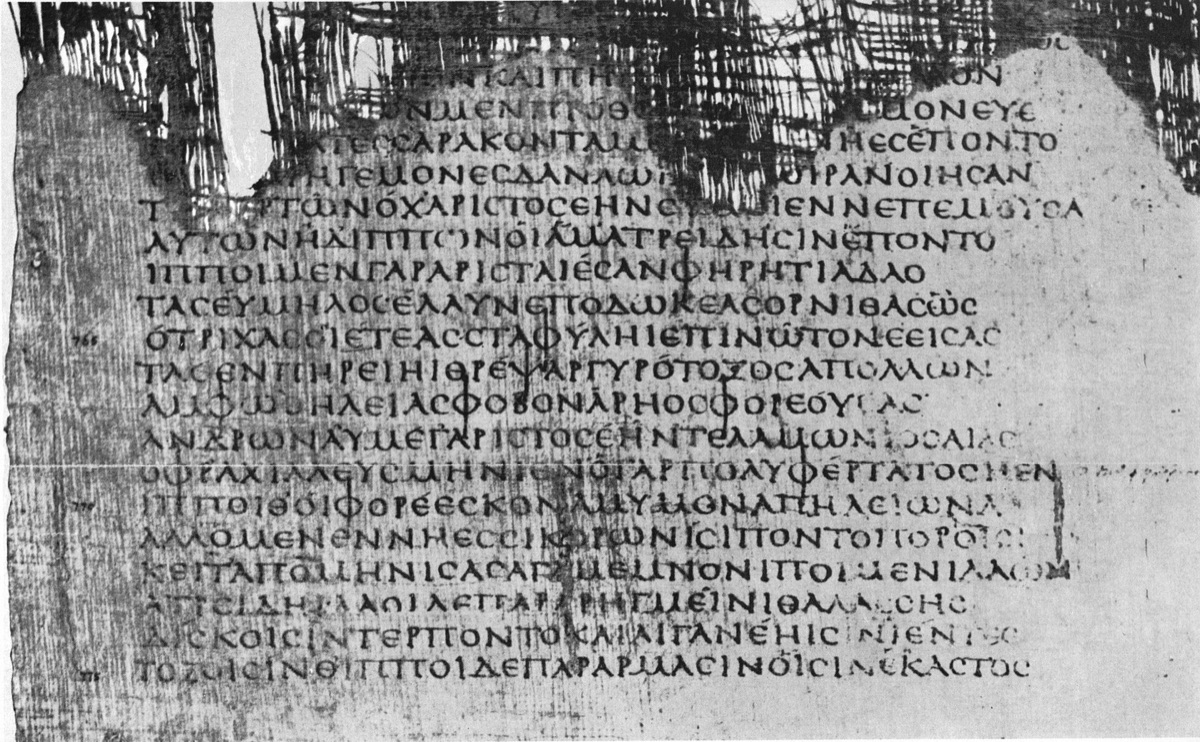
Roughly 1,600 years ago, in a town on the edge of the Egyptian desert, someone was being prepared for eternity - and whoever did the preparing decided that Homer belonged in the ritual. Archaeologists from the University of Barcelona have found a fragment of the Iliad tucked against the abdomen of a Roman-era mummy, placed there deliberately as part of the embalming. Nothing like it has been recorded before.
The poem was already about a thousand years old when it was folded into those wrappings. It is still in print today. That is the real story here: a piece of literature that has outlived the civilisation that buried it, found in the one place nobody thought to look.
- What: a Greek papyrus fragment carrying the Catalogue of Ships from Book II of the Iliad
- Where: Tomb 65, Sector 22, at Al Bahnasa - ancient Oxyrhynchus, about 160 km south-southwest of Cairo
- Position: on the mummy’s abdomen, placed as part of the embalming ritual
- Age: Roman era, roughly 1,600 years old
- Who: the Oxyrhynchus Archaeological Mission, University of Barcelona (IPOA)
- Why it is a first: the first known case of a Greek literary text deliberately incorporated into a mummification
1. What They Found, and When
The Oxyrhynchus Archaeological Mission has been digging at Al Bahnasa for decades under the University of Barcelona’s Institute of the Ancient Near East (IPOA), directed by Maite Mascort and Esther Pons. During the campaign of November to December 2025, a team led by Núria Castellano opened Tomb 65 in Sector 22 and found a Roman-era mummy with something unusual resting on its abdomen: a papyrus.
Papyrus in a burial is not itself surprising at this site. What the papyrus said was. Over January and February 2026, conservator Margalida Munar stabilised the fragile sheet, and papyrologist Leah Mascia worked with Ignasi-Xavier Adiego - professor of classical philology at the University of Barcelona and director of the Oxyrhynchus project - to read it. The Greek text turned out to come from the Catalogue of Ships in Book II of the Iliad, naming Greek commanders who sailed for Troy, among them Guneus and Tlepolemus.
2. Why This One Is Different
Earlier campaigns at Oxyrhynchus had already turned up Greek papyri positioned on mummies in much the same way. Every one of them was magical or ritual in content - the sort of text you would expect in a funeral: spells, invocations, protective formulas. Words with a job to do.
As Adiego put it, this is not the first time the mission has found Greek papyri used in mummification, “but until now, their content was mainly magical.” A work of literature had never been found playing that role. Somebody reached for a poem instead of a spell.
| A grave good | Part of the ritual | |
|---|---|---|
| What it is | An object buried alongside the dead | An element built into the embalming itself |
| Example | The Hawara Homer - a roll of Iliad II found under a woman’s head (1888) | This fragment, laid on the abdomen during preparation |
| Implies | The book mattered to someone | The text was given ritual work to do |
The distinction is the whole point. A beloved book buried with its owner is touching but well attested. A literary text folded into the mechanics of mummification suggests something else: that Homer had accumulated a kind of power - that the Iliad was not only read but used.
3. The Passage Itself
Of all the pieces of the Iliad to find, the Catalogue of Ships is a wonderfully strange one. It sits in Book II, lines 494 to 759, and it is essentially a list: twenty-nine contingents under forty-six captains, 1,186 ships, each with its home town named. Generations of readers have found it the least thrilling stretch of the poem. Generations of scholars have found it the most valuable - a fossilised map of the Greek world, preserving place names that had faded from use by the time the poem was written down.
It was taken seriously as a record, too. Centuries later the Athenians cited lines from the Catalogue as evidence in a territorial dispute over Salamis. It was a list people trusted.
- Tlepolemus (Iliad 2.653) - son of Heracles, leading nine ships from Rhodes
- Guneus (Iliad 2.748) - leading twenty-two ships of the Enienes and Peraebi
4. The Town That Kept Everything
That this survived at all is down to where it was dropped. Oxyrhynchus - Greek for sharp-nosed, after the fish worshipped there - sits west of the Nile on a branch called the Bahr Yussef. Its rubbish mounds, its dry soil and its climate combined into an accident of preservation with no real equal: paper that would have rotted anywhere else simply sat there.
When Bernard Grenfell and Arthur Hunt began systematic excavation in 1896, the scale caught them off guard. Grenfell wrote that merely turning up the soil with one’s boot would frequently disclose a layer of papyri. What came out of those mounds - tax returns, private letters, shopping lists, lost plays, early Christian texts - has been published across more than eighty volumes and is still being worked through today. Much of what we know about ordinary life under Roman rule in Egypt comes from a town’s discarded paperwork.
5. The Tomb
Tomb 65 is part of a funerary complex of three limestone chambers holding Roman-era burials and decorated wooden sarcophagi. The mission has recorded mummies there finished with gold leaf and geometric patterns, and fitted with golden and copper tongues - a practice meant to let the dead speak in the afterlife. It is a wealthy, cosmopolitan, thoroughly Greco-Egyptian setting, which makes a Greek poem in the wrappings feel less like an anomaly and more like a clue.
6. What We Do Not Know Yet
Worth being straight about the limits, because they are real:
- This is a field announcement, not a published edition. The find was announced by the University of Barcelona; the detailed scholarly publication of the papyrus - the part where other papyrologists get to check the reading - is still ahead.
- The dating is approximate. Reports give the mummy as Roman era and roughly 1,600 years old. No precise century has been published for the papyrus itself.
- The papyrus may be older than the burial. Reused sheets were common in Roman Egypt. A fragment can arrive in a tomb by a long and unglamorous route.
- We do not know whose choice this was. Whether the person in the wrappings loved Homer, or whether the embalmers made the selection, is not something the evidence can currently tell us.
None of that dents the core claim, which is narrow and well-defined: at this site, in this position, a literary text had never been documented before.
7. Why It Lands
The Iliad was composed somewhere around the eighth century BC and carried orally before anyone wrote it down. By the time this mummy was wrapped, the poem was already ancient - roughly as distant from that embalmer as that embalmer is from us. It had crossed a sea, changed language communities, survived the collapse of the world that produced it, and was apparently still potent enough to be worth including in the most serious ritual a person undergoes.
Sixteen centuries later, a conservator in Barcelona unrolled it and could still read the names of the ships.
We spend a lot of time asking which of our own things will last. Here is one data point: the durable thing was not the gold leaf, and it was not the tomb. It was the poem.
Sources
- University of Barcelona: The UB archaeological mission at Oxyrhynchus finds Homer’s Iliad in a Roman-era mummy
- ScienceDaily / University of Barcelona: Archaeologists found Homer’s Iliad inside a 1,600-year-old Egyptian mummy
- Smithsonian Magazine: Archaeologists Unearth a Papyrus Fragment From the Iliad Tucked Inside the Wrappings of a 1,600-Year-Old Egyptian Mummy
- SciTechDaily: First-of-Its-Kind Discovery - Homer’s Iliad Found Embedded in a 1,600-Year-Old Egyptian Mummy
- Gizmodo: Homer’s Iliad Found Stuffed Into Egyptian Mummy’s Wrappings
- CNN: Egyptian mummy unearthed with literary text on abdomen in first ever find
Photo: the Hawara Homer - a second-century AD papyrus of the Iliad, Book II, lines 757-775 (Bodleian Library, Papyrus Hawara 24-28), found by Flinders Petrie in 1888 rolled beneath the head of a mummified woman at Hawara. Public domain, via Wikimedia Commons. It is a representative example of an ancient Iliad papyrus from an Egyptian burial, not the Oxyrhynchus fragment described in this article.
Curated by Jerry Cards - jerrycards.com. We research the week’s most consequential tech, science, and business news so you don’t have to. More at jerrycards.com/news.