
 العربية
 Español
 中文
中文 Deutsch
 Français
 Português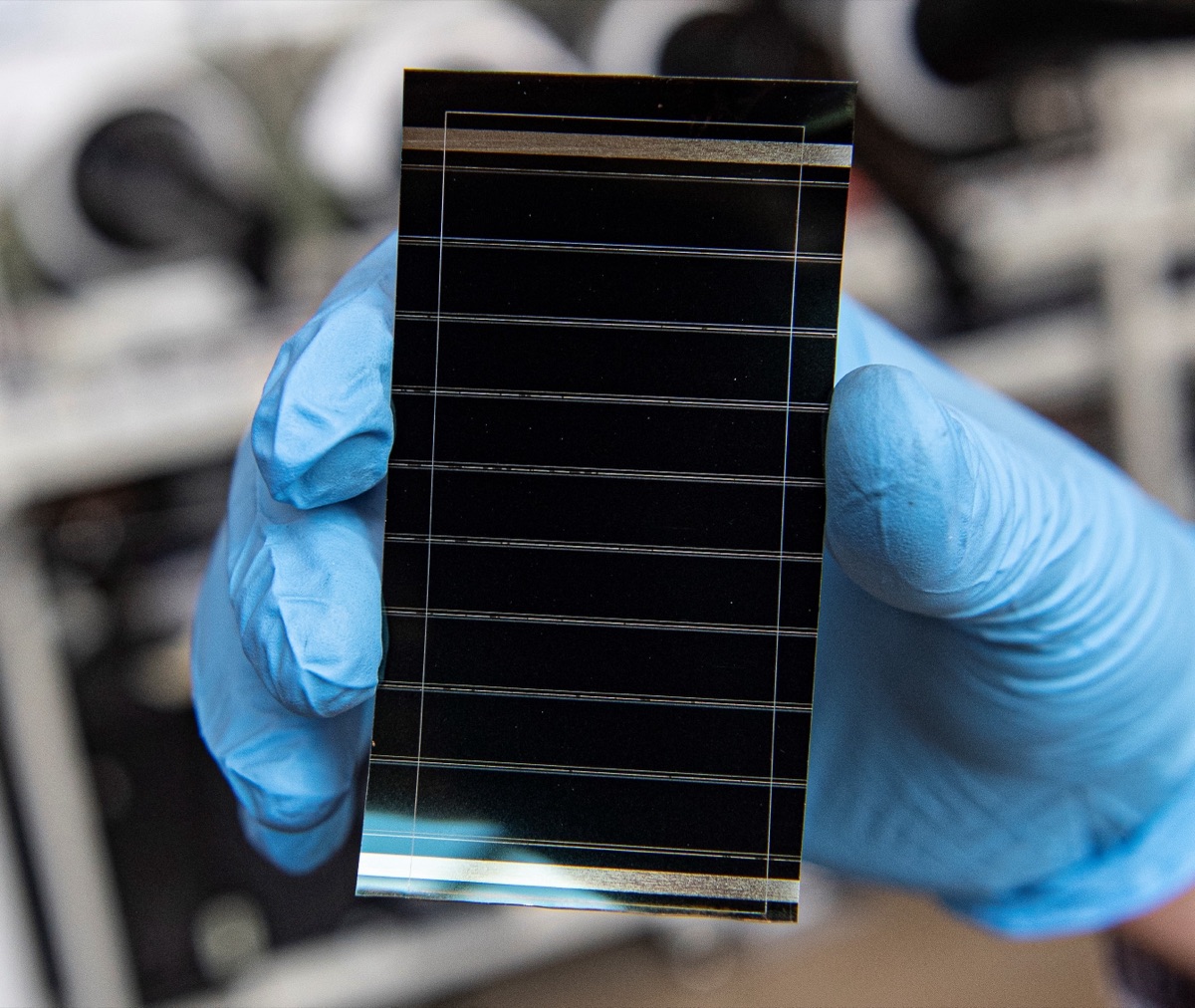
A solar cell just converted 34.82% of the sunlight striking it into usable electricity - a new certified world record. That number alone is a milestone. But the part worth paying attention to isn't the decimal point; it's where the record was set. For the first time, this class of efficiency was reached on the exact manufacturing platform that already builds most of the world's solar panels - which is the difference between a beautiful lab result and a path to cheaper power on real rooftops.
Here is what JinkoSolar actually achieved, how a stacked “tandem” cell breaks a physical limit that has boxed in silicon for decades, and the honest caveats that keep this exciting rather than overhyped.
- Result: 34.82% certified power-conversion efficiency for a perovskite-on-silicon tandem solar cell
- Who: JinkoSolar - one of the world's largest solar manufacturers
- Certified by: the Chinese Academy of Sciences' Shanghai Institute of Microsystem and Information Technology (SIMIT)
- The platform: built on N-type TOPCon, the cell architecture that now dominates mass production
- Progress: up from JinkoSolar's own previous mark of 34.76%; the company calls it its 33rd efficiency world record
- Announced: June 2026
1. Why a single layer of silicon can only go so far
Almost every solar panel in the world is made of silicon, and silicon is extraordinarily good - but it has a built-in limit. A solar cell can only turn sunlight into electricity efficiently within a narrow energy window set by the material's “bandgap.” Light that is too low-energy passes straight through; light that is too high-energy is absorbed but wastes most of its extra energy as heat.
For a single silicon junction, physics caps the achievable efficiency at roughly 29%. In practice, the very best silicon lab cells reach about 27%, and the panels sold commercially sit lower still. After decades of refinement, silicon is simply running out of room - each new gain is now measured in tenths of a percent.
2. The trick: stack two cells, catch two slices of sunlight
A tandem cell sidesteps silicon's ceiling by stacking a second, different solar material on top of it. The top layer here is a perovskite - a class of crystals that can be tuned to absorb the high-energy blue and green light that silicon converts poorly. The silicon underneath keeps doing what it does best: harvesting red and infrared light.
Two layers split the rainbow between them - perovskite takes the blue end, silicon takes the red end - so the pair captures far more of the sun's energy than either material could alone, vaulting past the limit that caps any single layer.
That is why tandems are the most credible route to dramatically higher solar efficiency, and why nearly every major manufacturer and lab is now racing on them.
3. The real headline: it was built on TOPCon
Plenty of record cells look spectacular on a chart and then go nowhere, because they rely on delicate, expensive structures that can't be made cheaply at scale. JinkoSolar's result is different in a way that matters enormously: it was built on N-type TOPCon.
TOPCon (tunnel-oxide passivated contact) is not exotic - it is the opposite. Over the past couple of years it has become the workhorse of the solar industry, the cell design most new gigawatt-scale factory lines are already built around. Reaching a 34.82% tandem record on a TOPCon foundation means the efficiency gains land on manufacturing infrastructure that already exists in enormous volume, rather than requiring the industry to retool around something new. That is what turns a research number into a plausible product roadmap.
JinkoSolar credited the gain to a stack of engineering refinements rather than a single trick: a dual-layer composite passivation contact structure for the N-type TOPCon cell, multidimensional interface passivation, gradient crystallization control of the perovskite layer, and improved optical coupling and light management between the two layers.
4. Where the 34-35% race stands
This is a contest now measured in hundredths of a percentage point, which is itself a sign of how mature the technology has become.
| Milestone | Efficiency |
|---|---|
| Best single-junction silicon (lab) | ~27% |
| JinkoSolar perovskite/TOPCon tandem (earlier) | 34.76% |
| JinkoSolar perovskite/TOPCon tandem (new) | 34.82% |
| All-comers perovskite-silicon tandem record (LONGi, 2025) | ~34.85% |
The top all-comers tandem mark belongs to LONGi at about 34.85% (set in 2025). JinkoSolar's 34.82% sits a hair below it - but on the more directly manufacturable TOPCon platform, which is arguably the more commercially meaningful place to land.
The honest caveats
- These are lab cells, not panels. Record efficiencies are measured on small test cells under controlled conditions. The full-size modules you can actually buy remain several percentage points lower - though they tend to follow lab records upward over time.
- Durability is the open question. Perovskites are brilliant absorbers but historically less stable than silicon against heat, moisture, and time. Proving that tandem panels last 25-plus years in the field is the hurdle the whole industry is working on.
- Scaling is non-trivial. Coating a perovskite layer uniformly across a large wafer - and then a full module - is harder than doing it on a postage-stamp cell.
None of that dims the trajectory. Solar is already among the cheapest sources of new electricity ever built, and efficiency is the lever that keeps driving the cost down: more watts from the same panel, the same rooftop, the same acre of land. A record set on the industry's mainstream production platform is exactly the kind of step that, repeated, quietly makes clean power the obvious economic choice.
Sources
- pv magazine: JinkoSolar achieves 34.82% efficiency for perovskite-silicon tandem solar cell
- JinkoSolar: official efficiency announcement · Perovskite-Info: Jinko announces 34.82% perovskite/TOPCon record
- Background on the single-junction silicon limit and tandem cells: U.S. Department of Energy - Perovskite Solar Cells
- LONGi 2025 tandem record context: LONGi - silicon-perovskite tandem world efficiency
Curated by Jerry Cards - jerrycards.com. We research the week's most consequential tech, science, and business news so you don't have to. More at jerrycards.com/news.