
 العربية
 Español
 中文
中文 Deutsch
 Français
 Português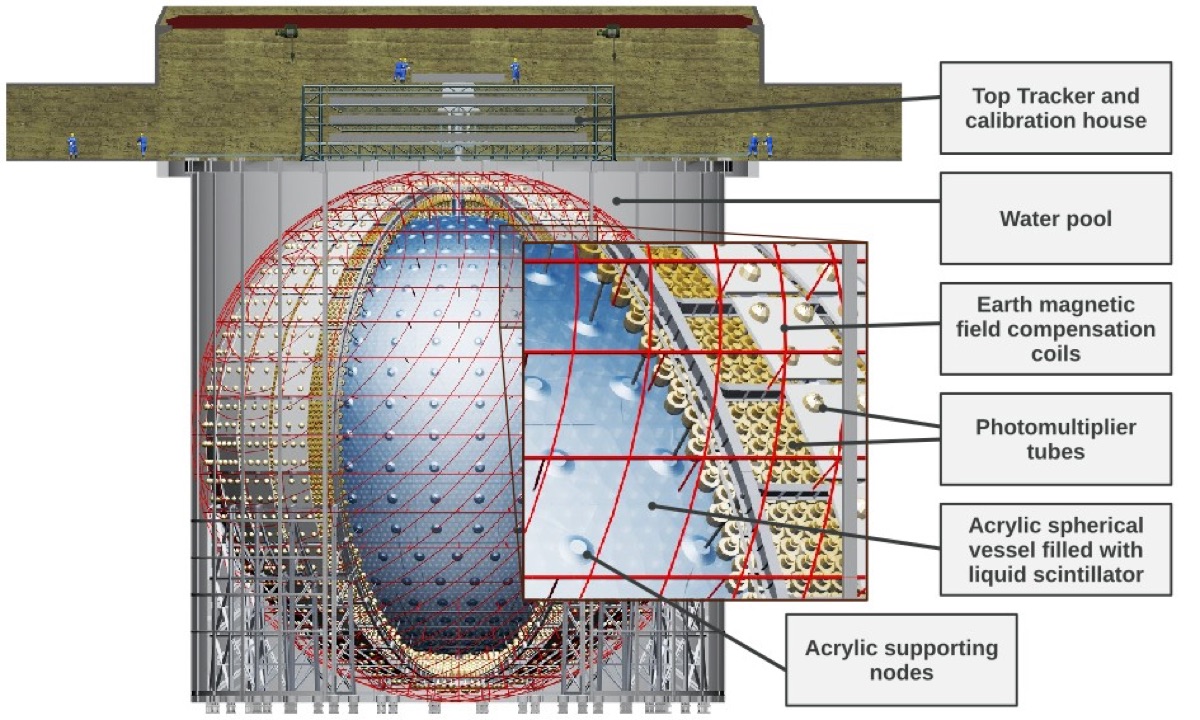
About 100 trillion neutrinos are passing through your body right now - and you will never feel a single one. These are the most abundant matter particles in the universe and among the least understood. This week, a giant transparent sphere buried under a hill in southern China took a major step toward changing that. On June 11, 2026, the Jiangmen Underground Neutrino Observatory - JUNO - published its first physics results in Nature, and they are already the most precise measurements of their kind ever made. The astonishing part: the team needed just 59 days of data to get there.
Here is what JUNO measured, how the machine works, and why physicists are so excited about what comes next.
- What: first physics results from JUNO, published in Nature on June 11, 2026 (vol. 654)
- The feat: the most precise measurement yet of two of the six numbers that govern neutrino oscillation
- From just 59 days of data (Aug 26 to Nov 2, 2025)
- Precision: uncertainty cut by a factor of about 1.6 - roughly a 60% improvement over every prior experiment combined
- The detector: a 20,000-tonne liquid sphere, 700 m underground, watched by ~45,000 light sensors
- The real prize: determining the neutrino mass ordering - expected within about six years
1. First, What Is a Neutrino - and What Did JUNO Measure?
Neutrinos are tiny, electrically neutral particles that pour out of the Sun, nuclear reactors, exploding stars, and the Big Bang itself. They are so antisocial that roughly 100 trillion pass through your body every second while almost none ever touch it. They also do something genuinely strange: as they travel, they oscillate, morphing between three flavors - electron, muon, and tau. Six numbers - three mixing angles, two mass-squared differences, and one phase - describe this quantum choreography.
JUNO watches antineutrinos produced by two nearby nuclear power plants about 52.5 km away, and measures how many seem to vanish (oscillate away) over that distance. From its first 59 days of running, it pinned down two of those six numbers - the so-called “solar” parameters - with the best accuracy ever achieved:
| Parameter | JUNO value | What it describes |
|---|---|---|
| sin² θ₁₂ (solar mixing angle) | 0.3092 ± 0.0087 | how strongly two of the neutrino states mix |
| Δm²₂₁ (solar mass splitting) | (7.50 ± 0.12) × 10⁻⁵ eV² | the tiny mass-squared gap between those two states |
These are not exotic abstractions - they are fundamental constants of nature, on the same footing as the mass of the electron. Measuring them more precisely sharpens the entire framework physicists use to describe matter.
2. Why “59 Days Beating Decades” Is the Real Headline
The numbers above came from less than two months of data. Yet they already cut the uncertainty by a factor of about 1.6 - about a 60% improvement - compared with the combined result of every previous reactor and solar neutrino experiment of the past few decades, including pioneers like KamLAND, Daya Bay, and Super-Kamiokande.
Two reasons. First, sheer size: with 20,000 tonnes of detector liquid, JUNO catches far more neutrino events per day than its predecessors. Second, exquisite design: it is built to resolve the faint, wavelike pattern that oscillation stamps onto the neutrino energy spectrum. With more years of data, JUNO is designed to measure three of the six oscillation parameters to better than 1% precision - a level no experiment has reached.
3. The Machine: A 20,000-Tonne Sphere Under 700 Meters of Rock
JUNO is, quite simply, the largest detector of its type ever built. At its heart is a 35.4-meter acrylic sphere - taller than a 12-story building - filled with ultra-pure liquid scintillator that flashes faint light when a neutrino interacts inside it. Capturing those flashes is a wall of nearly 45,000 light sensors.
| Spec | Detail |
|---|---|
| Detector liquid | 20,000 tonnes of liquid scintillator in a 35.4 m acrylic sphere |
| Light sensors | ~20,000 large (20-inch) + 25,600 small (3-inch) photomultiplier tubes |
| Depth | 700 m underground, Guangdong Province, China |
| Neutrino source | two nuclear power plants ~52.5 km away |
| First dataset | 59 days (Aug 26 to Nov 2, 2025); data taking began Aug 2025 |
The 700 meters of rock overhead act as a shield, filtering out the constant rain of cosmic rays that would otherwise drown the delicate neutrino signal. The whole apparatus is a study in patience: enormous, immaculately clean, and tuned to register the gentlest whisper in particle physics.
4. The Real Prize: The Neutrino Mass Ordering
Precise as these first numbers are, they are a warm-up. JUNO was built to answer a question that has stumped physicists for years: the neutrino mass ordering.
There are three neutrino mass states. Experiments have measured the gaps between them, but not their order: is the third state the heaviest of the trio (the “normal” ordering) or the lightest (the “inverted” ordering)? It sounds like bookkeeping, but the answer ripples through cosmology and into one of the deepest questions in science - why the universe is filled with matter rather than nothing at all.
By reading the subtle interference pattern in how reactor antineutrinos oscillate, JUNO is designed to resolve this at 3-sigma confidence within about six years of data taking. The first results released this week are the clearest sign yet that the detector is performing as designed and genuinely on track to get there.
5. A Global Effort
JUNO is a Chinese-led project hosted by the Institute of High Energy Physics, but it is profoundly international. The collaboration numbers roughly 750 scientists and engineers from about 74 institutions across 17 countries and regions, with major contributions from Europe, Asia, and the Americas. The facility cost more than $300 million and took the better part of a decade to design and build.
That scale is the point. Catching neutrinos - particles that almost refuse to be caught - takes instruments this big and teams this broad. The reward is a tool that will not just measure oscillation, but also watch neutrinos from the Sun, the Earth's interior, the atmosphere, and the next nearby supernova, should one light up the sky.
What We Still Don't Know
- The mass ordering itself - the headline question - is not yet answered; that is the multi-year campaign now underway.
- The absolute neutrino mass remains unknown; oscillation reveals differences between masses, not the masses themselves.
- Whether neutrinos and antineutrinos behave identically (the CP-violation question) is a deeper puzzle for future experiments.
- How the precision will sharpen as months of data become years - the sub-1% goal is the target, not yet the result.
For now, the takeaway is simple and genuinely uplifting: a vast, patient, international machine switched on, looked at the universe's most elusive particles, and in just 59 days saw them more clearly than anyone ever had.
Sources
- Nature: Measurement of reactor neutrino oscillation with the first JUNO data (vol. 654, issue 8118, 11 June 2026)
- ScienceDaily: Giant underground neutrino detector brings scientists closer to cracking the neutrino puzzle · Science (AAAS): First results put neutrino experiment in China on track for breakthrough
- Xinhua: China's JUNO team releases first physics result in Nature · INFN: JUNO debuts with extremely high precision
Detector cutaway diagram: JUNO Collaboration, via Wikimedia Commons, licensed CC BY 4.0.
Curated by Jerry Cards - jerrycards.com. We research the week's most consequential tech, science, and health news so you don't have to. More at jerrycards.com/news.