
 العربية
 Español
 中文
中文 Deutsch
 Français
 Português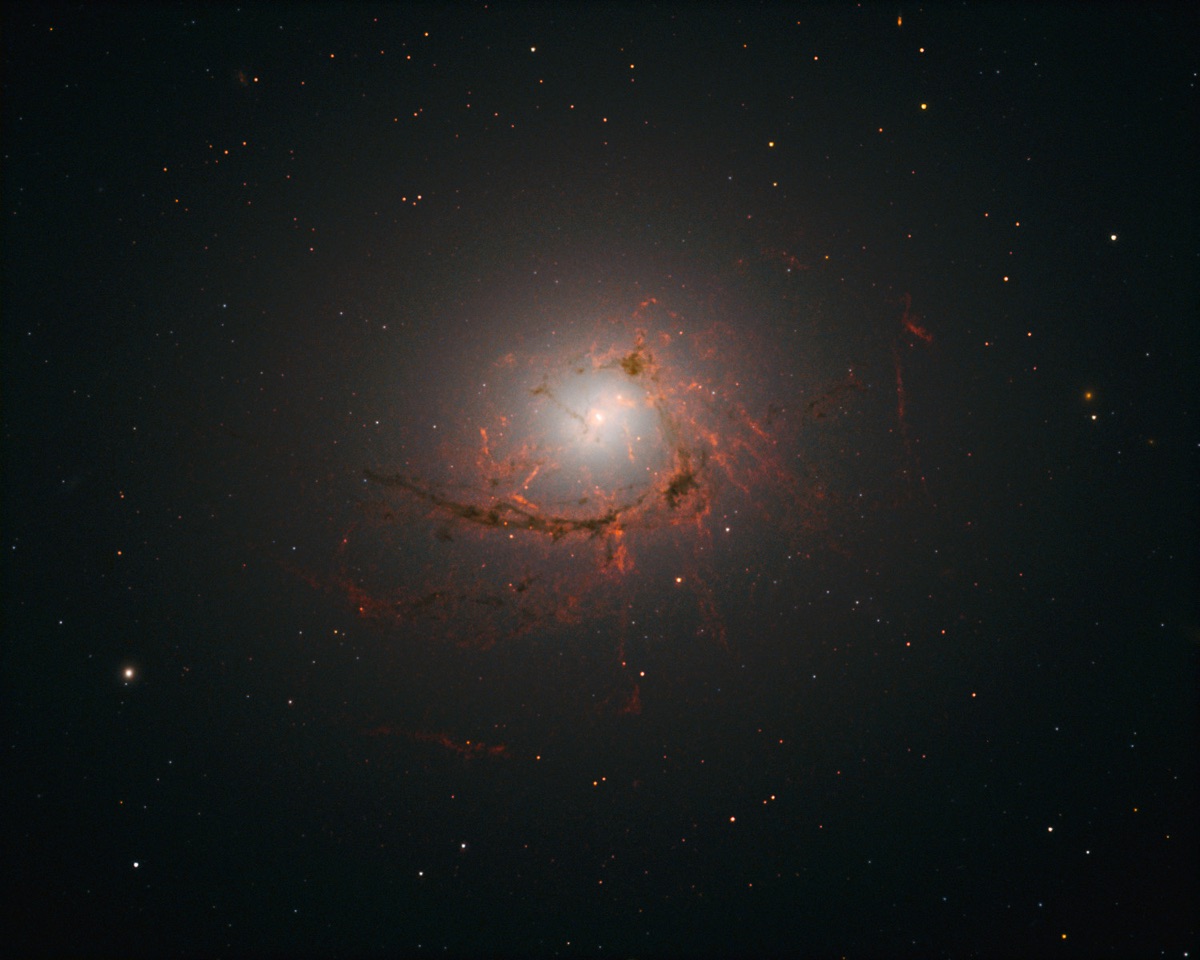
For the first time, astronomers have watched a supermassive black hole set its own dinner table. Using the James Webb Space Telescope, an international team has traced - in extraordinary detail - how gas travels from the vast, hot atmosphere of a galaxy cluster all the way down to the doorstep of the black hole at its center. The target was NGC 4696, the largest galaxy in the Centaurus Cluster, and what Webb revealed is not just a black hole eating, but a beautiful, self-regulating cosmic recycling loop that may finally explain how the universe's biggest black holes keep themselves fueled.
- Target: NGC 4696, the central galaxy of the Centaurus Cluster, about 145 million light-years away
- Telescope / instrument: JWST's NIRSpec near-infrared spectrograph, observing for nearly eight hours
- The disk: a spinning circumnuclear disk of gas ~800 light-years across, with gas racing at up to 600 km/s (about 1.3 million mph)
- The feed lines: filaments a few hundred light-years wide and thousands long, funneling cool gas inward from cluster scales
- Temperature range: six orders of magnitude, from ~100-million-degree X-ray plasma down to cold molecular gas
- Resolution: detail down to about 30 light-years across the galaxy's core
- The punchline: a self-regulating feed → heat → cool → feed cycle
1. A Giant at the Heart of the Centaurus Cluster
Most big galaxies host a supermassive black hole in their core, and NGC 4696 is no exception. It is the brightest and largest galaxy in the Centaurus Cluster - a dense swarm of galaxies roughly 145 million light-years from Earth - which makes it one of the best laboratories in the nearby universe for studying how a central black hole interacts with the gas around it. Long before Webb, the Hubble Space Telescope had photographed delicate, curling filaments of dust threading toward the galaxy's center (the image above), hinting that something was organizing the gas on its way in. What was missing was the motion: how fast that gas moves, what it is made of, and how it connects to the black hole itself.
2. What Webb Actually Saw
To capture the motion, the team - led by Julie Hlavacek-Larrondo of the Universite de Montreal, with collaborators including Megan Donahue and G. Mark Voit of Michigan State University - trained Webb's NIRSpec spectrograph on the galaxy's core for nearly eight hours. A spectrograph splits infrared light into its component wavelengths, letting astronomers read off how gas is moving, what elements it contains, and how conditions change from point to point. The result was the most detailed map yet of gas flowing into a black hole's neighborhood.
| Feature | Measurement |
|---|---|
| Distance to NGC 4696 | ~145 million light-years |
| Spinning circumnuclear disk | ~800 light-years across |
| Peak gas speed in the disk | up to 600 km/s (~1.3 million mph) |
| Feeding filaments | hundreds of light-years wide, thousands long |
| Temperature span | ~6 orders of magnitude (~10^8 K plasma to cold molecular gas) |
| Spatial resolution | ~30 light-years |
| Observation time | ~8 hours (JWST NIRSpec) |
It is a rotating disk of gas that surrounds the central region of a galaxy, well outside the tiny accretion disk that hugs the black hole itself. Think of it as a holding reservoir and on-ramp: gas gathers and spins here before losing energy and spiraling further inward to the black hole. Seeing an 800-light-year-wide disk this clearly - and measuring how fast it turns - lets astronomers connect the large-scale gas supply to the black hole's actual meal.
3. The Self-Refueling Cycle
The most striking result is not a single number but a story that the numbers tell together. Webb's map ties the pieces into a loop that regulates itself:
- Feed: cool gas streams down the filaments and into the spinning disk, which channels it toward the black hole.
- Heat: as it feeds, the black hole launches powerful jets and outflows that pump energy into the surrounding gas, heating it and pushing it back out.
- Cool: over time that hot gas radiates away its heat, cools, and collapses into new filaments.
- Repeat: magnetic fields help guide the cooled gas back inward, refilling the disk - and the cycle begins again.
In other words, the black hole helps create the very conditions that feed it later, keeping its fuel supply in a rough, long-term balance. “Webb observations are offering us thousands of new facts and measurements, and it is a lot to absorb,” said co-author Megan Donahue. Her colleague G. Mark Voit added that the team's models suggest “magnetic fields should help feed the universe's biggest black holes by channeling cool gas toward them” - exactly the kind of pathway Webb has now traced.
An active galactic nucleus (AGN) is a supermassive black hole that is actively accreting gas and releasing enormous energy. “Feedback” is the way that energy loops back to influence the galaxy: jets and outflows heat and stir the surrounding gas, throttling how fast new stars can form and how fast the black hole itself can eat. It is one of the most important - and hardest to observe - processes shaping how galaxies grow.
4. Why It Matters: The Cooling-Flow Puzzle
Clusters like Centaurus are filled with hot gas that, left alone, should cool and rain down onto the central galaxy, igniting a runaway burst of star formation. Yet observations have long shown that this does not happen at anything like the expected rate - the gas is somehow kept warm and the star formation kept in check. The leading explanation has been feedback from the central black hole, but the full plumbing - how gas actually gets from cluster scales all the way down to the black hole, and back - has been devilishly hard to see. By resolving the filaments, the disk, and the range of gas temperatures in one connected system, this Webb study traces that pathway end to end in a single galaxy, turning a long-standing theory into something astronomers can now measure directly.
What We Still Do Not Know
- How universal it is. NGC 4696 is one exceptionally well-suited galaxy; whether every giant elliptical at the center of a cool-core cluster runs the same cycle will take a larger sample.
- The exact role of magnetic fields. Models predict magnetic channeling of the cool gas, but directly mapping those fields on these scales remains a frontier.
- The innermost approach. Webb resolves down to about 30 light-years - remarkable, but still far larger than the black hole's true accretion zone, so the final plunge is inferred rather than seen.
Sources
- Hlavacek-Larrondo, J., et al. (2026). “JWST Reveals How Black Holes Are Fed: Kiloparsec-scale Multiphase Filaments Feed Sub-kiloparsec Circumnuclear Disks.” The Astrophysical Journal Letters. Preprint: arXiv:2606.06620
- Space.com: James Webb Space Telescope discovers how black holes feed themselves
- ScienceDaily: NASA's James Webb catches a supermassive black hole feeding · Phys.org: How supermassive black holes feed themselves
- Featured image: NGC 4696, ESA/Hubble & NASA (heic1621a) - credit NASA, ESA/Hubble, A. Fabian (CC BY 4.0)
Curated by Jerry Cards - jerrycards.com. We research the week's most consequential science, tech, and space news so you don't have to. More at jerrycards.com/news.