
 العربية
 Español
 中文
中文 Deutsch
 Français
 Português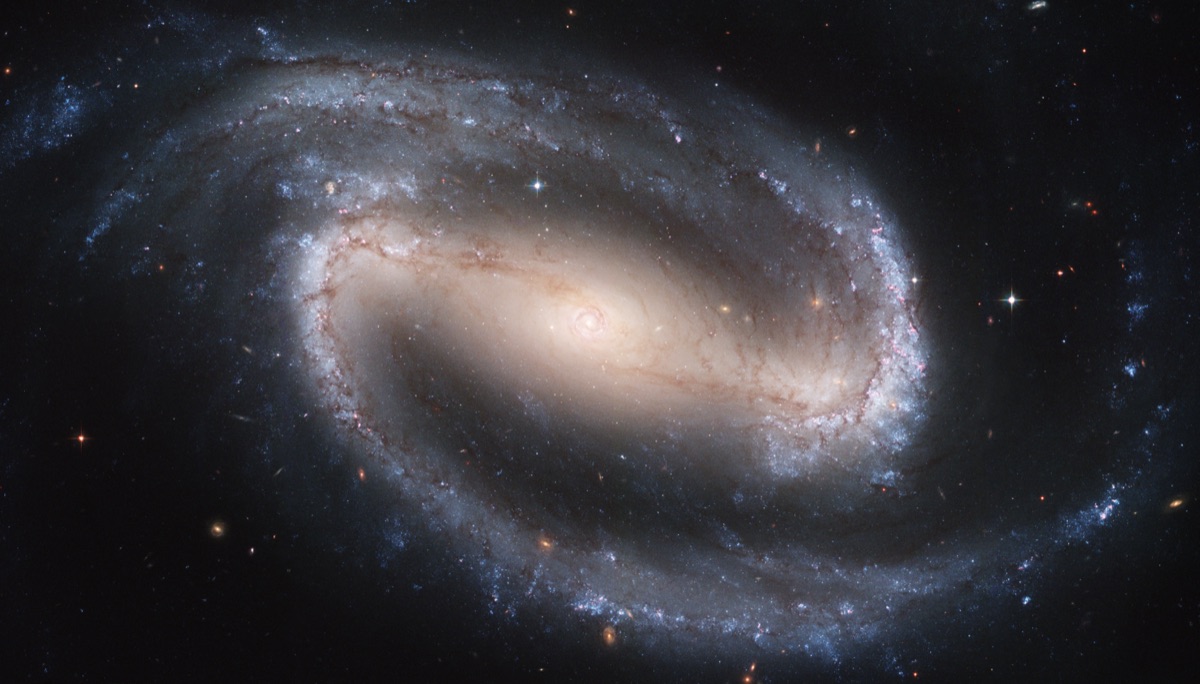
The James Webb Space Telescope has a habit of finding the early universe already grown up - and it just did it again. Astronomers have identified M1149-BSG-z5, a barred spiral galaxy at redshift z = 5.102. We are seeing it as it looked just over a billion years after the Big Bang, its light travelling roughly 12.6 billion years to reach JWST. That makes it, in the words of the discovery paper, the “highest redshift barred galaxy candidate to date” - the most distant galaxy with a clear stellar bar ever spotted. And a bar, it turns out, is not just a pretty feature. It is a sign that a galaxy has already settled down.
- What: a barred spiral galaxy in the early universe
- Redshift: z = 5.102 (spectroscopically confirmed)
- When we see it: ~1.1 billion years after the Big Bang; light ~12.6 billion years old
- Record: the highest-redshift barred galaxy candidate found so far
- The bar: semi-major axis ~4.5 kpc (~14,700 light-years) - comparable to the Milky Way's
- Instrument: JWST NIRISS (Near-Infrared Imager and Slitless Spectrograph)
- Status: a preprint (not yet peer-reviewed), a single object, a strong candidate
1. What Webb Actually Found
M1149-BSG-z5 turned up almost by accident. It was captured in a ‘parallel field’ of a JWST Cycle-2 program - the MAGNIF survey (‘Medium-band Astrophysics with the Grism of NIRISS’), pointed near the massive lensing cluster MACS J1149.5+2223. While one JWST instrument studied the cluster, NIRISS quietly imaged and took spectra of a neighboring patch of sky - and there sat a surprisingly orderly disk. The grism spectroscopy pinned its distance precisely at z = 5.102, and the imaging revealed the tell-tale shape: a bright central bar of stars feeding a spiral disk.
| Property | M1149-BSG-z5 | For comparison |
|---|---|---|
| Redshift | z = 5.102 | ~1.1 Gyr after the Big Bang |
| Bar size (semi-major axis) | ~4.5 kpc (~14,700 ly) | Similar to the Milky Way's bar |
| Stellar mass | ~28 billion Suns (1010.45 M☉) | ~half the Milky Way's stellar mass |
| Star formation rate | 144 M☉/yr | ~100x the Milky Way today |
| Effective radius | 2.61 kpc (~8,500 ly) | a compact, dense disk |
| Chemistry / nucleus | ~50% solar metallicity; active black hole | “already chemically evolved” |
2. Why a Bar Is Such a Big Deal
A galactic bar is the straight, glowing bridge of stars that runs across the middle of many spiral galaxies, channeling gas inward and organizing the spiral arms. Roughly two-thirds of nearby disk galaxies have one - including our own Milky Way. But bars are more than ornamentation. A bar can only grow once a galaxy's disk has become dynamically cool and settled: stars orbiting in an orderly, rotation-dominated pattern rather than sloshing around chaotically. In other words, a bar is a badge of maturity - a galaxy that has, in a real sense, grown up.
M1149-BSG-z5's bar has a semi-major axis of about 4.5 kiloparsecs - roughly the size of the bar at the center of the Milky Way today. A galaxy in the cosmic dawn already wore a structure we usually associate with a mature, present-day spiral.
3. Why This Early Is a Surprise
The early universe was a rougher place. Young galaxies were gas-rich, turbulent and prone to violent mergers - conditions that theory expects to suppress bars, either preventing them from forming or quickly destroying them. That is why, for decades, astronomers assumed bars were a late-blooming feature. Even JWST, which has been steadily pushing the frontier, had traced clear bars back only to around z ≈ 4, with barred fractions of just a few percent at z ≈ 3.5.
M1149-BSG-z5 pushes that boundary to z = 5.102. The authors argue its baryon-dominated, gas-rich disk is precisely what let a bar form so fast: with ordinary matter (not dark matter) dominating the inner regions, gravitational instabilities could take hold and whip the disk into a bar early. It is a single, spectacular example of the same story JWST keeps telling - the young universe built mature, orderly galaxies faster than our models said it should.
4. A Busy, Grown-Up Galaxy
This is no quiet backwater. M1149-BSG-z5 is forging new stars at 144 solar masses a year - on the order of a hundred times the Milky Way's sedate present-day pace - and it has already enriched itself with heavy elements to about half the Sun's metallicity, which the paper describes as “already chemically evolved.” At its core sits an active supermassive black hole (a broad-line AGN), though a modest one: its mass is only about a thousandth of the galaxy's stellar mass. The picture is of a galaxy doing everything a grown-up spiral does - building stars, forging metals, feeding a central black hole, and sculpting a bar - barely a billion years into cosmic history.
What We Still Don't Know
- It is a preprint. The study has been posted to arXiv (23 June 2026) but has not yet completed peer review, so the numbers may still shift.
- It is formally a candidate. Resolving a bar in a galaxy this distant is at the edge of what is possible; the authors themselves frame it as the highest-redshift barred galaxy candidate.
- It is one object. A single grown-up disk is a wonderful outlier, not yet a census. How common early bars really are will take a larger sample to settle.
- Selection matters. M1149-BSG-z5 is unusually massive and bright, which is part of why we can see its structure at all - fainter early disks may hide bars we simply cannot resolve.
Sources
- Wang et al., ‘A massive barred spiral galaxy at z = 5.102 discovered by JWST,’ arXiv preprint (23 Jun 2026): arXiv:2606.25022
- Phys.org: JWST discovers a new barred spiral galaxy
- Background on galactic bars and the Milky Way's bar: Galactic bar (Wikipedia)
Curated by Jerry Cards - jerrycards.com. We research the week's most wonderful discoveries in tech, science, and space so you don't have to. More at jerrycards.com/news.