
 العربية
 Español
 中文
中文 Deutsch
 Français
 Português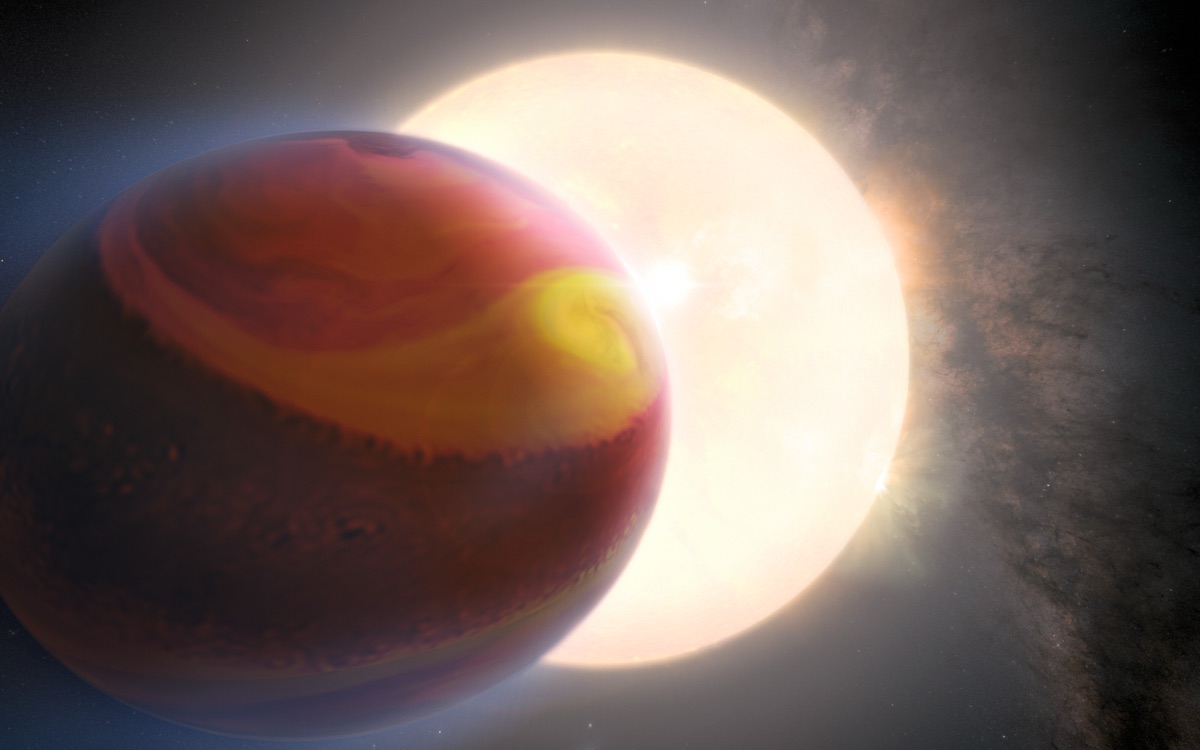
For the first time, astronomers have read the sky of a planet outside our solar system the way you would read a globe - turning it slowly, longitude by longitude. Using the James Webb Space Telescope (JWST), a team led by the Max Planck Institute for Astronomy peeled apart the morning and evening skies of WASP-121 b - officially named Tylos - an ultra-hot giant planet about 858 light-years away. What they found is a single world wearing two very different faces: a scorching, light-swallowing dusk and a cooler dawn, with fierce winds dragging heat around the globe. It is a milestone in a quiet revolution: we are no longer just finding planets around other stars - we are starting to map their weather.
- What: First direct map of a planet's dawn vs. dusk atmosphere on an exoplanet
- Where: WASP-121 b (Tylos), ~858 light-years away, constellation Puppis
- How: A method called rotational transits - reading the atmosphere strip by strip as the planet spins during transit
- Telescope / instrument: JWST, NIRSpec near-infrared spectrograph
- Key result: The evening (dusk) side is hotter and absorbs more starlight than the morning (dawn) side; eastward winds carry heat around the planet
- Team / paper: Led by Cyril Gapp (Max Planck Institute for Astronomy); Nature Astronomy, June 2026
1. Meet Tylos: a world where iron would boil
WASP-121 b was discovered in 2015 and later given the name Tylos (its host star is named Dilmun, after the ancient civilization). It is an ultra-hot Jupiter: a gas giant slightly more massive than Jupiter but puffed up to nearly twice its size by ferocious heat, orbiting so close to its star that a full year lasts just 1.27 days.
| Property | Value |
|---|---|
| Distance from Earth | ~858 light-years (constellation Puppis) |
| Discovered | 2015 |
| Orbital period (its year) | 1.27 Earth days |
| Mass / radius | ~1.16x Jupiter's mass, ~1.75x its radius |
| Dayside temperature | ~2,770 K (~2,500 C / ~4,525 F) |
| Nightside temperature | ~1,000 K (~725 C / ~1,340 F) |
Because it orbits so tightly, Tylos is almost certainly tidally locked - one hemisphere faces its star in endless day, the other in endless night. The dayside runs near 2,770 K, hot enough to vaporize iron and other metals; the nightside, while far cooler, still glows at around 1,000 K. Earlier studies hinted that its exotic skies could host clouds of vaporized metals and minerals - the kind of conditions where, some researchers suggested, it might even rain liquid gems.
A planet's terminator is the dividing line between its day and night sides - the band of permanent twilight. On Earth it is where sunrise and sunset are happening right now. On Tylos there are two such edges: the morning (dawn) terminator, rotating out of night into day, and the evening (dusk) terminator, rotating from day into night. This study is about telling those two edges apart.
2. The breakthrough: reading a planet strip by strip
When a planet crosses in front of its star (a transit), a sliver of starlight filters through its atmosphere on the way to us. The gases imprint their fingerprints on that light, and astronomers decode which molecules are present. The catch: a normal transit blends the whole atmosphere into one averaged measurement, smearing together morning and evening, hot and cold.
The new work gets around this with a technique called rotational transits. A transit of Tylos takes several hours, and in that time the planet itself rotates by roughly 30 degrees. As different longitudes swing into view, the slice of atmosphere backlit by the star slowly changes. By tracking how the starlight absorption shifts moment by moment, the team effectively scanned the planet a strip at a time.
“By measuring how starlight absorption changes as WASP-121 b rotates, we probe its atmosphere longitude by longitude.” - Cyril Gapp, Max Planck Institute for Astronomy
The measurement was made with JWST's NIRSpec near-infrared spectrograph, whose precision is what finally made this possible. Atmospheric differences between a planet's morning and evening had been predicted by computer models for years - but the signal is subtle, and no telescope before JWST could pin it down on a world this far away.
3. Two different skies
The headline result: Tylos's two terminators are not the same. The evening (dusk) side absorbs noticeably more starlight than the morning (dawn) side, the signature of a hotter, more extended evening atmosphere.
| Feature | Morning (dawn) | Evening (dusk) |
|---|---|---|
| Relative temperature | Cooler | Hotter |
| Starlight absorbed | Less | More |
The reason is wind. On a tidally locked planet, the dayside is relentlessly heated while the nightside cools, setting up a powerful eastward jet that races around the equator. That super-rotating wind carries heat from the blazing dayside toward the evening edge before it spills onto the night side - so dusk arrives warmer than dawn. What JWST captured is, in effect, a snapshot of an entire planet's heat being blown around its globe.
4. Reading the chemistry of a twilight
The strip-by-strip data also tracked how the molecular fingerprints changed across the planet:
- Carbon monoxide (CO) stood out more strongly in the later part of the transit - a thermal effect of the hotter evening atmosphere rather than simply more gas being present.
- Water (H2O) faded in the hottest regions, consistent with water molecules being torn apart (thermally dissociated) at the extreme temperatures near the dayside.
Together, the temperature contrast, the wind-driven asymmetry, and the chemistry all tell a consistent story - and they line up with what global circulation models had forecast. That agreement is exactly what scientists hope for: theory predicting a phenomenon, and a new observation confirming it.
5. Why this matters
For most of the history of exoplanet science, a distant world was a single dot of data - a mass, a radius, maybe an average temperature. This study is part of a leap to something richer: three-dimensional weather maps of other worlds. Being able to separate a planet's dawn from its dusk means we can study its winds, its heat transport, and its chemistry as a dynamic system, not a static average.
Tylos is an extreme laboratory precisely because it is so hot and so close to its star - the signals are large and easy to study, making it the perfect place to prove the rotational-transit method works. The real prize is what comes next: applying the same approach to smaller, cooler, more temperate planets. The techniques being sharpened on a world where iron boils are the same ones that will, one day, let us read the skies of planets that look a little more like home.
What we still want to know
- How fast are those winds? The asymmetry points to a powerful eastward jet; pinning down exact wind speeds is a target for follow-up work.
- What are the clouds made of? Mineral and metal clouds have been proposed for Tylos; mapping where they form across the planet is an open question.
- Can the method reach smaller worlds? Rotational transits work beautifully on a big, hot, fast-spinning planet - extending them to cooler, Earthier worlds is the next frontier.
Sources
- C. Gapp et al., “Atmospheric asymmetries in WASP-121 b revealed by rotational transits detected with JWST,” Nature Astronomy (2026). DOI: 10.1038/s41550-026-02887-6
- Phys.org: JWST reveals dawn-dusk atmosphere split on ultra-hot exoplanet WASP-121 b · ScienceDaily: James Webb reveals two completely different twilights on an alien world
- Discover Magazine: JWST dives deep into WASP-121 b · Background: WASP-121b (Tylos)
Image: artist's impression of WASP-121 b (Tylos). Credit: NASA, ESA, Q. Changeat et al., M. Zamani (ESA/Hubble), used under CC BY 4.0.
Curated by Jerry Cards - jerrycards.com. We research the week's most consequential tech, science, and business news so you don't have to. More at jerrycards.com/news.