
 العربية
 Español
 中文
中文 Deutsch
 Français
 Português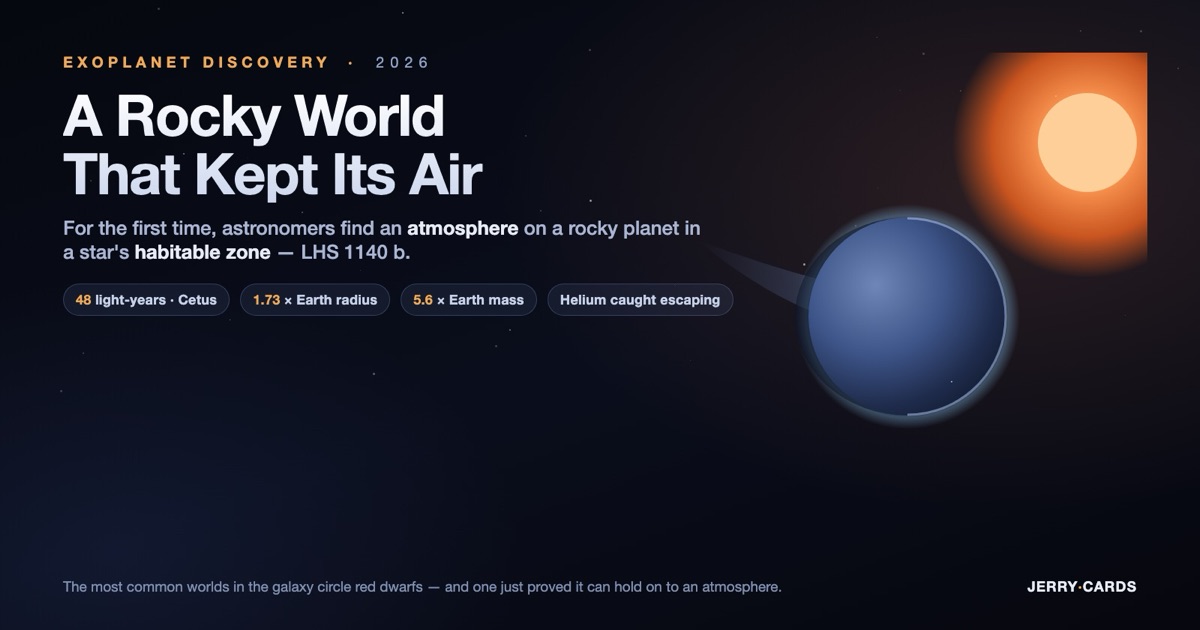
Forty-eight light-years from here, a rocky planet a little larger than Earth just did something no other world like it has ever been caught doing: it held on to its atmosphere. On July 16, 2026, a team led by the Center for Astrophysics | Harvard & Smithsonian reported in Science the first confirmed atmosphere around a rocky planet orbiting in the habitable zone of another star. The planet is LHS 1140 b, and the way they found its air - by catching helium quietly escaping into space, exactly where a theory said it would be - is as elegant as the result is important.
It is not proof of oceans, and it is certainly not proof of life. But it answers, for the first time with real data, one of the most nervous questions in the search for life beyond Earth: can a small, temperate, rocky world actually keep an atmosphere? For at least this one, the answer is yes.
- What: the first atmosphere confirmed on a rocky planet in a star’s habitable zone
- Where: LHS 1140 b, a super-Earth ~48 light-years away in the constellation Cetus
- How: helium caught escaping from the upper atmosphere, seen during a transit
- Tools: the WINERED spectrograph on the 6.5-m Magellan/Clay telescope, Chile (observed Sept 23, 2024)
- Team & venue: led by Collin Cherubim, Center for Astrophysics | Harvard & Smithsonian - Science, July 16, 2026
- The twist: the atmosphere was predicted by a model before it was observed
1. Meet LHS 1140 b
LHS 1140 b is a super-Earth: about 1.73 times the radius of our planet and 5.6 times its mass. It circles LHS 1140, a small, cool red dwarf star (roughly a fifth of the Sun’s mass) once every 24.7 days. Because its star is so faint, that tight orbit still lands the planet in the temperate habitable zone - it receives a little under half the sunlight Earth does, giving it an equilibrium temperature around -47°C (226 K). Density measurements hint that it may be a candidate ocean world, carrying a large fraction of water. In short: one of the most tantalizing nearby targets in the entire exoplanet catalog.
2. Why finding an atmosphere here is such a big deal
Here is the uncomfortable fact at the heart of the search for life: the most common stars in the galaxy are red dwarfs, and most of the nearby, Earth-sized planets we could realistically study orbit them. But red dwarfs are moody. When they are young they unleash powerful flares of X-rays and ultraviolet light, and over hundreds of millions of years that radiation can blow a planet’s atmosphere clean off, leaving a bare, airless rock. Without an atmosphere, there is no surface liquid water, no shield, no chemistry - no life as we know it.
So the whole enterprise has hinged on an unanswered question: can rocky planets around red dwarfs hold on to their air at all? LHS 1140 b is the first temperate, rocky world for which the answer is a clear, measured yes - an atmosphere that appears to have survived for billions of years.
What makes this result especially satisfying is the order of events. Lead author Collin Cherubim had built a theoretical model of planets straddling the ‘cosmic shoreline’ - worlds in transition between puffy, gas-rich sub-Neptunes and bare rocks. The model predicted that such planets should retain a helium-rich upper atmosphere slowly bleeding into space, and it flagged LHS 1140 b as a prime candidate. The team then went looking for exactly that signal - and found it. The theory told them where to point the telescope.
3. How you detect air on a world you cannot see
We cannot photograph LHS 1140 b - it is a speck lost in its star’s glare. Instead, astronomers waited for the planet to transit: to pass directly in front of its star from our point of view. As the starlight filters through the thin shell of gas at the planet’s edge, certain colors get absorbed, leaving a chemical barcode.
The team used a specific fingerprint: the near-infrared line of helium (at about 1,083 nanometers), which is the tell-tale sign of a light, extended, escaping atmosphere. On September 23, 2024, they trained the WINERED spectrograph on the 6.5-meter Magellan/Clay telescope at Las Campanas Observatory in Chile on the planet during a transit - and read the helium in the starlight. Crucially, this transit-spectroscopy technique for spotting escaping helium had been used before on giant and Neptune-sized planets, but never on a rocky world. LHS 1140 b is the first.
| Property | LHS 1140 b | Earth |
|---|---|---|
| Radius | ~1.73 x Earth | 1.0 |
| Mass | ~5.6 x Earth | 1.0 |
| Year (orbit) | 24.7 days | 365 days |
| Star | Red dwarf (M4.5) | Sun (G2) |
| Sunlight received | ~0.4 x Earth | 1.0 |
| Equilibrium temp. | ~ -47°C | ~ -18°C (no air) |
4. What it does - and does not - mean
It is worth being precise, because the honest version of this story is still a wonderful one. ‘Habitable zone’ is a statement about temperature and distance, not a verdict on habitability: it marks where a planet could hold liquid water, not where it definitely does. This detection does not prove that LHS 1140 b has oceans, a breathable atmosphere, or life. And the very helium that reveals the atmosphere is, by definition, leaking away - the signal is a sign of loss as much as of presence. The atmosphere could even be a leftover primordial envelope rather than an Earth-like one.
What it does establish is the thing that had to come first: an atmosphere exists, and has endured, on a temperate rocky planet around a red dwarf. As co-author David Charbonneau - one of the pioneers of exoplanet atmospheres - framed it, it is perfectly reasonable to imagine that a world like this could host life. The point is not that we have found it. The point is that, for the first time, the question is a measurement rather than a hope.
5. What comes next
The natural follow-up is to find out what the atmosphere is made of. Helium is the flag; the fuller chemistry - water vapor, carbon dioxide, nitrogen, oxygen - is the prize, and it is exactly the kind of question the James Webb Space Telescope and the next generation of giant ground-based observatories are built to chase. Because LHS 1140 b is relatively nearby and reliably transits its star, it now jumps to the front of the line as one of the best places to keep looking. And Cherubim’s model lists other candidates to check, so this may be the first of several rocky worlds we catch keeping their air.
What we still don’t know
- The full composition of the atmosphere - helium is detected, but the water, CO2, and other gases are not yet mapped.
- Whether there is surface liquid water or an ocean - suggested by the planet’s density, but not confirmed.
- Whether the atmosphere is primordial or secondary - a leftover gas envelope versus one rebuilt by volcanism and chemistry.
- How fast it is escaping, and how much has already been lost over billions of years.
Sources
- Center for Astrophysics | Harvard & Smithsonian: First atmosphere detected on a habitable-zone rocky world
- Cherubim et al., ‘Helium escaping from the atmosphere of a nearby rocky exoplanet orbiting in a habitable zone’, Science, July 16, 2026 (DOI 10.1126/science.aea9708)
- EarthSky: 1st atmosphere detected on a rocky, habitable-zone exoplanet
- Sci.News: Potential atmosphere detected on habitable-zone exoplanet LHS 1140 b
- LHS 1140 b - planet parameters and history
Curated by Jerry Cards - jerrycards.com. We research the milestones of science and technology - past and present - so you don’t have to. More at jerrycards.com/news.