
 العربية
 Español
 中文
中文 Deutsch
 Français
 Português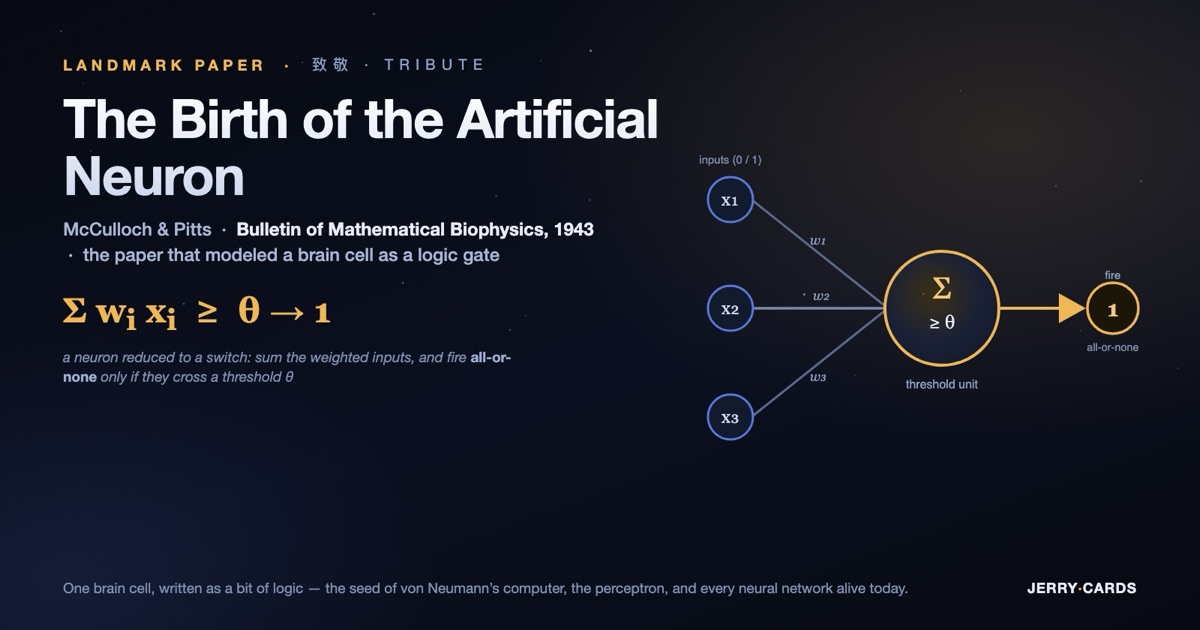
In December 1943, in the pages of a small journal of mathematical biology, two people who barely fit anywhere in the academic world wrote down an idea that would eventually build the machines now writing, seeing and reasoning alongside us. Warren McCulloch was a 44-year-old neurophysiologist and polymath. Walter Pitts was a self-taught logician, not yet 21, who had run away from home as a teenager and was, when the two met, effectively homeless. Together they published a paper that did something no one had done before: it turned a brain cell into mathematics, and in doing so drew the first blueprint of the artificial neuron.
This is a tribute to that paper - and to the improbable partnership behind it.
- Who: Warren S. McCulloch (1898–1969), neurophysiologist; and Walter Pitts (1923–1969), self-taught logician
- The paper: ‘A Logical Calculus of the Ideas Immanent in Nervous Activity,’ The Bulletin of Mathematical Biophysics, vol. 5, pp. 115–133 (December 1943)
- The idea: a neuron fires all-or-none, so it can be modeled as a logic gate — the McCulloch–Pitts neuron, a threshold switch
- The result: networks of such neurons can compute any logical proposition; with loops and a tape, they equal a Turing machine
- The legacy: the brain seen as a computing machine — and the seed of the artificial neural network
1. A brain cell, reduced to a switch
A biological neuron is a staggeringly complex thing — a living cell that gathers signals from thousands of others across its branching dendrites, and, if the incoming excitement is strong enough, sends a pulse racing down its axon to the next cells in line. McCulloch and Pitts noticed one crucial simplification hiding inside that complexity. A neuron does not fire a little or a lot: it fires or it stays silent. Its output is all-or-none.
That single fact, they realized, changes everything. If a neuron is essentially a yes/no device, then it is a piece of logic — a switch that is either true or false. You can give it several inputs, weight them, set a firing threshold, and say: the neuron outputs 1 (fire) only when the weighted inputs reach the threshold, and 0 otherwise. This idealized unit is now called the McCulloch–Pitts neuron, and it is the great-grandparent of every artificial neuron in every neural network today.
“Because of the ‘all-or-none’ character of nervous activity, neural events and the relations among them can be treated by means of propositional logic.”
— McCulloch & Pitts, opening their 1943 paper
2. Logic in, logic out - and the brain as a computer
Once a neuron is a logic gate, the floodgates open. The three building blocks of all logic — AND, OR and NOT — can each be built from a single threshold neuron by choosing the right weights and threshold. And because those three operations are enough to express any logical function, a network of McCulloch–Pitts neurons, wired appropriately, can compute any logical proposition at all.
| One neuron can be… | How |
|---|---|
| AND | Fire only when all inputs are active — set a high threshold |
| OR | Fire when any input is active — set a low threshold |
| NOT | An inhibitory input that shuts the neuron off when it is active |
Then McCulloch and Pitts went further. If you allow the network to contain loops — neurons that feed back on themselves, giving the system a form of memory — and imagine it hooked up to an unlimited tape to read and write on, the network becomes equivalent to a Turing machine: it can carry out any computation that can be carried out at all. Alan Turing had defined universal computation in 1936; McCulloch and Pitts now argued that a web of idealized neurons could reach the very same ceiling.
The philosophical payload was immense. For the first time, someone had made a precise, mathematical case that the brain could be understood as a computing machine — and, turned around, that computing machines might be built out of neuron-like parts. The gap between minds and mechanisms had suddenly narrowed to a set of equations.
3. The unlikeliest partnership in science
The human story behind the paper is as remarkable as the mathematics. Walter Pitts was a prodigy out of a novel. Born in Detroit in 1923, he taught himself Greek, Latin and logic as a boy. The legend — well attested — is that at age 12 he hid in a library for three days reading Bertrand Russell and Alfred North Whitehead’s Principia Mathematica, the towering attempt to build all of mathematics from pure logic, and then wrote to Russell himself to point out passages he thought were mistaken. Russell was impressed enough to reply. At 15, Pitts left home for good, drifted to the University of Chicago, and began slipping into lectures — including Russell’s — without ever being enrolled. He had no money and, much of the time, nowhere to live.
Warren McCulloch, by contrast, was an established scientist and irrepressible polymath, a doctor and neurophysiologist who refused to respect the borders between disciplines. A mutual friend, the young Jerome Lettvin, introduced the two around 1940. They discovered a shared obsession: both had been electrified by Turing’s idea that thinking might be mechanized. In 1942, McCulloch did something simple and generous — he invited the homeless Pitts to move into his family home. And there, in long evenings of argument and chalk, the 44-year-old physician and the 20-year-old runaway worked out the logic of the neuron.
4. From one brain cell to the computer
The paper landed at exactly the right moment. Just two years later, in 1945, John von Neumann circulated his First Draft of a Report on the EDVAC, the document that laid out the logical design of the modern stored-program computer — the ‘von Neumann architecture’ that still underlies almost every machine you own. Von Neumann explicitly cited McCulloch and Pitts and described his computer’s logic elements in their idealized-neuron notation. The abstraction meant to model the brain turned out to be a beautifully clean way to describe a machine.
The idea rippled outward from there. McCulloch and Pitts joined Norbert Wiener’s circle at MIT and helped launch cybernetics — the science of control and feedback in animals and machines — with McCulloch chairing the famous Macy Conferences (1946–1953). The neuron-as-logic-unit became one of the founding metaphors of the entire information age.
5. The line that runs to modern AI
What McCulloch and Pitts did not yet have was learning: their neurons were wired by hand, not trained from data. That final ingredient arrived later, and every step built on the 1943 foundation. Follow the thread — each of these is its own landmark:
| Year | Step | What it added |
|---|---|---|
| 1943 | McCulloch–Pitts neuron | A neuron is a logic gate; networks can compute anything |
| 1958 | Rosenblatt’s perceptron | A neuron that learns its weights from examples |
| 1986 | Backpropagation | A way to train deep, multi-layer networks efficiently |
| 2012 | AlexNet | Deep networks + GPUs ignite the modern deep-learning era |
| 2017 | The transformer | The architecture behind today’s large language models |
Every one of those systems is, at bottom, a vast society of artificial neurons — each one a distant, learning descendant of the little all-or-none switch McCulloch and Pitts sketched in 1943.
What the model left out - on purpose
- Real neurons are richer. Living neurons are analog, noisy, spiking, and constantly rewiring themselves; the McCulloch–Pitts unit deliberately ignored all of that. The genius was in what to leave out — keeping just enough to make the idea computable.
- Learning came later. The 1943 neurons were designed, not trained. Giving artificial neurons the ability to learn their own connections is what turned the idea into a practical technology.
- The brain is still mostly mystery. That a simple model proved so powerful does not mean the brain is a digital computer; how biological intelligence really works remains one of science’s deepest open questions — and one this paper helped us even begin to ask precisely.
Sources & further reading
- Original paper: W. S. McCulloch & W. Pitts, ‘A Logical Calculus of the Ideas Immanent in Nervous Activity’, The Bulletin of Mathematical Biophysics 5, 115–133 (1943)
- Wikipedia: A Logical Calculus of the Ideas Immanent in Nervous Activity · Walter Pitts · Warren Sturgis McCulloch
- John von Neumann, First Draft of a Report on the EDVAC (1945) — the stored-program architecture that cites McCulloch–Pitts
- Amanda Gefter, ‘The Man Who Tried to Redeem the World with Logic’, Nautilus (on Walter Pitts)
Curated by Jerry Cards - jerrycards.com. Our 致敬 (tribute) series celebrates the landmark papers and discoveries that quietly built the modern world. More at jerrycards.com/news.