
 العربية
 Español
 中文
中文 Deutsch
 Français
 Português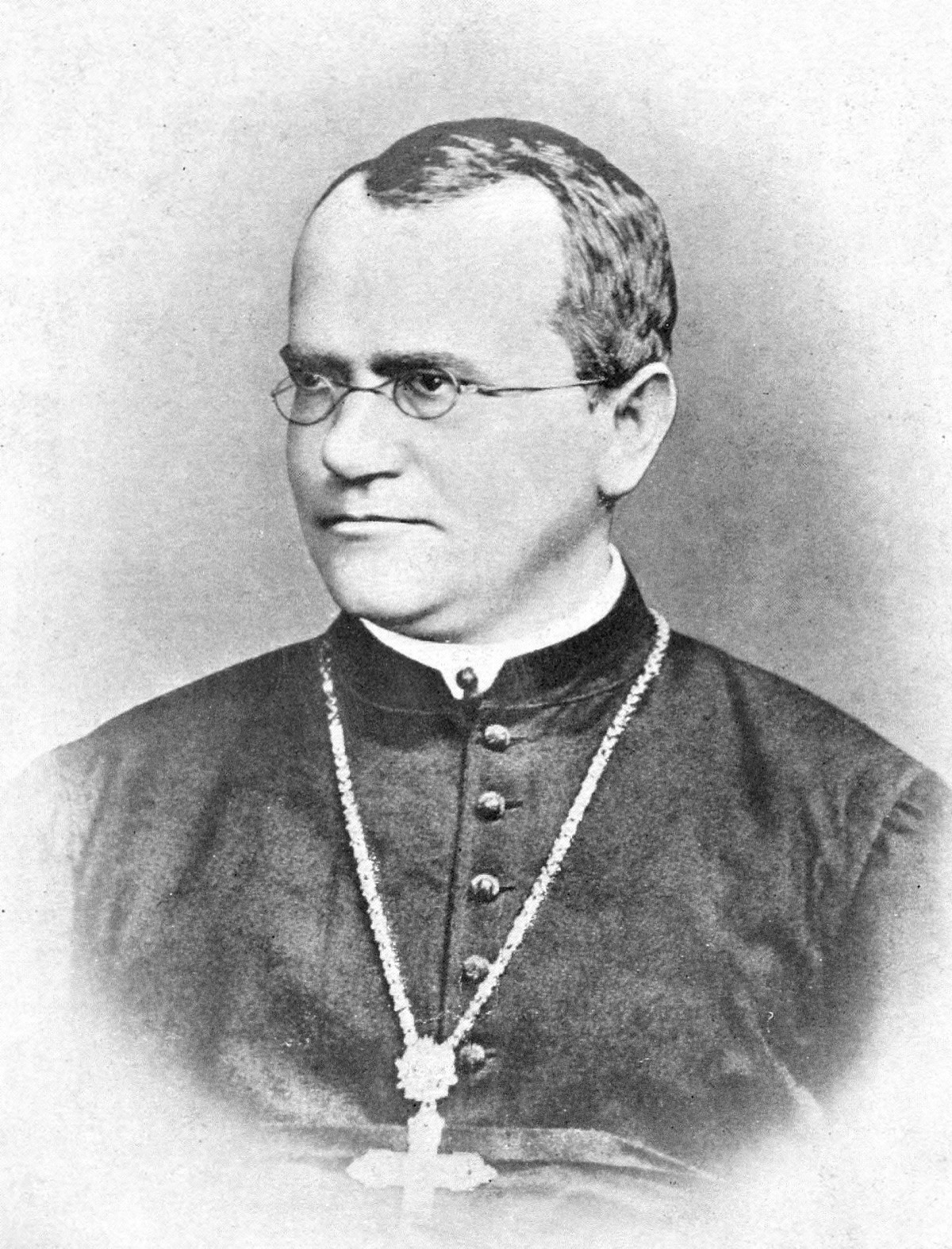
In 1866, the science of genetics was born in the pages of a journal almost no one read, written by a man almost no one would remember for another 34 years. Its author was Gregor Mendel, an Augustinian friar in the Moravian city of Brünn (today Brno, in the Czech Republic). Its subject was the humble garden pea. And its quiet, careful arithmetic - the record of eight years and some 28,000 plants - contained the hidden rules by which every living thing passes itself on to the next generation.
Mendel was not a celebrated professor. He was a monk with a talent for mathematics and a monastery garden, and he did something that generations of naturalists before him had never quite done: he treated heredity as a counting problem. Here is what he found, why it was ignored, and how a paper about peas became the foundation of modern biology and medicine.
- Author: Gregor Johann Mendel (1822-1884), Augustinian friar, St Thomas's Abbey, Brünn/Brno
- Paper: ‘Versuche über Pflanzen-Hybriden’ (Experiments on Plant Hybridization)
- Presented: two lectures to the Natural History Society of Brünn, 8 February & 8 March 1865
- Published: 1866, in the Proceedings of the Natural History Society of Brünn, vol. IV, pp. 3-47
- The data: ~28,000 plants over 1856-1863; seven either/or traits of the garden pea (Pisum sativum)
- The discovery: heredity follows simple, countable laws - dominance, segregation, and independent assortment
- The wait: ignored for ~34 years, then independently rediscovered in 1900
1. A Friar in a Monastery Garden
Mendel was born on 20 July 1822 to a farming family in Silesia. Bright but poor, he entered the Augustinian St Thomas's Abbey in Brünn in 1843 - as much a route to an education as a religious calling. The monastery was a hub of scholarship, with a library, a herbarium, and a tradition of scientific inquiry. Mendel studied physics and mathematics at the University of Vienna, and it was that mathematical training - unusual for a naturalist of his day - that would make all the difference.
Back in Brünn, he turned the monastery's experimental garden into a laboratory. He chose the garden pea for good reasons: it comes in clearly distinct varieties, it normally self-pollinates (so he could control breeding precisely), and it grows quickly. Between 1856 and 1863 he cultivated and tested some 28,000 plants, hand-pollinating them with a brush and recording the outcome of every cross.
2. Eight Years, 28,000 Plants, Seven Traits
Mendel deliberately narrowed his attention to seven traits, each of which came in just two clean, contrasting forms - no in-between. That simplicity was the whole trick: it let him count offspring and look for numerical patterns.
| Trait | Dominant form | Recessive form |
|---|---|---|
| Seed shape | Round | Wrinkled |
| Seed colour | Yellow | Green |
| Flower colour | Violet | White |
| Pod shape | Inflated | Constricted |
| Pod colour | Green | Yellow |
| Flower position | Axial (along stem) | Terminal (at tip) |
| Stem length | Tall | Dwarf |
3. Three Ideas That Explained Heredity
When Mendel crossed a purebred tall plant with a purebred dwarf, the offspring were not medium-height. They were all tall. The dwarf trait had seemingly vanished. But when he let that first generation self-pollinate, the dwarfs came back - in a startlingly consistent proportion. Three simple ideas accounted for everything he saw.
1. Discrete units, inherited whole. Heredity is not a paint-mixing of parental blood, as most of Mendel's contemporaries assumed. Each trait is governed by a pair of discrete ‘factors’ (we now call them genes), one inherited from each parent. A factor can be masked but is never diluted - which is why a trait can disappear in one generation and reappear, unchanged, in the next.
2. The Law of Segregation. When a plant makes pollen or egg cells, its two factors separate, and each sex cell carries only one - chosen at random. Cross two hybrids, and the dominant and recessive forms reshuffle in a predictable ratio.
3. The Law of Independent Assortment. The factors for one trait are handed down independently of the factors for another. Seed colour is not tied to stem height; each trait shuffles on its own.
Cross two hybrids and, on average, three out of four offspring show the dominant trait and one shows the recessive - a 3:1 ratio. For seed shape, Mendel counted 5,474 round seeds to 1,850 wrinkled: 2.96 to 1. That clean fraction, appearing again and again across all seven traits, was the fingerprint of the hidden rules - and the first time heredity had ever been captured as mathematics.
4. Ignored for 34 Years
Mendel presented his results in two lectures in early 1865 and published them in 1866. And then... almost nothing. The paper ran in a respectable but little-read regional journal; it was cited only a handful of times; and the few naturalists who encountered it did not grasp what they were looking at. The age was captivated by Darwin's On the Origin of Species (1859), but no one connected Mendel's tidy ratios to the grand question of how variation is inherited.
In 1868 Mendel was elected abbot of his monastery, and the duties of leadership steadily crowded out his research. He died on 6 January 1884, honoured locally as an administrator, with no inkling that he had written one of the most important papers in the history of science. He is often said to have remarked, with quiet confidence, “My time will come.”
5. The Rediscovery - and a New Science
His time came in 1900. That year, three botanists working independently - Hugo de Vries in the Netherlands, Carl Correns in Germany, and Erich von Tschermak in Austria - each ran into the very same laws in their own breeding experiments, and each, searching the literature, unearthed Mendel's forgotten 1866 paper. The vindication was complete and simultaneous.
The new science needed new words. The British biologist William Bateson, Mendel's fierce champion, coined the term genetics in 1905. In 1909 the Danish botanist Wilhelm Johannsen gave Mendel's abstract ‘factors’ their modern name: the gene. From there the discoveries cascaded.
| Year | Built on Mendel |
|---|---|
| 1910s | Thomas Hunt Morgan places genes on chromosomes (fruit flies) |
| 1953 | Watson & Crick reveal the double-helix structure of DNA - the molecule of Mendel's factors |
| 2003 | The Human Genome Project reads all ~3 billion letters of human DNA |
| Today | CRISPR gene editing, gene therapy, crop breeding, and consumer ancestry tests |
In 1936 the great statistician Ronald Fisher re-examined Mendel's tallies and noticed they hugged the predicted ratios more tightly than random chance should allow. It launched a century of friendly debate. The modern verdict is not fraud but a careful experimentalist whose expectations likely shaped borderline judgment calls - and whose conclusions were, in every essential, correct. A second refinement came later: ‘independent assortment’ holds for genes on different chromosomes, but genes sitting close together tend to be inherited as a set (genetic linkage, mapped by Morgan). Mendel, by luck and good judgment, had chosen seven traits that behaved beautifully - and the fuller picture only deepened the science he began.
Why It Still Matters
Every time a doctor weighs a family's risk for an inherited condition, a farmer plants a better-yielding crop, a lab edits a gene, or someone opens an ancestry report, they are standing on Mendel's peas. He gave biology its first exact law and turned heredity from folklore into a countable, predictable science. And he did it alone, in a garden, decades ahead of everyone else - proof that a quiet, patient, carefully reasoned idea can outlast the silence that greets it and, in the end, change the world.
Sources
- G. Mendel, ‘Versuche über Pflanzen-Hybriden,’ Verhandlungen des naturforschenden Vereines in Brünn, Bd. IV (1866), pp. 3-47
- Wikipedia: Experiments on Plant Hybridization · Gregor Mendel
- National Human Genome Research Institute: 1900 rediscovery of Mendel's work
- Embryo Project Encyclopedia: Experiments in Plant Hybridization (1866)
Curated by Jerry Cards - jerrycards.com. Our landmark-paper tribute series celebrates the ideas that built the modern world. More at jerrycards.com/news.