
 العربية
 Español
 中文
中文 Deutsch
 Français
 Português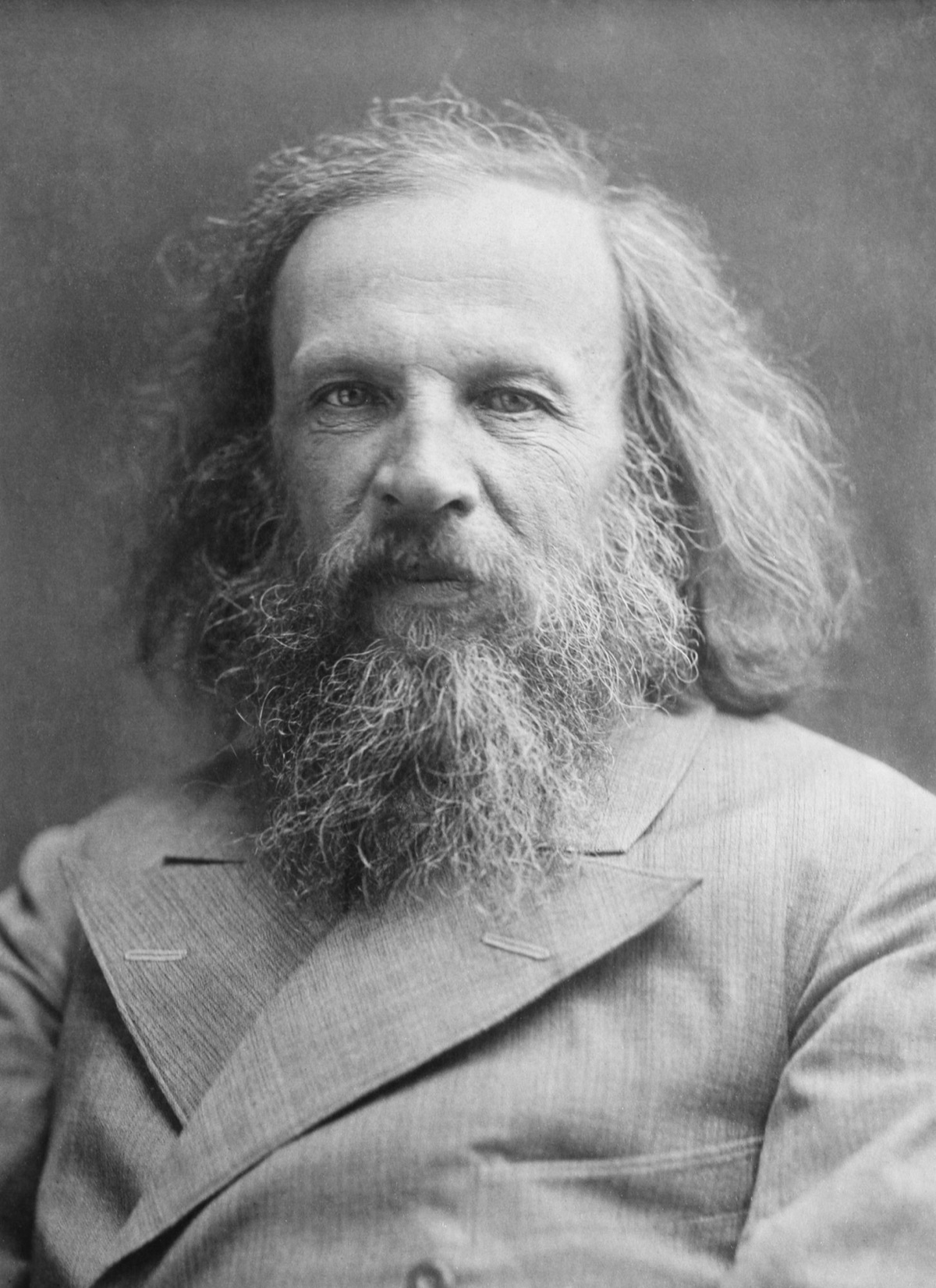
In 1869, a Russian chemist laid the 63 known chemical elements out on a single sheet of paper - and, in doing so, turned chemistry into a science that could predict the future. His name was Dmitri Mendeleev, and the chart he drew is now the most recognisable diagram in all of science: the periodic table. What made it revolutionary was not merely that it organised the elements neatly. It was that Mendeleev trusted his pattern so completely he left blank squares for elements no one had ever seen - and told the world exactly what they would be like when they were found.
He was right. This is a tribute to how he did it, the elements he foretold, and why that one chart still hangs on every classroom wall on Earth.
- Who: Dmitri Ivanovich Mendeleev (1834–1907), professor of chemistry at the University of St Petersburg
- When: formulated 17 February 1869 (Old Style) / 1 March 1869 (New Style); presented to the Russian Chemical Society on 6 March 1869
- What: the 63 elements then known, arranged by atomic weight, revealing that their properties recur periodically - the periodic law
- The bold move: he left gaps for undiscovered elements and predicted their properties in detail
- The payoff: gallium (1875), scandium (1879) and germanium (1886) were discovered almost exactly as predicted
1. A deck of cards nobody could sort
By the 1860s chemists had identified 63 elements - oxygen, iron, gold, chlorine, sodium and dozens more - and measured a number for each called its atomic weight. But the elements were a jumble. Some were soft metals that burst into flame in water; some were choking gases; some were inert and dull. There were hints of family resemblances, but no one had found the underlying order. It was like holding a shuffled deck and sensing there were suits, without knowing how to deal them.
Mendeleev, so the story goes, wrestled with the problem so hard that the answer came to him in a dream. He wrote the elements and their properties on cards and shuffled them like a game of patience until the arrangement fell out. When he lined them up in order of atomic weight, something remarkable appeared.
2. The periodic law
As the atomic weight climbed, the elements’ properties did not change at random - they came back around, again and again, in a regular rhythm. A soft, wildly reactive metal (lithium) would be followed by a march of other elements until, a set distance later, another soft, wildly reactive metal turned up (sodium), then again (potassium). Reactive gases lined up under reactive gases; sluggish metals under sluggish metals.
Arrange the elements by weight, and their character repeats at regular intervals. Put those repeats underneath one another, and every column becomes a family.
This is the periodic law, and the grid that captures it is the periodic table: rows (periods) run across in order of weight; columns (groups) stack elements that behave alike. Mendeleev was not entirely alone - the German chemist Lothar Meyer arrived at a strikingly similar arrangement around the same time, and a full tribute names him too. But it was what Mendeleev did next that set his table apart.
3. The blank squares
Here is the leap of genius. When an element did not sit comfortably in the pattern - when following the weights strictly would have put, say, a metal in a column of non-metals - Mendeleev did not force it or abandon the scheme. He trusted the law and concluded that an element was simply missing. So he left an empty square and moved the others along.
Then he went further than any cautious scientist should dare. Reading across from the known neighbours above, below and beside each gap, he predicted the missing elements’ properties: their atomic weights, their densities, the formulas of their oxides, even how their compounds would look and behave. He gave them provisional names using the Sanskrit prefix eka (meaning “one,” as in one place beyond): eka-aluminium, eka-boron and eka-silicon.
It was a falsifiable bet, laid down in public. If the elements never showed up, or showed up wrong, the whole edifice would fall. He waited for the world to catch up.
4. The world catches up
It took only a decade and a half for the empty squares to fill - and the results were uncanny.
| Mendeleev's prediction | The real element | Predicted vs actual |
|---|---|---|
| eka-aluminium | Gallium (1875, France; Lecoq de Boisbaudran) | weight ~68 vs 69.7; density ~6.0 vs 5.9 |
| eka-boron | Scandium (1879, Sweden; Lars Fredrik Nilson) | weight ~44 vs 45.0 |
| eka-silicon | Germanium (1886, Germany; Clemens Winkler) | weight ~72 vs 72.3; density ~5.5 vs 5.47 |
The clinching case was germanium. When Clemens Winkler isolated it in 1886 and worked out its numbers - an atomic weight of 72.3, a density of 5.47, an oxide just as Mendeleev had sketched - the match to a 15-year-old prediction was so close it read like a receipt. Even the sceptics were converted. A table built to organise the known had proved it could describe the unknown.
A good scientific idea explains what you already see. A great one tells you what you will see next. By predicting three elements before anyone found them, Mendeleev showed that the periodic law was not a filing system but a law of nature - and turned chemistry from a catalogue of substances into a predictive science.
5. The table only got stronger
The truest test of a great idea is what happens when the unexpected arrives. Twice, the periodic table faced surprises that could have broken it - and each time it absorbed them and came out stronger.
The noble gases. In the 1890s William Ramsay and colleagues discovered an entire family of colourless, almost completely unreactive gases - helium, neon, argon, krypton, xenon - that nobody had predicted at all. A brittle scheme would have shattered. Instead the newcomers slotted in perfectly as a brand-new column at the edge of the table, extending the pattern rather than contradicting it.
Atomic number. Mendeleev had ordered elements by atomic weight, and a few stubborn pairs sat in the “wrong” order for their chemistry. In 1913 the young physicist Henry Moseley, using X-rays, discovered the deeper principle: elements should be ranked by their atomic number - the count of protons in the nucleus. Re-order the table by atomic number and every awkward case falls into line. Mendeleev had found the right pattern; Moseley found the reason it was true.
6. The most useful chart in the world
What began as 63 elements on a sheet of paper now holds 118, its seventh row completed only in 2016 with four freshly named elements (nihonium, moscovium, tennessine and oganesson). Every one of them sits exactly where Mendeleev’s logic says it should.
And the table is not a museum piece - it is a working tool used every single day:
| The table tells you... | ...which makes possible |
|---|---|
| How elements bond | Designing new medicines, plastics and fertilisers |
| How electrons behave | Semiconductors and the silicon chips in every phone |
| Which elements share a family | Lithium batteries, rare-earth magnets, catalysts |
| What is chemically possible | Everything from steelmaking to spacecraft alloys |
Fittingly, element number 101 is called mendelevium, so the man who first read the elements’ hidden order now has a permanent place within it. In 2019 the world celebrated the table’s 150th birthday as the UNESCO International Year of the Periodic Table.
Why it still matters
We tend to picture the periodic table as a thing to memorise - a wall poster, a chemistry-class chore. But look again at what it really is: a single diagram that captures the deep structure of ordinary matter, the reason gold is gold and oxygen is oxygen, arranged so cleanly that its blank spaces could be read like prophecy. It is one of the purest demonstrations we have that the universe is not just knowable but orderly - that behind the messy variety of the world lies a pattern simple enough to draw on a single page.
Some charts organise what we already know. A rare one predicts what we do not. In 1869 Dmitri Mendeleev drew that rarer kind - and then had the nerve to leave the empty squares that told us where to look.
Sources & further reading
- Wikipedia: Periodic table · Dmitri Mendeleev · Mendeleev’s predicted elements
- Encyclopaedia Britannica: Dmitri Mendeleev - biography and the periodic table
- The Royal Society: “The periodic law of the chemical elements” (Phil. Trans. R. Soc. A, 2020)
- UNESCO: International Year of the Periodic Table 2019 (150th anniversary)
- Image: portrait of Dmitri Mendeleev, public domain, via Wikimedia Commons
Curated by Jerry Cards - jerrycards.com. Our 致敬 (tribute) series celebrates the landmark papers and discoveries that quietly built the modern world. More at jerrycards.com/news.