
 العربية
 Español
 中文
中文 Deutsch
 Français
 Português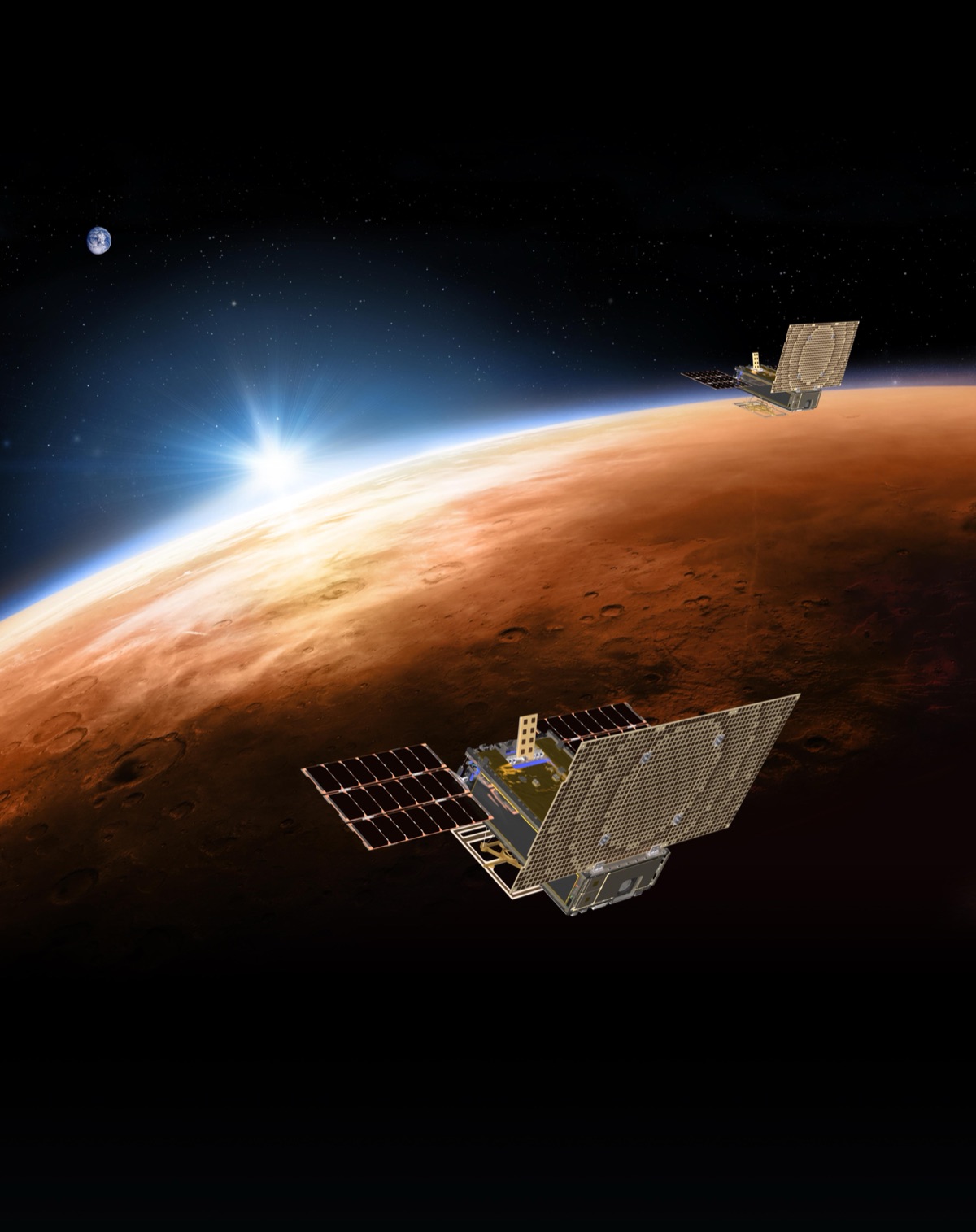
In 2018, two satellites the size of a briefcase flew all the way to Mars. NASA's twin MarCO CubeSats hitched a ride with the InSight lander, relayed its nail-biting touchdown back to Earth in near-real time, and proved that something small enough to carry under your arm can do serious work in deep space. But MarCO had no real engine of its own - it coasted. Ever since, the question hanging over small satellites has been brutally simple: how do you give something that tiny enough thrust to go somewhere on its own, without filling it up with fuel and plumbing?
A team at MIT just answered it in an unusually elegant way. They have shown that a single, non-toxic propellant can power both a chemical thruster and a set of electric thrusters - drawing from one shared tank. It is a genuine two-in-one engine, and it could be the missing piece that lets briefcase-sized spacecraft strike out for Mars or the asteroid belt on their own.
- What: a dual-mode (chemical + electric) propulsion system fed by one propellant from one tank
- The fuel: ASCENT - a non-toxic, 'green' ionic-liquid propellant, about as thick as baby oil
- Two modes: a chemical thruster for fast, powerful burns; electrospray thrusters for ultra-efficient cruising
- Lab result: electrospray thrusters ran on just 1 gram of ASCENT each, continuously for up to 100 hours, with thrust comparable to their usual specialized fuels
- Next step: NASA's Green Propulsion Dual Mode CubeSat - one chemical + four electrospray thrusters, one tank - targeting a November 2026 launch
- Where: MIT Space Propulsion Laboratory; published in the Journal of Propulsion and Power
1. Two Kinds of Rocket, and Why You Could Never Have Both
Spacecraft thrusters come in two broad families, and for decades they have been an either/or decision - especially on a small satellite.
Chemical thrusters burn propellant to produce a lot of force quickly. They are the muscle: great for escaping orbit, dodging debris, or making a fast course correction. The trade-off is appetite - they burn through fuel rapidly.
Electric thrusters are the marathon runners. Instead of burning fuel, they use electricity to accelerate tiny amounts of propellant to enormous speeds. The thrust is gentle - on the order of the weight of a few grains of sand - but they are astonishingly efficient, able to keep nudging a spacecraft for months or years on very little propellant.
The dream is obvious: powerful bursts and patient, fuel-sipping cruising. The obstacle has always been plumbing. Each thruster type traditionally demands its own propellant, tanks, and feed systems - two complete fuel architectures bolted onto one vehicle. A full-size spacecraft can sometimes afford that. A CubeSat, where every cubic centimeter is contested, almost never can. So designers have had to pick a lane.
2. The Trick: One Fuel That Can Do Both Jobs
The MIT team - led by Amelia Bruno, a former postdoc in the Department of Aeronautics and Astronautics, with Matthew Corrado (SM '22, PhD '26) and Professor Paulo Lozano, who directs the MIT Space Propulsion Laboratory - collapsed that either/or by finding a single propellant that both systems can use.
“If you can have chemical and electrical propulsion in one small package, it's the best of both worlds.”
- Amelia Bruno, lead author
The same liquid is routed two ways. Sent to the chemical thruster, it reacts to produce a quick, forceful burn. Sent to the electrospray thrusters, electric fields pull charged particles straight out of the liquid and fling them away at high speed to create thrust - no combustion required. One tank, one fluid, two completely different ways to push.
3. Meet ASCENT, the 'Green' Propellant
The fuel that makes this possible is ASCENT - the Advanced SpaceCraft Energetic Non-Toxic propellant. It is an ionic liquid (a salt that is liquid at room temperature) with a viscosity, the MIT team notes, a bit like baby oil. It was originally synthesized by the U.S. Air Force as a deliberately safer stand-in for the propellant spacecraft have leaned on since the 1960s.
The conventional workhorse, hydrazine, is extraordinarily toxic and corrosive - so dangerous that ground crews handle it in full protective suits, which adds cost, time, and risk to every launch campaign. ASCENT (formerly known as AF-M315E) is far less hazardous to handle, yet it is no slouch on performance: it delivers roughly 50% more impulse for a given tank volume than hydrazine. NASA proved it in space on the 2019 Green Propellant Infusion Mission - the first new high-performance monopropellant the agency had flight-tested in about half a century. A safer fuel that is also more capable is a rare win-win.
4. What They Actually Demonstrated
The headline question was whether ASCENT - already trusted in chemical thrusters - could also feed the delicate, high-voltage world of electrospray thrusters without misbehaving. The lab results say yes.
| What was tested | Result |
|---|---|
| Propellant per electrospray thruster | ~1 gram of ASCENT |
| Continuous run time | up to 100 hours, steadily |
| Thrust | comparable to the specialized ionic liquids these thrusters normally use |
| Bottom line | one non-toxic fuel can serve both chemical and electric thrusters |
Running steadily on a single gram for up to 100 hours is exactly the kind of patient, efficient behavior a deep-space cruise demands - and it confirms ASCENT plays nicely in electrospray mode, not just as a chemical fuel.
5. How an Electrospray Thruster Works
If chemical rockets are about fire, electrospray thrusters are about finesse. Because ASCENT is an ionic liquid, it is full of electrically charged particles. Apply a strong electric field at a finely shaped emitter, and those charged particles are drawn out of the liquid and accelerated to very high velocity, streaming away as an ultra-fine jet. Each particle leaving carries away a tiny bit of momentum; add up trillions of them and you get smooth, precise, remarkably efficient thrust. There is no combustion, no moving parts in the classic sense - just electric fields doing the work, which is why these thrusters can run for so long on so little. Electrospray propulsion is a signature specialty of Lozano's MIT lab.
6. Next Stop: a Flight Test in 2026
The concept is already headed for orbit. The MIT work underpins NASA's Green Propulsion Dual Mode (GPDM) mission - a briefcase-sized CubeSat that will carry one chemical thruster and four electrospray thrusters, all fed from a single propellant tank. The mission is targeting a November 2026 launch, and it is designed to show the dual-mode idea working in the real environment it was built for: space.
7. Why It Matters: A Solar System Within Reach of Small Satellites
CubeSats transformed near-Earth space because they are cheap, fast to build, and small enough to launch by the dozen. What has held them back from going further is exactly the propulsion problem this work attacks. Give a CubeSat both a strong kick and a patient, efficient cruise from one compact, non-toxic fuel system, and suddenly the destinations get much more ambitious.
“We could send CubeSats to Mars, or the asteroid belt, where they could make the journey slowly, using electrospray thrusters.”
- Prof. Paulo Lozano, director, MIT Space Propulsion Laboratory
That is the vision MarCO hinted at in 2018: fleets of tiny, inexpensive explorers fanning out across the solar system, each able to steer itself. A safer, greener, two-in-one engine makes that future markedly more plausible.
The Road Ahead
- The flight test is the proof. Lab performance is encouraging; the November 2026 GPDM CubeSat is where the dual-mode design earns its stripes in real space conditions.
- Full performance numbers will firm up. The team has shown comparable thrust and long, steady runs; detailed specific-impulse and efficiency figures for the combined system will sharpen as flight data comes in.
- Scaling the vision. Reaching Mars or the asteroid belt is a long-duration challenge, but a single efficient fuel system is exactly the kind of simplification that makes such missions affordable to attempt.
The research was supported in part by NASA.
Sources
- MIT News: New propulsion system could make tiny satellites both fast and fuel-efficient · MIT AeroAstro
- Peer-reviewed paper: Journal of Propulsion and Power (2026), DOI 10.2514/1.B40175
- ScienceDaily: MIT's new spacecraft engine could send tiny satellites to Mars · Phys.org
- Background on the propellant: NASA: Green Propellant Infusion Mission (ASCENT / AF-M315E)
- Image: NASA/JPL-Caltech - twin MarCO CubeSats at Mars (public domain)
Curated by Jerry Cards - jerrycards.com. We research the week's most consequential tech, science, and business news so you don't have to. More at jerrycards.com/news.