
 العربية
 Español
 中文
中文 Deutsch
 Français
 Português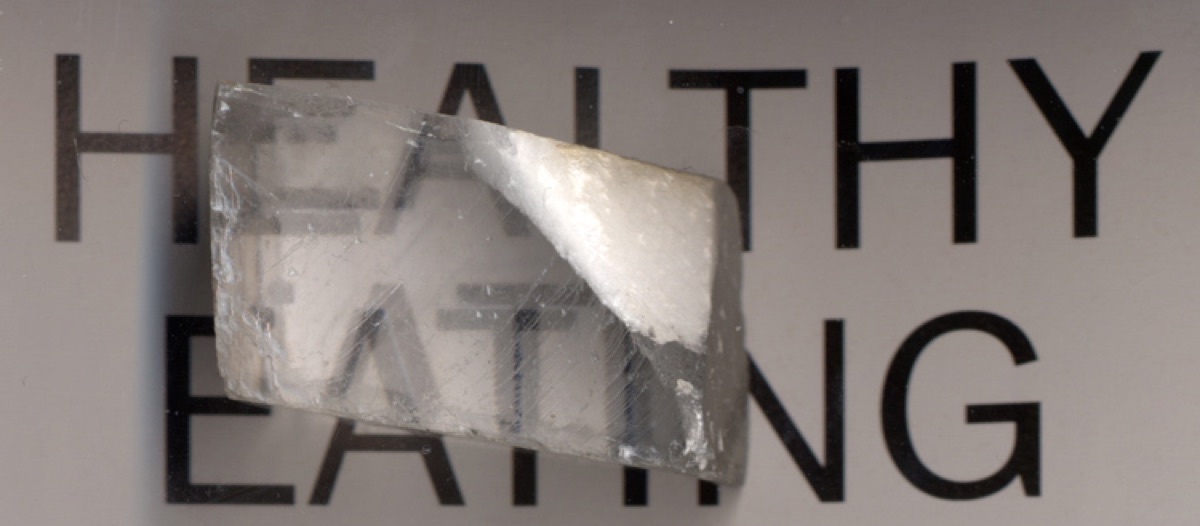
One crystal can act like a mirror and a pane of glass at the same time - depending only on which way you turn it. Researchers have just put hard numbers on that strange behavior, reporting that a layered material called molybdenum oxychloride (MoOCl2) bends light more powerfully than almost any natural material ever measured. The headline figure - an in-plane birefringence of roughly 2.2 - sails past calcite, the mineral that held the title for more than a century, and it arrives with an unusual bonus: a rare epsilon-near-zero point sitting in visible green light. For the engineers trying to shrink augmented-reality optics down to something you could wear in a contact lens, that combination is close to a wish list.
Here is what was actually measured, why it is a milestone, the physics that makes one crystal behave like two different materials, and what it could mean for the glasses and lenses on the horizon.
- Material: molybdenum oxychloride (MoOCl2), a layered van der Waals crystal
- In-plane birefringence: ~2.2 - more than 10x calcite (~0.17), several times rutile (~0.29)
- Special bonus: a visible-frequency epsilon-near-zero point at 512 nm (green light)
- Optical chameleon: reflects like metal along one axis, transparent like glass across the other
- Why it is useful: optics could be thousands of times thinner than a human hair
- Possible uses: ultrathin AR glasses, on-eye displays, smart contact lenses, broadband polarizers, photonic chips
- Published in: Nano Letters (ACS) - DOI 10.1021/acs.nanolett.5c06153
- Who: XPANCEO (Dubai) with the National University of Singapore and the University of Chemistry and Technology, Prague
1. First, What Is Birefringence?
Most transparent materials treat light the same in every direction: one beam goes in, one beam comes out. A birefringent material does something stranger - it splits a single ray into two that travel at different speeds and bend by different amounts. Look at text through a clear slab of calcite (Iceland spar) and you see it doubled. That double vision is the visible signature of birefringence, and the size of the effect is captured by a number, Δn, the difference between the material's two refractive indices.
For over a century, calcite was the practical champion of strong, usable birefringence. The bigger that number, the more sharply a material can separate, steer, or filter light - and the thinner you can make the optical component that does the job. So a material with a very large Δn is not a curiosity; it is a shortcut to smaller, lighter optics.
2. Why 2.2 Is a Milestone
Against that backdrop, MoOCl2's in-plane birefringence of about 2.2 is enormous. Here is how it stacks up against well-known optical materials (approximate visible-light values):
| Material | Birefringence (Δn) | Note |
|---|---|---|
| Quartz | ~0.009 | Common, very weak |
| Calcite | ~0.17 | The century-long benchmark |
| YVO4 (synthetic) | ~0.22 | Used in telecom optics |
| Rutile (TiO2) | ~0.29 | A strong natural performer |
| MoOCl2 | ~2.2 | One of the strongest ever measured in a natural material |
In other words, MoOCl2 bends light more than an order of magnitude harder than calcite and roughly seven to eight times harder than rutile. The team reported the value as part of a complete map of the crystal's optical properties - its full dielectric tensor - which is the difference between a fun observation and something an engineer can design around.
3. The Optical Chameleon: Mirror One Way, Glass the Other
The most eye-catching trick is directional. Send light at MoOCl2 polarized along one axis and the crystal reflects it like a polished metal. Rotate the polarization 90 degrees and the same crystal turns transparent, behaving like ordinary glass. A single flake is, in effect, two optical materials in one.
The reason is beautifully simple. Inside MoOCl2 are one-dimensional chains of molybdenum atoms. Electrons can glide freely along those chains - that direction behaves like a metal, which is why it reflects - but they are hemmed in across the chains, so that direction behaves like an insulating dielectric, which is why it transmits. That built-in lopsidedness is what produces both the giant birefringence and the chameleon effect.
A material's permittivity (the Greek letter epsilon) describes how its electrons respond to light. When epsilon passes through zero, light inside the material behaves in exotic ways - its wavelength stretches out and the phase can become nearly uniform across the slab, which is prized for steering and concentrating light. Most known epsilon-near-zero materials hit that point in the infrared. MoOCl2 reaches it at 512 nm - visible green light, which is rare and especially handy for displays you actually look through.
4. Why This Matters for AR Glasses and Smart Contact Lenses
Here is the through-line to consumer technology. The single hardest problem in augmented-reality eyewear is size: the optics that route and shape light have to be tiny, light, and stackable, or the glasses end up bulky. The stronger a material bends light, the thinner the component you need to do a given job. A birefringence of 2.2 means polarizers, waveguides and lenses could be made thousands of times thinner than a human hair.
The researchers point to a concrete shortlist of uses: ultrathin AR glasses and on-eye displays, smart contact lenses, ultrathin broadband polarizers, sub-diffractional waveguides, and enhanced nonlinear photonic chips. It is the kind of building-block result that does not make a product by itself, but quietly removes a ceiling for a whole category of devices.
5. Who Did It - and Why a Lens Company Cares
The discovery has a fitting home. It was led by XPANCEO, a Dubai-based deep-tech company that became the UAE's newest unicorn in 2025 after a $250 million round valued it at about $1.35 billion. XPANCEO is building AI-powered smart contact lenses - prototypes have included AR vision, wireless data and charging, and health-sensing lenses that read signals like eye pressure and glucose from tear fluid - so a material that could thin out on-eye optics is squarely in its wheelhouse. The company worked with optics groups at the National University of Singapore and the University of Chemistry and Technology, Prague, on the measurements.
Corresponding author Dr. Valentyn Volkov, XPANCEO's founder and CTO, framed the contribution as turning a striking effect into usable engineering data: “Observing a phenomenon is the first step, but engineering requires precise numbers.” The team added that by “rigorously measuring the complete dielectric tensor of MoOCl2,” the work “provides the experimental foundation needed to understand why this material behaves the way it does.”
What Comes Next
- From flake to fab. The measurements were made on small crystals; growing MoOCl2 uniformly and at scale is the next engineering milestone before it reaches real devices.
- Designing with the numbers. Now that the full optical fingerprint is published, optics teams can model lenses, polarizers and waveguides that exploit the 2.2 birefringence and the 512 nm epsilon-near-zero point.
- A widening family. MoOCl2 joins a fast-growing class of layered van der Waals crystals with outsized optical properties - a toolbox that keeps getting richer for the wearables of the next decade.
Sources
- Nano Letters (ACS): Giant Optical Anisotropy and Visible-Frequency Epsilon-near-Zero in Hyperbolic van der Waals MoOCl2 (DOI 10.1021/acs.nanolett.5c06153)
- EurekAlert!: a crystal with two optical faces shows one of the strongest light-bending effects in a natural material
- ScienceDaily: this strange crystal acts like metal and glass at the same time · SciTechDaily: bends light like nothing else in nature
- AGBI: Dubai's smart contact lens developer XPANCEO joins the unicorn club ($250M, ~$1.35B valuation)
Curated by Jerry Cards - jerrycards.com. We track the week's most consequential tech and science so you don't have to. More at jerrycards.com/news.