
 العربية
 Español
 中文
中文 Deutsch
 Français
 Português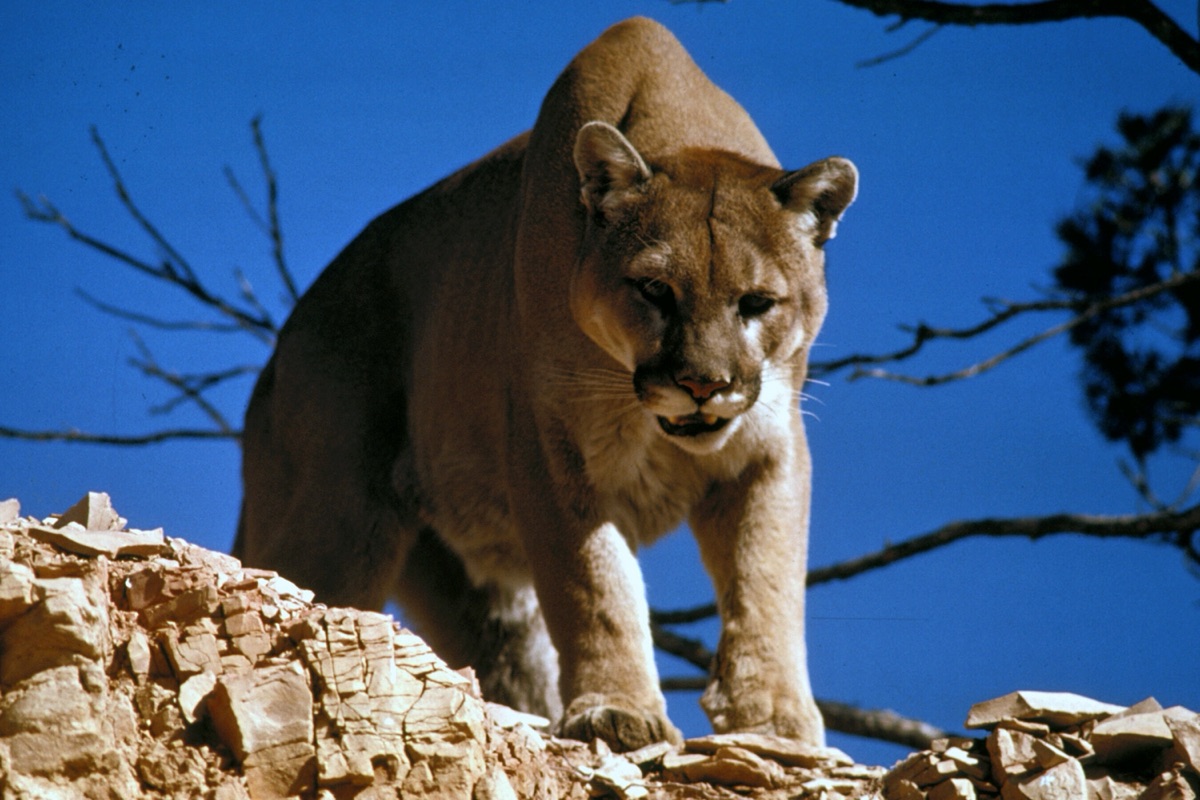
The most famous wildlife comeback story of the last half-century is set in Yellowstone. Wolves return after a 70-year absence, elk stop loitering in the valleys, willows and aspen rebound, beavers come back, even the rivers are said to change course. It is the textbook image of a trophic cascade - the idea that a single top predator can ripple all the way down an ecosystem. And quietly baked into that story was an assumption: that you need a vast, wild, mostly people-free landscape for the magic to work.
A new Stanford study, published in Ecology and Evolution in June 2026, gently overturns that assumption. Its setting is about as un-wild as a nature preserve gets: 1,190 acres of California oak woodland wedged between the suburbs of Silicon Valley, a short drive from Stanford lecture halls and tech campuses. And yet, the researchers report, when mountain lions began spending more time there, the whole community of animals - and even the plants - started to shift.
- Where: Stanford's Jasper Ridge Biological Preserve ('Ootchamin 'Ooyakma), ~1,190 acres (483 ha), Portola Valley, California - about 45 miles south of San Francisco
- What: Mountain lion (Puma concolor) activity rose over a nine-year window of motion-triggered camera-trap monitoring
- The cascade: as pumas grew more present, deer activity fell, coyotes and bobcats pulled back, prey and mesopredators became less nocturnal, and woody plants - young oaks included - grew denser
- How they tested it: three independent analyses, including convergent cross mapping (a causal-inference method for time series)
- The honest caveat (authors' own): a corroborating but preliminary signal; effects on foxes, rabbits and plants remain provisional
- The big idea: trophic cascades can happen in small, suburban preserves - if they stay connected to large wild landscapes
- Published: Ecology and Evolution 2026, vol. 16(6), DOI 10.1002/ece3.73775
1. An apex predator moves back in
The mountain lion goes by more common names than almost any animal on Earth - puma, cougar, panther, catamount - and once ranged across nearly all of the Americas. In California it never fully disappeared, and in the hills around the San Francisco Bay it has been slowly reclaiming ground. A single adult can roam a home range of roughly 20 to 170 square kilometers (about 8 to 66 square miles), which is exactly why a 1,190-acre island of habitat seems, on paper, far too small to host a functioning predator.
Stanford has monitored Jasper Ridge with networks of motion-triggered cameras for roughly two decades, building one of the longer continuous records of a mammal community anywhere near a major city. Beginning around 2015, the cameras started catching pumas more and more often. Over a nine-year span, the researchers documented a sustained rise in puma activity - and used that natural experiment to ask a simple question: when a top predator returns to a small, human-surrounded preserve, does anything downstream actually change?
2. The cascade, step by step
The pattern the team describes is a classic cascade, scaled down to a suburban footprint. It runs along two linked chains.
| Trophic level | What happened as pumas increased |
|---|---|
| Apex predator - mountain lion | Activity rose over nine years |
| Large prey - black-tailed deer | Activity declined |
| Mesopredators - coyotes, bobcats | Activity declined |
| Smaller predator - grey fox | Appeared to increase (provisional) |
| Vegetation - woody plants, young oaks | Grew denser (provisional) |
The first chain is the headline tri-trophic cascade: more pumas, fewer and warier deer, and - where deer browse less - a chance for young trees to get established. The second chain is a mesopredator story: big cats suppress the activity of coyotes and bobcats, which in turn appears to give a smaller carnivore, the grey fox, more room to operate. Both chains point the same direction, which is part of why the authors find the overall picture convincing even while individual links remain tentative.
A predator does not have to eat an animal to change its behavior. The mere risk of being hunted reshapes where and when prey move, feed and rest. Ecologists call this non-lethal influence the ecology of fear (or “landscape of fear”). At Jasper Ridge, one of its clearest signatures was timing: deer and mesopredators became less nocturnal, apparently shifting their activity away from the night-and-twilight hours when pumas do most of their hunting. The herd does not need to shrink for the woods to change - the animals just need to behave differently.
3. Three ways of looking at the same nine years
Long-term field data are messy, and correlation is famously not causation - especially in an ecosystem where weather, drought and human visitors all vary year to year. So the team leaned on three complementary analyses rather than a single statistic.
| Analysis | What it asked | What it found |
|---|---|---|
| Convergent cross mapping | Did puma activity causally drive changes in prey and mesopredators (not just move alongside them)? | Yes - pumas influenced longitudinal changes in deer, coyote and bobcat activity |
| Daily activity patterns | Did prey and mesopredators shift when they were active? | Yes - both became less nocturnal, consistent with avoiding pumas |
| Plant community surveys | Did reduced deer pressure show up in the vegetation? | Woody plant density rose as puma activity rose (from just three surveys over 17 years) |
Convergent cross mapping is the technical heart of the paper. Borrowed from complex-systems science, it tests whether the history of one variable is encoded in the dynamics of another - a way of probing for causal influence in tangled, real-world time series where you cannot run a controlled experiment. Here, it pointed to the pumas as a genuine driver, not a bystander.
4. Why a 1,190-acre result is a big deal
The instinct is to shrug: of course a top predator affects its neighbors. But the significance is geographic. The celebrated cascades - Yellowstone's wolves, sea otters and kelp forests along the Pacific coast - all unfold across enormous, relatively wild expanses. The open question has been whether the same dynamics survive in the small, fragmented, people-saturated patches that make up most of the world's protected land.
The numbers make the stakes concrete: roughly 82% of protected areas in the United States are smaller than 5 square kilometers. If apex-predator ecology only functioned in giant wildernesses, the overwhelming majority of protected land could never be fully alive in the ecological sense. Jasper Ridge is a hopeful counter-example - but it comes with a crucial condition. The preserve is not truly isolated; it is stitched to the much larger wild country of the Santa Cruz Mountains, which is what allows wide-ranging pumas to filter in at all. The lesson is less about any single patch and more about the corridors between patches.
“They are not just things that happen in places like Yellowstone, far away from the city and people. They can happen in these places that are quite small.”
- Chinmay Sonawane, lead author, Stanford University
Co-author Rodolfo Dirzo frames the flip side - what is lost when the top of the chain goes missing: “When one piece is missing - and it's typically the top predators that require larger areas and are more sensitive to human impact - we will no longer have fully functioning ecosystems.”
And there is a nice symmetry the team is careful to note: the fear runs both ways. Senior author Elizabeth Hadly points out that the pumas themselves are reacting to us - “Pumas are afraid of our smell and our sounds; they don't like to see us moving,” she says. “Clearly, we exert our own ecology of fear.” The cat that restructures the woodland is itself tiptoeing around the humans next door.
5. The honest limitations
This is a study that wears its uncertainty openly - and good science reporting should too. The authors describe their results as “corroborating, preliminary signals,” not a closed case.
- It is observational, not experimental. No one added or removed pumas on purpose. Convergent cross mapping strengthens the causal read, but a natural experiment can never fully rule out other drivers (drought, human visitation, prey disease).
- The lower-cascade links are provisional. The paper is explicit that inferences about grey foxes, brush rabbits and woody plants “remain provisional and warrant stronger empirical confirmation.”
- The plant evidence is thin. The vegetation conclusion rests on just three surveys spread across a 17-year period - suggestive, not definitive.
- It is a single site. One preserve, however well-monitored, is one data point. Whether the pattern generalizes to other small, connected reserves is the obvious next question.
None of this undercuts the core finding; it sharpens it. The headline is not “pumas fixed an ecosystem,” but rather “the fingerprints of a real trophic cascade showed up somewhere we did not expect to find them.”
The takeaway
For anyone who has ever worried that big predators and dense human settlement simply cannot coexist, Jasper Ridge offers a quietly optimistic data point. A mountain lion does not need a Yellowstone to earn its keep. Given a foothold and a corridor to the wider wild, it can slip into a patch of suburban oak woodland and, without fanfare, help keep the place in balance - thinning the browse, nudging the smaller hunters, giving the next generation of oaks a chance. The practical to-do that follows is not glamorous, but it is clear: protect not just the patches of habitat we love, but the connections between them. The wildlife will handle the rest.
Sources
- Sonawane, C., Leempoel, K., Nova, N., Meyer, J. M., Hebert, T., Zuckerwise, A., Dirzo, R., & Hadly, E. A. (2026). Mammal Community Responses to Increasing Puma Activity in a Suburban Preserve. Ecology and Evolution, 16(6). DOI 10.1002/ece3.73775
- Stanford Report: Mountain lions have major ecological impact even in a small preserve
- Phys.org coverage · Jasper Ridge Biological Preserve
Curated by Jerry Cards - jerrycards.com. We research the week's most consequential science, tech, and health stories so you don't have to. More at jerrycards.com/news.