
 العربية
 Español
 中文
中文 Deutsch
 Français
 Português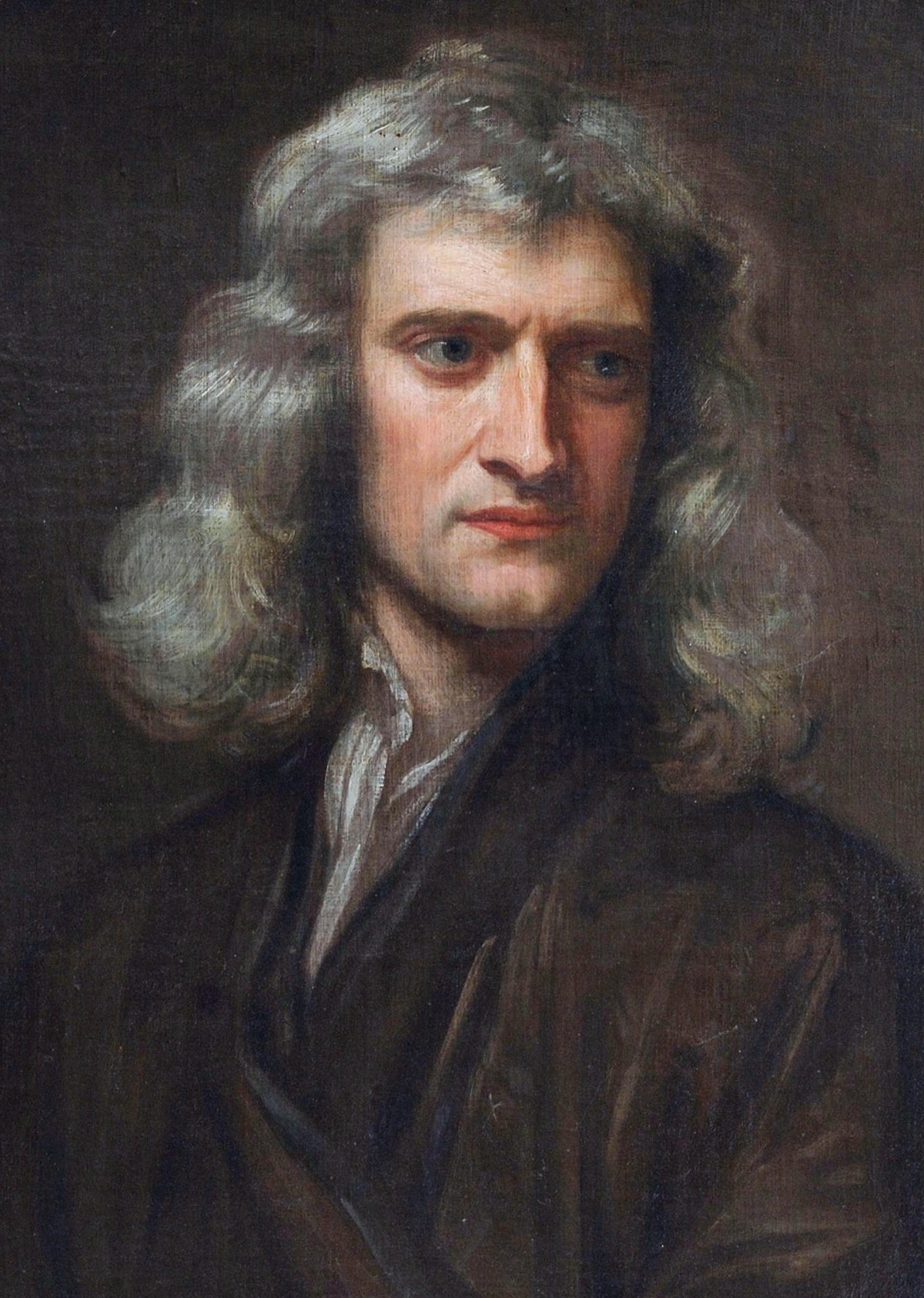
In 1687, a single book took the falling of an apple and the orbit of the Moon - two things that had never been thought to have anything to do with each other - and proved they obey the exact same law. The book was Philosophiae Naturalis Principia Mathematica (the Mathematical Principles of Natural Philosophy), written by Isaac Newton, and it is, by wide agreement, the most important book in the history of physics. In its pages the heavens and the Earth stopped being two separate realms and became one universe, running on rules simple enough to write down - and precise enough to predict the future.
This is a tribute to how Newton did it, the laws he gave us, and why - more than three centuries later - his equations still fly our rockets.
- Who: Sir Isaac Newton (1642–1727), Lucasian Professor of Mathematics at Trinity College, Cambridge
- When: the first of its three books was presented to the Royal Society in April 1686; the first edition is traditionally dated to 5 July 1687
- What: three laws of motion that describe every moving thing, plus the law of universal gravitation
- The big idea: the force that pulls an apple to the ground is the same force that holds the Moon in orbit - one law for Earth and sky
- The payoff: Kepler’s laws, the tides, comets and eclipses all became calculable; Halley used it to predict a comet’s return in 1758
1. The apple and the Moon
Newton himself told the story of the apple. In a memoir written in 1752, his friend William Stukeley recalled Newton saying that “the notion of gravitation came into his mind… occasion’d by the fall of an apple, as he sat in a contemplative mood.” The question that struck him was not that the apple fell, but why: why straight down, toward the centre of the Earth?
The leap of genius was to ask how far that pull reaches. If it reaches the top of a tree, why not the top of a mountain? Why not all the way to the Moon? And if the Earth’s gravity reaches the Moon, then the Moon is also falling - constantly falling toward the Earth, but moving sideways so fast that it keeps missing, curving forever around instead of crashing down. The apple and the Moon are doing the same thing. That single thought - that the earthly and the heavenly are governed by one law - is the seed of the whole Principia.
2. Three laws of motion
Before gravity, Newton needed to say precisely what motion is. In a section titled “Axioms, or Laws of Motion,” he laid down three that have governed engineering ever since:
| Law | What it says | In everyday terms |
|---|---|---|
| First (inertia) | A body stays at rest, or moving steadily in a straight line, unless a force acts on it | Things do not stop or turn on their own - something has to push them |
| Second (force) | A force changes a body’s motion in proportion to the force, along the line it is applied (F = ma) | Push harder, or push a lighter thing, and it speeds up more |
| Third (reaction) | To every action there is an equal and opposite reaction | The reason a rocket rises: it throws gas down, the gas pushes it up |
These three sentences are enough to describe a thrown ball, a spinning top, a bridge under load, a car in a crash and a spacecraft between planets. They are still the first thing every physics and engineering student learns.
3. One law for the whole universe
Then came the crown jewel: the law of universal gravitation. Newton proposed that every mass in the universe attracts every other mass, with a force that grows with the product of their masses and shrinks with the square of the distance between them.
F = G × (m₁ × m₂) / r² — double the distance, and the pull drops to a quarter; the same rule for an apple, a cannonball, the Moon and the planets.
The word that matters is universal. The same equation that describes a stone dropping in a field also describes the Earth circling the Sun. There was no longer one physics for the ground and another for the sky - just one, everywhere. (Newton stated the law as a proportion; the constant G that turns it into a precise number was first measured in the laboratory by Henry Cavendish in 1798, more than a century later.)
4. The System of the World
The Principia is written in three books. The first two build the machinery of motion; the third, titled De mundi systemate (“On the System of the World”), turns it loose on the cosmos. One after another, ancient mysteries fell:
- Kepler’s laws. Kepler had found, by painstakingly fitting data, that planets move in ellipses and sweep out equal areas in equal times. Newton derived those laws from gravity in a few strokes - showing why they must be true.
- The tides. The twice-daily rise and fall of the seas turned out to be the Moon and Sun tugging on the oceans.
- The precession of the equinoxes. A 26,000-year wobble in the Earth’s axis, noticed by the Greeks, became the pull of the Sun and Moon on the Earth’s bulging middle.
- Comets. Long feared as omens, comets became ordinary members of the Solar System, riding elongated orbits under the same gravity as everything else.
The astronomer Edmond Halley - the same man who had persuaded Newton to write the Principia and paid for its printing - used Newton’s gravity to do something unprecedented: predict the future. He calculated that a comet seen in 1682 would return in 1758. Halley died in 1742 and never saw it. But on Christmas night 1758, the comet reappeared, right on schedule. It was the first time humanity had ever forecast an event in the heavens - and it carries Halley’s name to this day.
5. How the book came to be
The Principia almost never happened. In 1684 Halley visited Newton in Cambridge and asked what curve a planet would trace under an inverse-square pull. Newton answered, instantly, “an ellipse” - he had worked it out years before and mislaid the proof. Halley, astonished, pressed him to write it up. Over the next eighteen months Newton poured himself into the problem, and the trickle of pages grew into a three-volume masterwork. The Royal Society’s funds were low, so Halley quietly covered the cost of printing himself.
Newton wrote in Latin, the shared language of European scholarship, and in the austere style of classical geometry. He revised it twice more in his lifetime - a second edition in 1713, edited by Roger Cotes, and a third in 1726, edited by Henry Pemberton. It was in the essay added to the second edition, the General Scholium, that Newton wrote his famous refusal to speculate about what gravity is: “Hypotheses non fingo” - “I do not feign hypotheses.” He could not say what caused gravity; he could describe exactly what it does, and that was enough to remake science.
6. Why it still matters
Newton’s mechanics reigned essentially unchallenged for more than two hundred years. It powered the machines of the Industrial Revolution, the bridges and engines of the modern world, and - three centuries on - the trajectories that carried astronauts to the Moon and probes to the edge of the Solar System.
In the twentieth century, Einstein showed that Newton’s picture is an approximation - superbly accurate at everyday speeds and gravities, but giving way to relativity near the speed of light or a black hole. Yet that has barely dented Newton’s reach. For almost everything that moves in human experience, engineers still reach for his three-century-old laws first, because they are, to breathtaking precision, right.
We remember Newton for an apple. The deeper marvel is what he made of it: he showed that the same few rules run the whole universe, that those rules can be written on a page, and that once you know them you can predict what the cosmos will do next. Before the Principia, the sky was something we watched. After it, the sky was something we could calculate.
Sources & further reading
- Wikipedia: Philosophiæ Naturalis Principia Mathematica · Isaac Newton · Newton’s laws of motion
- The Royal Society: the Principia and Halley’s role in its publication
- Encyclopaedia Britannica: Edmond Halley and the comet prediction · the Cavendish experiment (measuring G, 1798)
- The Newton Project: William Stukeley’s 1752 memoir - the apple story in Newton’s own recollection
- Image: portrait of Isaac Newton after Sir Godfrey Kneller (1689), public domain, via Wikimedia Commons
Curated by Jerry Cards - jerrycards.com. Our 致敬 (tribute) series celebrates the landmark papers and discoveries that quietly built the modern world. More at jerrycards.com/news.