
 العربية
 Español
 中文
中文 Deutsch
 Français
 Português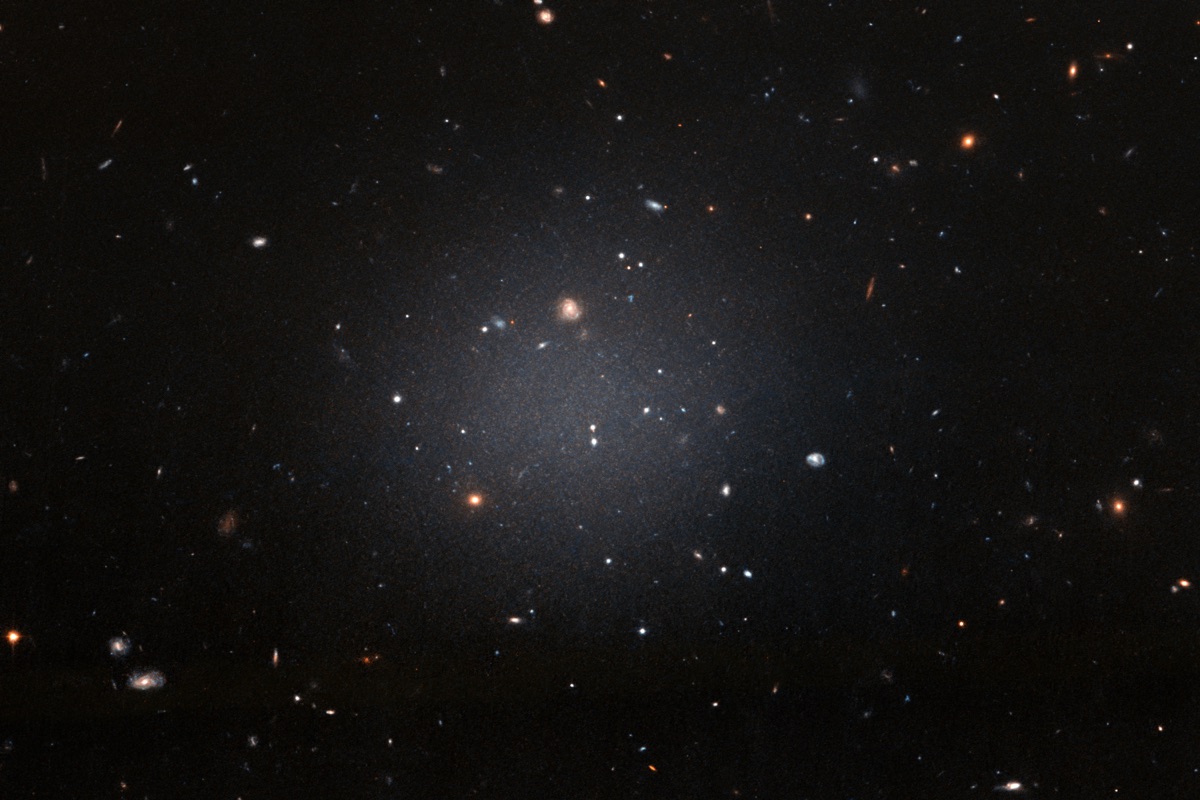
Here is one of the most delightful paradoxes in modern astronomy: the best way to prove that dark matter exists may be to find a galaxy that has almost none of it. On June 16, 2026, a Yale-led team announced exactly that - a third galaxy, NGC 1052-DF9, that appears to be missing its dark matter. And the discovery comes with a twist no one expected: this galaxy and its two known siblings all sit along a single, perfectly straight line across the sky, part of a string of about ten faint galaxies. “A line of galaxies lacking dark matter has never been seen before,” says lead author Michael Keim. Far from breaking our picture of the universe, it may be one of the strongest pieces of evidence yet that the picture is right.
Here is what they found, how they weighed a galaxy 65 million light-years away, and why “missing” dark matter is such good news for the theory.
- What: NGC 1052-DF9 (DF9), a faint dwarf galaxy that appears to contain almost no dark matter
- Where: ~65 million light-years away, in the NGC 1052 galaxy group
- Mass: ~100 million solar masses (about what its visible stars alone weigh) - roughly 100x less than a normal galaxy its size should have
- The twist: DF9 joins DF2 (2018) and DF4 (2019) along the same straight line - part of a chain of ~10 faint galaxies
- Tools: the Keck Cosmic Web Imager (W. M. Keck Observatory, Maunakea) plus the Hubble Space Telescope
- Published: The Astrophysical Journal, June 16, 2026 (DOI 10.3847/1538-4357/ae6b8d)
1. A galaxy that weighs only what you can see
Almost every galaxy ever studied is dominated by dark matter - the invisible material, detectable only by its gravity, that makes up roughly 85% of all matter in the universe and acts as the scaffolding on which galaxies are built. A galaxy the size of DF9 should sit inside a halo of dark matter weighing on the order of 10 billion solar masses, with its visible stars contributing only a small fraction of the total.
DF9 does not behave that way. When the team measured it, the galaxy came out to about 100 million solar masses - essentially just the mass of the stars you can see. The other roughly 99% simply is not there. As Keim put it: “Almost every galaxy in the universe is dominated by dark matter. But DF2, DF4, and now DF9 appear to be extraordinary exceptions.”
2. How do you weigh a galaxy 65 million light-years away?
You watch how fast its stars move. Gravity is the only thing holding a galaxy together, so the more mass a galaxy contains - visible and dark - the faster its stars must travel to stay bound. Measure the spread of those stellar speeds (astronomers call it the velocity dispersion) and you can back out the total mass.
In a heavy, dark-matter-rich galaxy, stars whip around quickly because there is a huge unseen mass pulling on them. In DF9, the stars drift gently. That slow, lazy motion is the tell-tale sign that there is very little extra mass - very little dark matter - tugging on them.
To catch that subtle motion in such a dim galaxy, the team turned to the Keck Cosmic Web Imager (KCWI) at the W. M. Keck Observatory on Maunakea, an instrument built specifically to tease apart faint starlight, with imaging support from the Hubble Space Telescope. These same ultra-diffuse, “see-through” galaxies were first brought to light by the wide-field Dragonfly Telephoto Array, the low-surface-brightness survey instrument co-built by van Dokkum and Roberto Abraham of the University of Toronto.
3. The line that should not exist
A single oddball galaxy is a curiosity. A row of them is a story. DF9 is the third dark-matter-free galaxy confirmed in the NGC 1052 group, and the remarkable thing is that all three lie along the same thin, straight track - threaded among a chain of about ten faint galaxies in total.
| Galaxy | First reported | Dark matter |
|---|---|---|
| NGC 1052-DF2 | 2018 | Little to none |
| NGC 1052-DF4 | 2019 | Little to none |
| NGC 1052-DF9 | 2026 | Little to none |
When DF2 was first announced in 2018, some astronomers wondered if it was a fluke or a measurement error. DF4 made it a pair. DF9, lined up with the other two, turns a coincidence into a pattern - and patterns point to a cause.
4. The cosmic collision that explains it
The leading explanation is wonderfully visual. Imagine two larger, gas-rich galaxies meeting in a high-speed, head-on collision. Their behavior splits in two:
- Dark matter sails straight through. Because it barely interacts with anything - including itself - the dark matter of both galaxies passes through the wreck almost untouched and keeps going.
- The gas gets stuck. Ordinary gas does interact. It collides, shocks, heats, and piles up in the middle, left behind as the dark matter races away.
That stranded knot of gas then cools and fragments, collapsing into a row of small new galaxies - built from ordinary matter alone, and strung out like beads along the path of the original crash. The straight line of DF2, DF4, and DF9 is exactly the fingerprint such an event would leave.
This is the same physics that produced the famous Bullet Cluster, where two galaxy clusters collided and astronomers watched the dark matter (mapped by gravitational lensing) cleanly separate from the hot gas (glowing in X-rays). DF9 and its siblings look like a small-scale, slow-motion version of that cosmic crash - a “bullet” among dwarf galaxies.
5. Why “missing” dark matter is great news for dark matter
This is the part that flips intuition. You might expect a galaxy with no dark matter to be a problem for the dark-matter theory. It is the opposite - and the reason is elegant.
There are broadly two ways to explain why galaxies seem to contain far more gravity than their visible stars can account for. Either there is a real, invisible substance (dark matter), or our law of gravity needs modifying on galactic scales (the main alternative, often called modified gravity or MOND). The crucial difference: a substance can be physically separated from stars and gas. A modified law of gravity cannot - it would always travel with the visible matter, because it is just a rule about how visible matter behaves.
So a galaxy where the “extra gravity” has been peeled cleanly away from the stars is something only the dark-matter picture can produce. As senior author Pieter van Dokkum of Yale framed it, the finding offers compelling evidence that dark matter behaves as a physical substance rather than as an effect of an alternative theory of gravity. Three of these galaxies, lined up in a row, make that argument three times over.
6. The team and what comes next
The study was led by Yale Ph.D. student Michael Keim with senior author Pieter van Dokkum (Sol Goldman Family Professor of Astronomy and Professor of Physics at Yale), alongside co-authors Zili Shen (a former Yale Ph.D. student), Imad Pasha (a Yale postdoctoral researcher), and Shany Danieli (an astronomer at Princeton).
Their next goal is to trace the full chain of galaxies and hunt for the larger galaxies whose ancient collision may have seeded this entire string - a chance to watch, in fossil form, one of the cleanest natural experiments the universe has ever run on the nature of dark matter.
A galaxy almost devoid of dark matter sounds like a contradiction. It is actually a gift: a place where nature separated the invisible from the visible and let us see the seam. Three of them in a perfect line turn a one-off oddity into a repeatable story about how dark matter - and ordinary matter - really behave.
Sources
- Yale News: Third time’s the charm for a row of faint galaxies without dark matter
- W. M. Keck Observatory: Astronomers Discover Third Galaxy Without Dark Matter
- The Astrophysical Journal (peer-reviewed paper): DOI 10.3847/1538-4357/ae6b8d
- Scientific American: Astronomers discover another galaxy seemingly devoid of dark matter
- ESA/Hubble: A ghostly galaxy lacking dark matter (NGC 1052-DF2)
Image: NGC 1052-DF2, the prototype dark-matter-free galaxy, imaged by Hubble. Credit: NASA, ESA, and P. van Dokkum (Yale University), via ESA/Hubble (CC BY 4.0).
Curated by Jerry Cards - jerrycards.com. We research the week’s most consequential science, tech, and health news so you don’t have to. More at jerrycards.com/news.