
 العربية
 Español
 中文
中文 Deutsch
 Français
 Português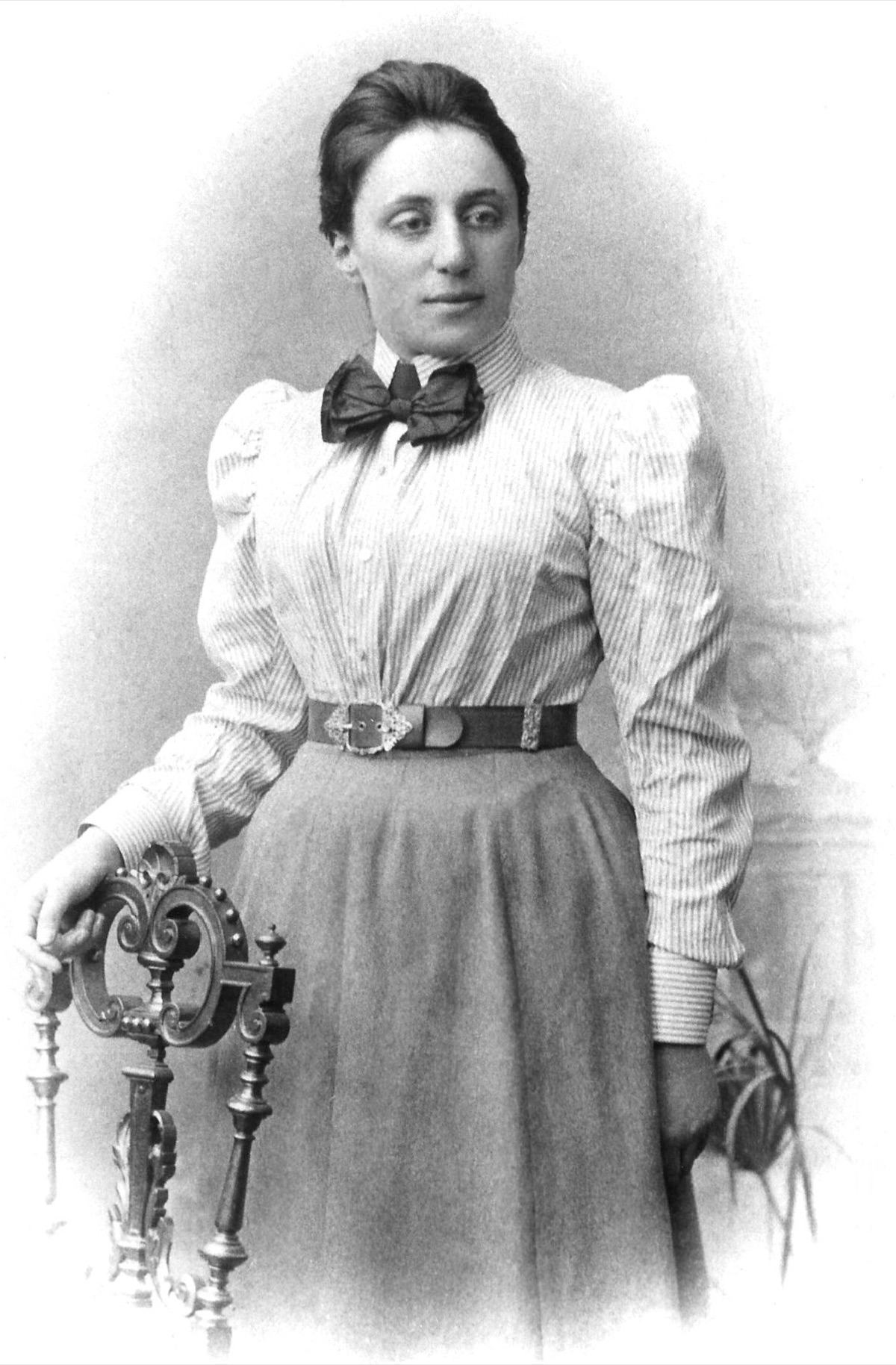
On 26 July 1918, the mathematician Felix Klein stood before the Royal Society of Sciences in Göttingen and read out a paper written by somebody else. He did so because the author was not a member of the Society and could not present it herself — the Society did not admit women. The paper was titled “Invariante Variationsprobleme” (Invariant Variation Problems). Its author was Emmy Noether. And it contained a result that many working physicists will, without much hesitation, call the most beautiful thing in their field.
Noether had proved that the conservation laws — the rules that say energy and momentum can never simply appear or vanish — are not independent facts about the universe at all. Each one is the visible shadow of a symmetry. This is a tribute to that theorem: what it says, the century-old puzzle it solved, and why every physicist alive still leans on it.
- Title: Invariante Variationsprobleme (Invariant Variation Problems)
- Author: Emmy Noether (1882–1935)
- Published: Nachrichten von der Gesellschaft der Wissenschaften zu Göttingen, Mathematisch-Physikalische Klasse, 1918, pp. 235–257
- Presented: by Felix Klein at the meeting of 26 July 1918 — Noether was not a member of the Society
- What it proved: Noether’s first theorem — every continuous symmetry of a physical system’s action corresponds to a conserved quantity; and Noether’s second theorem — local (gauge) symmetries instead produce identities among the equations of motion
- Why it matters: it explains why energy, momentum and angular momentum are conserved, and it is the mathematical backbone of gauge theory and the Standard Model of particle physics
1. The rules nobody could explain
By 1918, physics had a collection of conservation laws that worked superbly and made no sense. Energy is never created or destroyed. Momentum is never lost, only passed along. Angular momentum keeps a spinning skater spinning. These were the most reliable statements in all of science, confirmed by every experiment anyone could devise.
But why? Nobody could say. They looked like brute facts — house rules the universe happened to follow, discovered one at a time by careful measurement, with no obvious family resemblance between them. Conservation of energy and conservation of angular momentum seemed to be entirely different discoveries that just happened to share a shape.
2. Noether’s answer: they are all the same fact
Noether’s first theorem states, in plain language:
A symmetry here means something you can change about your situation without changing the laws that govern it. Slide your experiment three metres to the left; the physics is identical. Run it tomorrow instead of today; identical. Turn the whole apparatus forty degrees; identical. Each of those indifferences, Noether proved, forces a quantity to be conserved — and the mathematics tells you exactly which one.
| The symmetry | In plain English | What is conserved |
|---|---|---|
| Time translation | The laws of physics work the same today as tomorrow | Energy |
| Space translation | The laws work the same here as a mile away | Linear momentum |
| Rotation | Space has no preferred direction | Angular momentum |
| Gauge symmetry (phase) | A hidden internal dial can be turned with no observable effect | Electric charge |
The middle column is worth pausing on, because it is where the strangeness lives. Energy is conserved because the laws of physics do not change with time. That is not a metaphor or a loose analogy — it is a theorem. A fact that had looked like careful cosmic bookkeeping turned out to be a statement about the architecture of reality. If the rules of physics did drift from century to century, energy conservation would simply fail, and Noether’s mathematics says precisely how.
3. The puzzle that started it: energy in Einstein’s universe
Noether did not set out to write the deepest paper in physics. She was solving somebody else’s problem.
In April 1915, David Hilbert and Felix Klein invited her to Göttingen specifically because they were stuck. Einstein’s brand-new general theory of relativity had a disquieting feature: energy conservation in it behaved unlike energy conservation anywhere else in physics. The usual law seemed to dissolve into something weaker and stranger, and the finest mathematicians in the world could not decide whether this was a deep truth or a defect in the theory.
Noether’s second theorem settled it. The distinction, she showed, is between global symmetries (shift the whole universe three metres left) and local symmetries (relabel coordinates differently at every single point, which is exactly what general relativity allows). Global symmetries give you honest conserved quantities. Local symmetries do something different: they generate identities among the equations of motion themselves. General relativity was not broken. Its symmetry is local, so a locally-symmetric theory must treat energy this way. There was nothing to fix.
The second theorem was, for decades, the less celebrated one. Then physics caught up with it. Local symmetry is now called gauge symmetry, and it turned out to be the organising principle of fundamental physics: electromagnetism, the weak force and the strong force are all gauge theories. The Standard Model of particle physics — our best description of matter — is built on exactly the structure Noether mapped out in 1918, before any of those theories existed.
4. The circumstances
Noether proved all of this while holding no paid position and no academic title.
When Hilbert and Klein brought her to Göttingen in 1915, the faculty refused to grant her the habilitation that would let her lecture in her own name. So for years her courses were advertised under Hilbert’s name, with Emmy Noether listed underneath as providing ‘assistance.’ She was not paid. Hilbert argued with the faculty on her behalf, and a famous retort has been attached to him ever since — that the university was not a bathing establishment — though historians note his exact words were never recorded. She was permitted to habilitate in 1919: one year after the theorem that now carries her name.
She then spent the following decade doing something arguably even larger. Her work on rings, ideals and fields reshaped mathematics so thoroughly that she is generally counted as a founder of modern abstract algebra — the language in which much of pure mathematics has been written ever since.
— Albert Einstein, in a letter to The New York Times, dated 1 May 1935. In the same letter: “Pure mathematics is, in its way, the poetry of logical ideas.”
5. Why it still matters
Noether’s theorem is not a museum piece. It is a working tool, used daily:
- Particle physics. When physicists at the LHC look for new physics, they look for symmetries — because Noether guarantees that a new symmetry means a new conserved quantity, and a broken one means something must give way.
- Spaceflight. Every trajectory ever flown assumes conservation of energy and angular momentum. Noether is the reason those are principles rather than lucky habits.
- Cosmology. The universe is expanding, so it is not symmetric in time — which is why the textbook energy-conservation law does not straightforwardly apply to the cosmos as a whole. That startling fact is a direct reading of her theorem.
- Engineering and simulation. Physics engines and molecular simulators are written to respect symmetries precisely so that energy stays conserved and the model does not drift into nonsense.
- Machine learning. Modern architectures deliberately build in symmetry: a convolutional network works because a cat is a cat wherever it sits in the frame. Encoding what should not change is now a core design instinct — the same instinct Noether formalised.
6. The idea in one sentence
Ask a physicist why energy cannot be created or destroyed and the honest answer, since 1918, is not a shrug. It is this: because the laws of physics are the same today as they will be tomorrow. The universe keeps its promises because it does not care what time it is.
That is Emmy Noether’s theorem. She proved it unpaid, untitled, and read into the record by a colleague because she was not allowed in the room. It has held for more than a century, and every physicist since has built on top of it.
Some papers describe the world. A rare few explain why it holds together.
- Emmy Noether, ‘Invariante Variationsprobleme,’ Nachrichten von der Gesellschaft der Wissenschaften zu Göttingen, Mathematisch-Physikalische Klasse, 1918, pp. 235–257 — the original paper
- M. A. Tavel, English translation: ‘Invariant Variation Problems,’ Transport Theory and Statistical Physics 1 (1971), 186–207 — arXiv:physics/0503066
- Yvette Kosmann-Schwarzbach, The Noether Theorems: Invariance and Conservation Laws in the Twentieth Century (Springer, 2011)
- Albert Einstein, letter to the editor, The New York Times, dated 1 May 1935 — MacTutor History of Mathematics archive
- Biographical detail: MacTutor, Emmy Noether