
 العربية
 Español
 中文
中文 Deutsch
 Français
 Português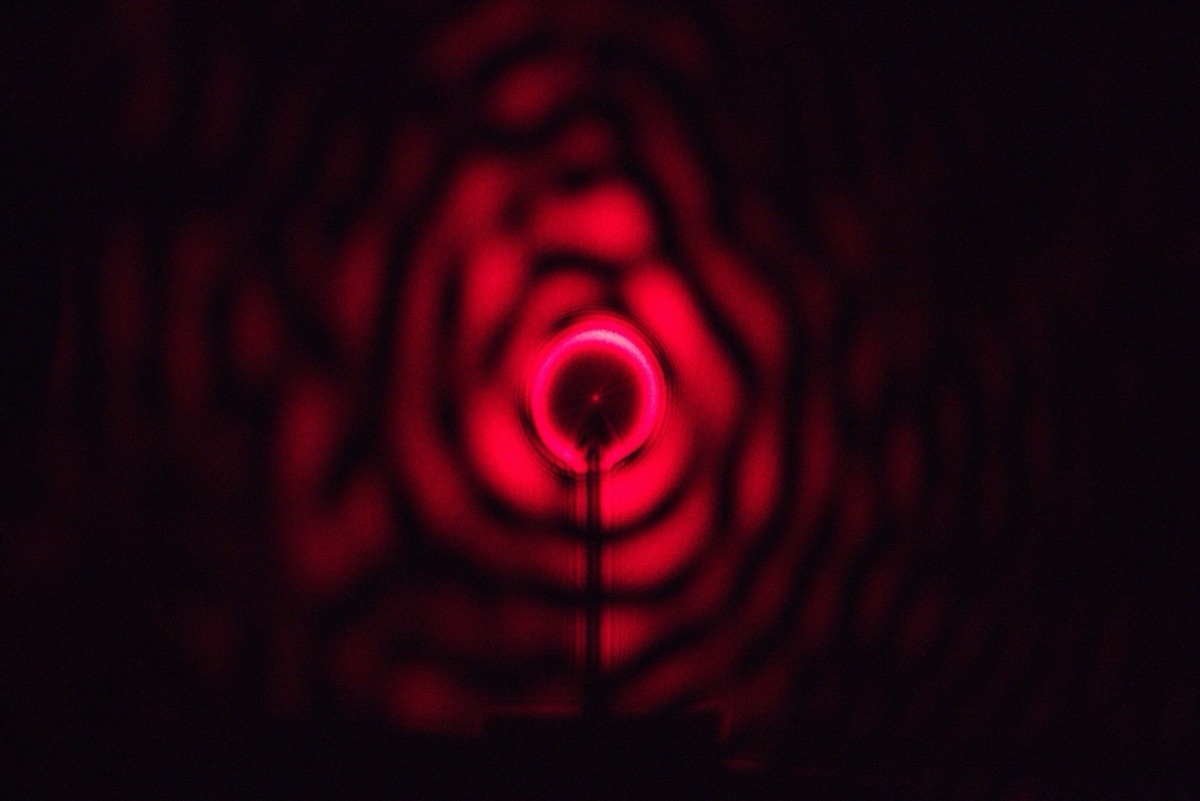
In 1818, a brilliant skeptic tried to use math to prove that light is not a wave — and instead handed physics one of its most beautiful confirmations. The mathematician Siméon Poisson, convinced that light was a stream of particles, took a rival’s new wave theory and pushed it to what he was sure was an absurd conclusion: if light really were a wave, a small round object should cast a shadow with a bright spot at its very center. Ridiculous, he said. Then someone checked — and the spot was there. Now, more than two centuries later, scientists have discovered that this same humble ‘impossible’ spot is a wonderfully simple way to build one of the most exotic and useful structures in modern optics: the optical skyrmion.
- What: the 200-year-old Poisson spot (a.k.a. the spot of Arago) is a simple, cost-free way to create optical skyrmions
- Who: a team led by Assistant Professor Yijie Shen at Nanyang Technological University (NTU Singapore), with first author Jun Yao and colleagues
- How: just shine a laser at a small circular disc — no expensive metamaterials or nanofabrication needed
- Surprise: a single Poisson spot holds four different kinds of skyrmion at once
- Why it matters: skyrmions are exceptionally robust, making them candidates for future data storage, optical communications and light-based computing
- Published: Optica, June 18, 2026 (DOI 10.1364/optica.591840)
1. The 1818 Bet That Backfired
Two hundred years ago, physics was in the middle of a long argument: is light a stream of tiny particles, as Isaac Newton had suggested, or a wave? In 1818 the French Academy of Sciences held a prize competition on the nature of diffraction, and the engineer Augustin-Jean Fresnel entered a bold, mathematically detailed wave theory.
One of the judges was Siméon Denis Poisson, a formidable mathematician — and a firm believer in the particle view. To discredit Fresnel, Poisson worked through his equations and derived what he considered a knockout blow: the wave theory implied that if you shone light past a small circular object, waves bending around every point of its edge would meet perfectly in step directly behind it, producing a bright spot at the exact center of the shadow. To Poisson, a glowing point in the middle of a shadow was self-evidently absurd — proof that the whole wave idea was wrong.
Another judge, the physicist François Arago, decided to actually try it. He set up a small disc and a point-like light source — and there, in the middle of the shadow, was the spot, exactly as the ‘absurd’ math had predicted. The prediction meant to destroy the wave theory instead became one of its most striking confirmations. Fresnel won the prize, and the wave picture of light carried the day. In a final irony, the effect has been known ever since as the Poisson spot — named for the skeptic who was certain it could not exist. (It is also, more justly, called the spot of Arago.)
2. So What Is a ‘Skyrmion’?
To see why a dusty old diffraction trick is suddenly exciting, you need to know what an optical skyrmion is — and that story also starts with a bit of history. In the early 1960s the British physicist Tony Skyrme was looking for a way to describe subatomic particles as stable ‘knots’ in a field. The mathematical objects he invented were later named skyrmions in his honor.
The key property is topological protection. A skyrmion is a little vortex — a pattern in which some quantity (a magnetic direction, say, or the orientation of a light wave) swirls smoothly through every direction, wrapping around like the spines of a hedgehog or the hairs on a comb. Because that swirl is a topological feature, you cannot gently iron it flat: to remove it you essentially have to tear the pattern apart. That built-in ruggedness is why magnetic skyrmions have been chased for years as a way to store computer bits that resist being accidentally erased.
Optical skyrmions are the same idea, written in light: instead of magnetic directions, the swirl lives in the properties of a light field — its polarization, or the directions of its electric and magnetic fields. They are a hot topic in the field known as structured light, precisely because that same robustness could let light carry information in a dense, distortion-resistant way. The catch, until now, has been that making them usually required expensive, elaborately engineered materials.
3. Four Skyrmions Hiding in One Spot of Light
That is where the NTU discovery comes in. The researchers realized that the intricate way light waves fold around a disc to build a Poisson spot naturally weaves these swirling textures into the light. When they looked closely at a single laser-made Poisson spot, they did not find one skyrmion — they found a whole family of them, coexisting in the same tiny point of light.
| Type of skyrmion | What is swirling |
|---|---|
| Spin skyrmion | the light’s spin (its intrinsic ‘twist’) |
| Stokes skyrmion | the polarization state (the Stokes vector) |
| Electric-field skyrmion | the direction of the electric field |
| Magnetic-field skyrmion | the direction of the magnetic field |
Finding four distinct skyrmion types packed into one spot — produced with nothing more than a laser and a small obstacle — is what makes the result so appealing. It turns an effect any optics student can demonstrate on a bench into a rich, ready-made playground for structured light.
4. Why Researchers Are Excited
The most immediate payoff is accessibility. Optical skyrmions have been generated before, but typically with costly nanostructured metamaterials, metasurfaces or specialized instruments — a high barrier that kept the field small. The NTU team’s recipe needs only a laser and a disc, so the researchers say the approach could make optical skyrmions much more accessible to researchers. Democratizing the tools is often what turns a niche curiosity into a fast-moving field.
The longer-term appeal is what skyrmions could eventually do. Because a skyrmion’s swirl is topologically stable, it is a naturally sturdy way to encode information — which is why they are studied as building blocks for high-density data storage, optical communications and light-based (photonic) computing, all areas that underpin the devices we use every day. A simple, reliable source of many skyrmion types at once is a useful thing to have while researchers explore those ideas.
This is fundamental, proof-of-concept optics, and it is worth being clear about that. The team has shown a beautifully simple way to create and study a family of optical skyrmions — not a finished memory chip or communication link. Translating these light-knots into practical hardware, with reliable ways to write, route and read the information they carry, is a substantial engineering road still ahead. The excitement here is about a new, low-cost doorway into the field, not a product announcement.
The Bigger Picture
There is a lovely thread running through this story. A bright spot was conjured up to end an argument, and instead it settled the argument the other way. For two hundred years it lived in textbooks as a charming proof that light is a wave. And now, with nothing more exotic than a laser pointer’s worth of physics, that same spot has turned out to be quietly full of structure — a hidden nest of the very light-knots that researchers hope will help carry and store tomorrow’s information. Old physics, it turns out, still has surprises to give.
Sources
- J. Yao, X. Xie, Y. Meng, S. Sun, J. Hu, Y. Shen, Y. Yang, ‘Optical skyrmions in Poisson spots,’ Optica 13(6), 1184 (2026) (DOI 10.1364/optica.591840)
- NTU Singapore: Creating complex light patterns using a two-century-old light phenomenon · EurekAlert! news release
- Phys.org: Scientists create optical skyrmions using a two-century-old light phenomenon · Encyclopaedia Britannica: Poisson’s spot
- Image: photograph of a Poisson (Arago) spot by Clément Eustache (Wikimedia Commons user Xenoir), licensed CC BY-SA 4.0.
Curated by Jerry Cards - jerrycards.com. We research the week’s most fascinating science, tech and discovery stories so you don’t have to. More at jerrycards.com/news.