
 العربية
 Español
 中文
中文 Deutsch
 Français
 Português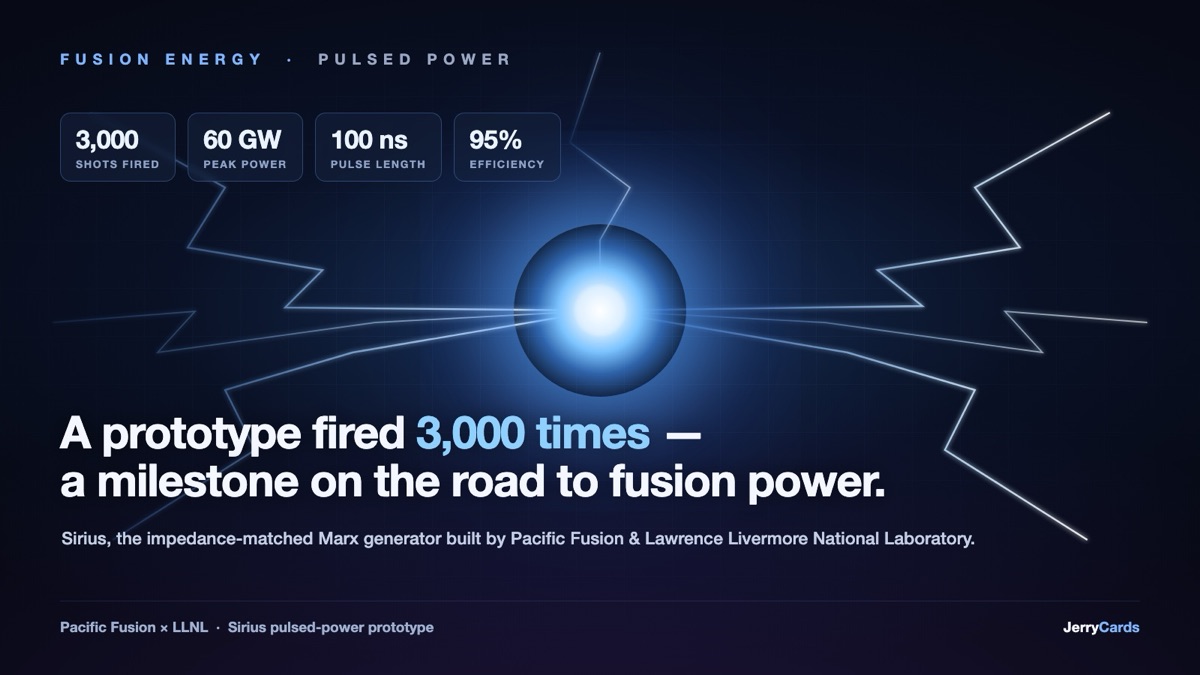
A machine in California just fired more than 3,000 bolts of controlled lightning - and that unglamorous number may matter more to the future of fusion energy than any single record-breaking shot. On July 16, 2026, Lawrence Livermore National Laboratory (LLNL) and the startup Pacific Fusion announced that their pulsed-power prototype, named Sirius, had completed a campaign of over 3,000 shots. No dramatic burst of starlight, no headline temperature. Just the same demanding electrical pulse, delivered again and again, thousands of times - which is precisely the point.
Here is what Sirius actually did, why engineers care so much about repetition, and how it fits into one of the most promising - and least understood - paths to clean fusion power.
- What: the Sirius pulsed-power prototype completed a campaign of more than 3,000 shots
- Who: Lawrence Livermore National Laboratory and Pacific Fusion, working under a formal research partnership
- Per shot: ~60 gigawatts delivered to the load in a 100-nanosecond pulse, at 95% energy efficiency
- Why it matters: a real fusion plant must fire reliably, over and over, for decades - this run tested exactly that
- Next: a June prototype already reached ~440 gigawatts; a module ~40x larger is being built toward net facility gain
1. What Sirius Did
Sirius is a four-stage impedance-matched Marx generator - a device that stores electrical energy and then dumps it in an extraordinarily fast, extraordinarily powerful burst. In each shot, it delivered roughly 60 gigawatts of power to a test load in a pulse lasting just 100 nanoseconds (100 billionths of a second). For a fleeting instant, that is tens of times the electrical output of a large power station - concentrated into a flash far shorter than a camera strobe.
Two things make that figure remarkable. The first is the 95% energy efficiency: almost all of the stored energy reaches the target rather than being lost as heat along the way. The second is that the machine did it more than 3,000 times. The campaign, whose 3,000-shot mark was celebrated in mid-May, was designed not to break a power record but to test component lifetime and reliability - how the hardware holds up under relentless repetition.
2. Why 3,000 Shots Is the Real Headline
Fusion has a famous half-truth attached to it: that the hard part is making it happen at all. In reality, scientists have created fusion in the lab for decades, and in December 2022 LLNL's National Ignition Facility crossed the threshold of ignition - getting more energy out of the fuel than the lasers put in. The remaining challenge is turning a rare, heroic event into a machine that runs like an engine: cheaply, efficiently, and again and again.
That is what a reliability campaign is for. A power plant cannot fire once and stop for repairs; it has to pulse continuously for years.
“For a future IMG-powered accelerator concept, reliability is a key requirement,” said Bill Stygar, the LLNL researcher who co-invented the technology. “We needed to show that our components could last 3,000 shots.” Such systems, he added, could eventually need parts capable of operating up to 100 shots per year for 30 years.
In other words, 3,000 shots is a down payment on the tens of thousands a commercial plant would demand over its lifetime. Proving the parts survive is what moves fusion from physics demonstration toward engineering reality. The milestone advanced the technology from Technology Readiness Level 4 to 5 on the U.S. Department of Energy's scale - the point at which a system is validated in a relevant environment.
3. The Clever Idea: One Pulse, One Step
Pulsed power is not new - Sandia's Z machine has used it to reach fusion conditions for years - but it has traditionally meant enormous, one-of-a-kind facilities. What makes Sirius different is its architecture, the impedance-matched Marx generator (IMG).
“The IMG approach generates the needed fast pulse in a single step and transmits it directly to the load, reducing the hardware required,” explained Kumar Raman, the LLNL project manager.
Older designs build up their pulse in stages, through long chains of components that add cost, size, and points of failure. The IMG collapses much of that into one step - which is how Sirius reaches 95% efficiency with a comparatively compact machine. Efficiency and simplicity are not just tidy engineering; they are what could make pulsed-power fusion affordable enough to scale into a power plant. The IMG was developed at Livermore with early Laboratory Directed Research and Development funding, then advanced jointly with Pacific Fusion, whose co-founder helped invent it.
4. The Machines Are Getting Bigger, Fast
Sirius is a stepping stone, and the steps are getting large quickly.
| Stage | Relative size | Headline figure |
|---|---|---|
| Sirius | baseline | ~60 GW, 100 ns, 95% efficient, 3,000+ shots |
| June 2026 prototype | ~11x larger | ~440 GW peak, 1.1 million volts, 80 ns |
| Planned module | ~40x larger | Target: fusion bursts >100 MJ, net facility gain |
The June prototype, roughly eleven times the size of Sirius, delivered about 440 gigawatts of peak power at 1.1 million volts - what Pacific Fusion describes as the highest-power single-step pulsed-power driver demonstrated so far. The company is now building an IMG module about 40 times larger than Sirius, aimed at producing fusion bursts exceeding 100 megajoules and reaching the field's next great milestone: net facility gain, where a machine releases more fusion energy than the total energy it stores.
5. How Pacific Fusion Plans to Use All That Power
Pacific Fusion's approach is called pulsed magnetic fusion. In simple terms, the giant, ultrafast electrical pulse is used to violently compress a small target of magnetized fusion fuel to the extreme density and temperature at which hydrogen isotopes fuse and release energy. The pulser is the hard part - and it is exactly the part Sirius and its successors are maturing.
There is a reason serious money is behind it. Pacific Fusion emerged from stealth in 2024 with a Series A of more than 900 million dollars - one of the largest funding rounds in fusion history - structured to release in stages as the company hits technical milestones like this one. It is also a notable model of collaboration: a national laboratory and a private company advancing the same technology together, each doing what it does best.
Both are routes to inertial fusion. But laser drivers like NIF convert only a small fraction of the electricity they draw into light, and fire slowly. Pulsed power is electrical from end to end - Sirius reaches 95% efficiency - and is built to repeat. For a machine that must eventually run like a power plant, that efficiency and repetition are enormous advantages.
“This milestone shows what close collaboration between national laboratories and private industry can accomplish,” said Keith LeChien, Pacific Fusion's co-founder and chief technology officer, who helped invent the IMG during his own years in the national-lab system.
What to Watch Next
- Net facility gain. The headline goal of the 40x-larger system - more fusion energy out than the machine stores - would be a landmark for the whole pulsed-power approach.
- Reliability at scale. 3,000 shots is a strong start; the bigger, higher-power machines will have to prove the same durability at far greater stress.
- From prototype to plant. Fusion timelines are famously hard, and Sirius is still a research prototype - but the pace of scaling here is unusually brisk, and the engineering discipline behind it is real.
Fusion will not arrive in a single triumphant flash. It will be built the way Sirius was tested: one reliable, efficient, repeatable pulse at a time - three thousand of them, and counting.
Sources
- Lawrence Livermore National Laboratory: LLNL, Pacific Fusion partnership advances next-generation pulsed-power technology
- American Nuclear Society - Nuclear Newswire: LLNL and Pacific Fusion achieve 3,000-shot milestone with Sirius pulsed-power prototype
- Interesting Engineering: Pulsed-power prototype completes 3,000 tests at 95% efficiency for future fusion plants · Power Magazine: Pacific Fusion says pulsed-power prototype hits milestone at national lab
- Background: LLNL National Ignition Facility (December 2022 fusion ignition) · Bloomberg: Pacific Fusion raises 900 million dollars
Curated by Jerry Cards - jerrycards.com. We research the week's most consequential tech, science, and business news so you don't have to. More at jerrycards.com/news.