
 العربية
 Español
 中文
中文 Deutsch
 Français
 Português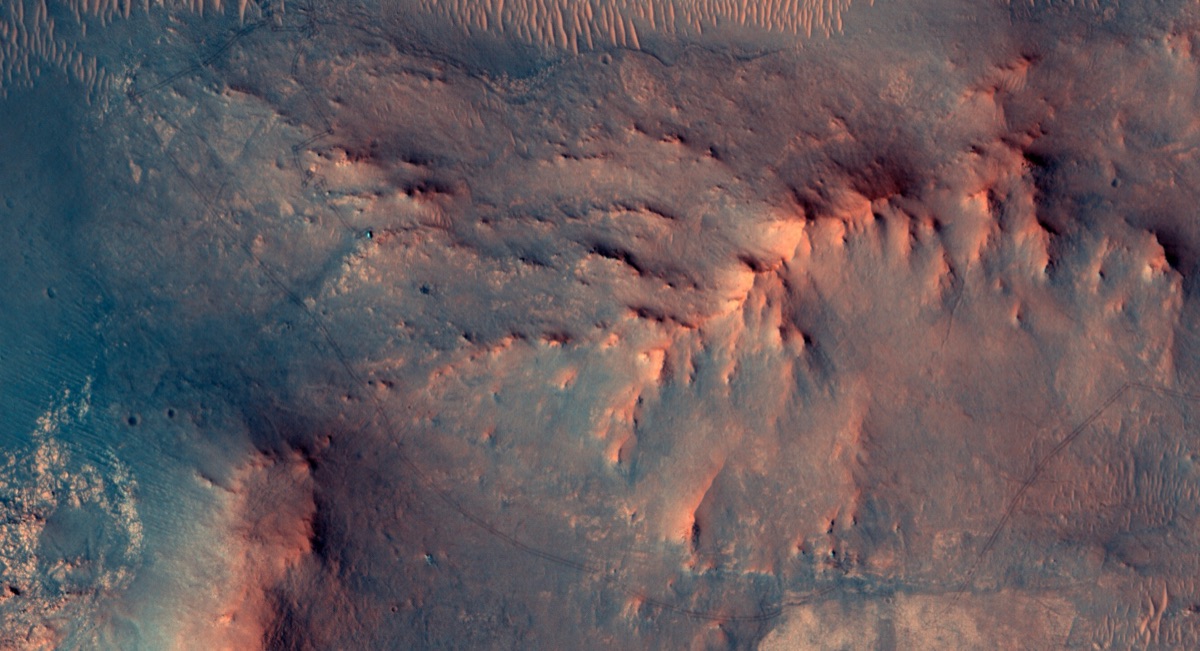
A rover the size of a small SUV has just done something no machine had ever done on another planet: it drove a marathon. On June 14, 2026, NASA’s Perseverance rover rolled past 26.2 miles (42.195 kilometers) of total driving across the floor and rim of Jezero Crater - the exact distance of a marathon - on the 1,890th Martian day, or sol, of its mission. It reached the mark in five years and four months. And in a lovely bit of cosmic choreography, a spacecraft circling overhead photographed the rover from orbit just as it approached the finish line.
- What: Perseverance passed 26.2 miles (42.195 km) of total driving on Mars - a full marathon
- When: June 14, 2026, on sol 1,890 of the mission
- How fast: 5 years and 4 months of driving since landing in February 2021
- The comparison: NASA’s Opportunity rover took 11 years and 2 months to cover the same distance
- The photo: the HiRISE camera on the Mars Reconnaissance Orbiter captured Perseverance from orbit on June 13 - one day before the milestone
- Where: higher ground west of Jezero Crater, in a region the science team nicknamed ‘Arbot’
1. A Marathon on the Red Planet
Perseverance landed in Jezero Crater on February 18, 2021, targeting a basin that billions of years ago held a lake fed by a river that built a fan-shaped delta - some of the best-preserved evidence of ancient water anywhere on Mars. Since then the rover has been steadily working its way across the crater floor, up an ancient delta, and eventually out onto the higher terrain beyond the crater’s western rim. Add up all of that wandering and, on sol 1,890, the odometer clicked past the length of a marathon.
The distance is a fun coincidence, but the pace is the real headline. Reaching a marathon in a little over five years makes Perseverance far and away the fastest long-distance driver humanity has ever put on another world.
| Rover | Time to drive a marathon (26.2 mi) | Landed |
|---|---|---|
| Perseverance | 5 years, 4 months (sol 1,890) | Feb 2021 |
| Opportunity | 11 years, 2 months | Jan 2004 |
One honest footnote: Opportunity still holds the all-time distance record for wheels on another world - about 28 miles (45 km) over its remarkable 14-year mission. Perseverance simply reached the marathon mark in less than half the time, and it is still driving.
Mars is so far away that a radio signal takes minutes to arrive, so engineers cannot steer in real time. Instead, Perseverance largely drives itself. Its upgraded self-navigation system, called AutoNav, uses onboard cameras to build 3D maps of the terrain and pick a safe path while the rover keeps rolling - ‘thinking while driving,’ as the team puts it - rather than stopping to wait for instructions from Earth. That autonomy is a big reason Perseverance can cover far more ground per day than earlier rovers.
2. Caught From Orbit
What makes this milestone especially charming is that it was witnessed. On June 13, 2026 - the day before the marathon mark - NASA’s Mars Reconnaissance Orbiter, flying hundreds of kilometers overhead, turned its powerful HiRISE (High-Resolution Imaging Science Experiment) camera downward and photographed Perseverance on the surface. In the image, the rover is a tiny bright speck against a vast field of rust-colored rock and dust - a single hard-working robot, seen from space, dwarfed by the ground it has crossed. One spacecraft photographing another, both of them tens of millions of miles from home.
3. Five Years, One Extraordinary Resume
The distance is a headline, but it is really a proxy for everything Perseverance has accomplished while covering it. In half a decade on Mars, the rover has:
- Collected samples for the trip home. Perseverance has sealed dozens of tubes of Martian rock, soil, and air - the first samples ever gathered on another planet with the goal of returning them to Earth. Ten backup tubes were even set down at a carefully mapped depot nicknamed ‘Three Forks’ as insurance for a future retrieval mission.
- Made aviation history. The rover carried the Ingenuity helicopter to Mars, which in April 2021 became the first aircraft ever to make a powered, controlled flight on another world. Planned for just five flights, Ingenuity flew 72 times over nearly three years - scouting terrain and proving that flight on Mars is possible.
- Made oxygen on another planet. A toaster-sized instrument called MOXIE pulled breathable oxygen out of the carbon-dioxide Martian atmosphere - the first time oxygen has ever been produced on another world, a proof of concept for one day letting astronauts make their own air and rocket propellant.
- Let us hear Mars for the first time. Microphones on the rover captured the first-ever audio recorded on the surface of another planet, including the thin whistle of Martian wind and the whir of the rover’s own workings.
4. Why It’s There - and What Comes Next
Perseverance’s core job is to answer one of the oldest questions humans have asked: was there ever life beyond Earth? Jezero Crater was chosen precisely because its ancient lake-and-delta setting is the kind of place where microbial life could have taken hold - and where chemical fingerprints of it might still be preserved in the rock. The rover cannot confirm past life on its own; that verdict will come from studying its sealed samples in the world’s most sensitive laboratories back on Earth, the goal of the planned Mars Sample Return campaign.
For now, the marathon is a milestone worth savoring on its own terms: a car-sized robot, built by people, self-driving across the surface of another planet, quietly banking the samples and the knowledge that future explorers will build on. And it is not done. Perseverance is still rolling across the highlands west of Jezero, odometer ticking upward, its 26.2 miles just the distance it happens to have covered so far.
The Honest Caveats
- Distance vs. speed. Perseverance holds the record for reaching a marathon fastest, not for total distance - Opportunity’s roughly 28-mile lifetime drive is still the all-time mark (for now).
- The big question is still open. Signs of ancient life have not been confirmed; that depends on returning and analyzing the samples on Earth, which is a mission still to come.
- A marathon is symbolic, not scientific. The 26.2-mile figure is a milestone chosen for its human resonance; the science lives in the rocks the rover studied along the way, not in the odometer.
Sources
- NASA / JPL-Caltech: NASA’s HiRISE Captures Perseverance Marking a Milestone on Mars · JPL image PIA26726
- Space.com: Perseverance just ran a marathon on Mars · Space.com: Mars orbiter watches the rover cross the finish line
- ScienceDaily: NASA’s Perseverance just completed a marathon on Mars · NASA: Mars 2020 Perseverance mission
Curated by Jerry Cards - jerrycards.com. We research the week’s most consequential tech, science, and space news so you don’t have to. More at jerrycards.com/news.