
 العربية
 Español
 中文
中文 Deutsch
 Français
 Português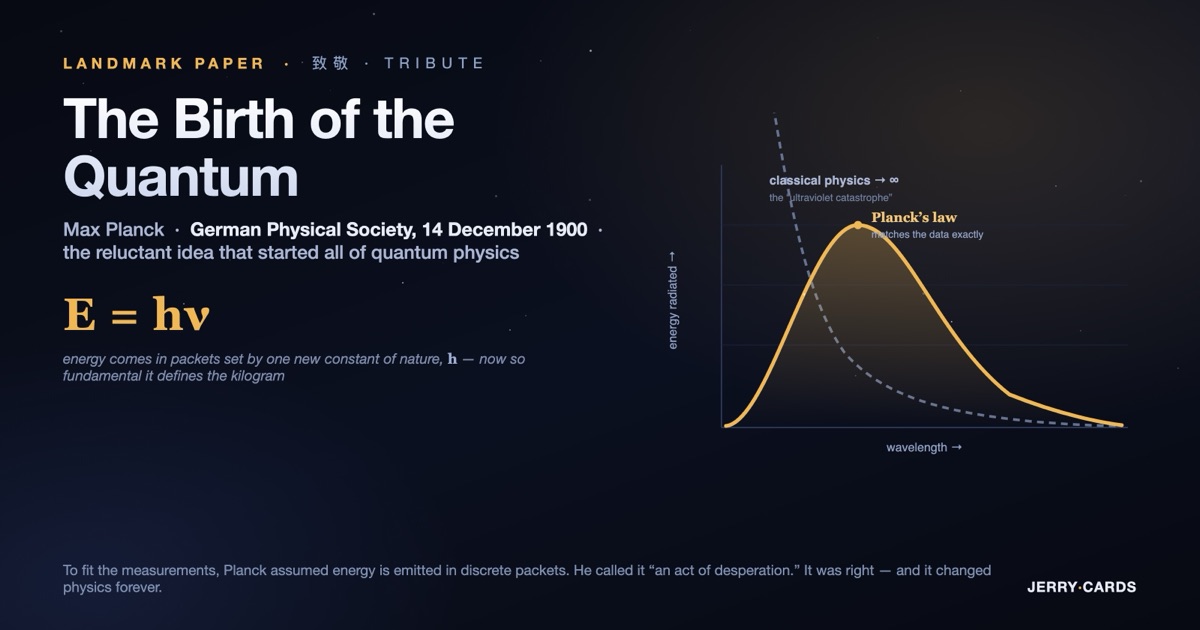
On a December afternoon in 1900, the most careful, conservative physicist in Berlin stood up and, almost by accident, ended the reign of classical physics. Max Planck was 42, a professor who prized continuity and order, and he had spent months on a problem that looked like tidy housekeeping: explaining the exact color of the glow given off by hot objects. To make his numbers fit reality, he was finally forced to assume something he could barely bring himself to believe - that energy comes not in a smooth flow but in tiny, indivisible packets. He called it ‘an act of desperation.’ It was the birth of the quantum, and with it, of the physics behind almost every device you own.
This is a tribute to the reluctant idea of 1900 - and to the man who spent years wishing he could take it back.
- Who: Max Karl Ernst Ludwig Planck (1858–1947), German theoretical physicist, then 42
- The moment: presented to the Deutsche Physikalische Gesellschaft (German Physical Society) in Berlin on 14 December 1900 — now called the birthday of quantum theory
- The paper: ‘Zur Theorie des Gesetzes der Energieverteilung im Normalspectrum,’ Verhandlungen der DPG 2, 237–245 (1900); fuller version in Annalen der Physik (1901)
- The problem: black-body radiation — classical physics predicted infinite energy at short wavelengths (the ‘ultraviolet catastrophe’)
- The idea: energy is emitted in discrete packets, quanta, with E = hν — introducing a new constant of nature, h
- The honour: the 1918 Nobel Prize in Physics, ‘for his discovery of energy quanta’
1. The color of heat
Heat something and it glows. A poker in a fire goes from dull red to orange to a brilliant yellow-white; the Sun and the stars are the same story on a grander scale. Nineteenth-century physicists had turned this everyday fact into a precise laboratory science. They studied the idealised case of a black body — a perfect absorber and emitter of radiation, realised in practice as a small hole in a heated cavity — and measured, wavelength by wavelength, exactly how much energy it pours out at each temperature. The resulting curve has a characteristic shape: it climbs from nearly nothing at short wavelengths, rises to a peak, and tails off toward long wavelengths, with the peak sliding toward the blue as the object gets hotter.
The experimental curve was known with real precision — by 1900 Heinrich Rubens, Ferdinand Kurlbaum, Otto Lummer and Ernst Pringsheim at Berlin had pinned it down, including in the far infrared. The trouble was that nobody could explain it. Every attempt to derive the curve from the trusted principles of classical physics failed — and failed in a spectacular, revealing way.
2. The catastrophe of classical physics
There were two rival formulas, and each worked only half the time. Wien’s law (1896) fit the short-wavelength end beautifully but drifted away from the data at long wavelengths. The approach demanded by classical thermodynamics — treating the radiation as countless tiny oscillators sharing energy equally, later crystallised as the Rayleigh–Jeans law — matched the long-wavelength end but then did something disastrous. It predicted that the energy should keep rising without limit as the wavelength got shorter, soaring to infinity in the ultraviolet.
Taken at face value, that meant every warm object — a coal, a kettle, your own body — should be blasting out an infinite amount of high-frequency radiation. It was a plain absurdity, and it sat squarely inside the most respected physics of the age. The physicist Paul Ehrenfest would later christen the failure the ‘ultraviolet catastrophe.’ The measured curve, by contrast, sensibly turned over and fell back to zero. Classical physics could not say why.
Classical physics assumed energy could be divided into ever finer amounts, and that every mode of vibration should carry the same average share of energy. But there are infinitely many possible short-wavelength modes. Give each one an equal, non-zero share, and you sum to infinity. The catastrophe was not a small numerical error — it was a sign that one of the deepest assumptions of classical physics, the smooth continuity of energy, was simply wrong.
3. An act of desperation
Planck attacked the problem from the direction he trusted most: thermodynamics and entropy. In October 1900, prompted by fresh long-wavelength data from Rubens and Kurlbaum, he guessed a new formula by mathematically interpolating between the two failing laws — and it fit the entire curve, at every wavelength and temperature, essentially perfectly. He presented this radiation formula to the German Physical Society on 19 October 1900. But a formula that merely fits is not an explanation, and Planck knew it. He spent the next eight weeks in what he later described as the hardest work of his life, trying to derive his formula from first principles.
The only way he could make it work was to borrow Ludwig Boltzmann’s statistical method — counting the number of ways energy can be distributed — and to make one strange, temporary-seeming assumption. He supposed that the oscillators in the cavity walls could not emit or absorb energy in arbitrary amounts, but only in whole-number multiples of a small basic quantity proportional to their frequency:
E = hν
Here ν (nu) is the frequency and h is a new fundamental constant — the quantum of action. Fitting his formula to the data, Planck extracted a value of h ≈ 6.55 × 10⁻²⁷ erg·s, within about one percent of the modern figure of 6.626 × 10⁻³⁴ J·s. As a bonus, the same fit handed him an accurate value for another constant he named after Boltzmann (today’s Boltzmann constant, k), and from it Avogadro’s number and the charge of the electron. He presented the derivation on 14 December 1900.
“The whole procedure was an act of desperation, because a theoretical interpretation had to be found at any price, no matter how high that might be… I was ready to sacrifice any of my previous convictions about physics.”
— Max Planck, recalling 1900 in a 1931 letter to Robert Williams Wood
4. The man who did not believe his own idea
Here is the twist that makes Planck’s story so human. He did not think he had discovered that energy is really grainy. He regarded the quantum as a formal mathematical assumption — a bookkeeping device forced on him to get the counting right — and he assumed that once physics matured, someone would show how to recover his formula smoothly from classical continuity. For more than a decade afterward he kept trying, personally, to tame the quantum and fold it back into the classical world. He never managed it, because it could not be done.
And yet he grasped, at some level, the scale of what he had touched. According to a family recollection, on the day of his discovery Planck took his young son Erwin for a walk in the Grunewald, the wooded park on the edge of Berlin, and told him that he had perhaps made a discovery as important as Newton’s. It is the paradox of his life: the cautious traditionalist who reluctantly lit the fuse of the most radical idea in modern science, and then watched, half in wonder and half in unease, as younger physicists ran with it.
5. The revolution he could not stop
The quantum refused to be explained away. In 1905 — his ‘miracle year’ — a 26-year-old Albert Einstein took Planck’s packets literally and proposed that light itself travels as quanta (later called photons), neatly explaining the photoelectric effect and winning Einstein his own Nobel Prize. In 1913 Niels Bohr used quanta to build the first working model of the atom, explaining why elements emit light at sharp, specific colors. By the mid-1920s Werner Heisenberg, Erwin Schrödinger, Paul Dirac and Max Born had assembled the full theory of quantum mechanics — the deepest and most accurately tested description of nature ever written.
Planck’s reward came in 1919, when he was awarded the reserved 1918 Nobel Prize in Physics, ‘in recognition of the services he rendered to the advancement of Physics by his discovery of energy quanta.’ The reluctant reformer had become the founder of a new physics — and, in his later years as the grand old man of German science, its conscience as well.
6. What one small constant made possible
Quantum theory is the physics of atoms, electrons and light — the physics of the very small. That is precisely why it is the hidden engine of modern technology. Nearly every advanced device made in the last century works only because we understand the quantum rules Planck stumbled into. A sampling:
| Technology | Why it needs the quantum |
|---|---|
| Transistors & computer chips | Semiconductors work only through quantum energy bands; every processor and memory chip is applied quantum mechanics |
| Lasers & LEDs | Light emitted in quantised jumps between energy levels — the direct descendant of E = hν |
| Solar cells | Photovoltaics rely on photons knocking electrons free — Einstein’s 1905 extension of Planck’s quanta |
| MRI & atomic clocks / GPS | Both exploit quantised energy states of nuclei and atoms; GPS timing rests on atomic transitions |
| Quantum computers | The newest computing paradigm manipulates individual quanta directly — the frontier that began in 1900 |
For over a century the kilogram was defined by a single platinum-iridium cylinder locked in a vault near Paris. In 2019, the world’s metrologists retired that lump of metal and redefined the kilogram by fixing the exact value of Planck’s constant at h = 6.62607015 × 10⁻³⁴ J·s, realised through an instrument called the Kibble balance. The most everyday unit of mass on Earth is now anchored to the tiny constant a reluctant physicist introduced to explain the color of a glowing coal.
What the quantum still asks of us
- What does it mean? Quantum mechanics predicts experiments to staggering precision, yet physicists still debate what it says about reality — whether particles have definite properties before we look, and how the quantum world becomes the solid one we experience.
- Can it join gravity? Planck’s constant also sets the ‘Planck scale,’ where quantum theory and Einstein’s gravity must somehow merge. Building that unified theory is one of the great unfinished projects of physics.
- How far can we push it? A second quantum revolution — quantum computing, sensing and cryptography — is now turning the strangest features of Planck’s world into working machines. It is still only beginning.
Sources & further reading
- Original paper (1901 version): M. Planck, ‘Ueber das Gesetz der Energieverteilung im Normalspectrum’, Annalen der Physik 4 (309), 553–563 (1901)
- The Nobel Prize in Physics 1918: Max Planck, ‘for his discovery of energy quanta’
- Encyclopaedia Britannica: Planck’s radiation law · Max Planck (biography)
- HISTORY: The birth of quantum theory, 14 December 1900
- NIST: The kilogram, mass and Planck’s constant (2019 SI redefinition) · Planck constant (overview) · Ultraviolet catastrophe
Curated by Jerry Cards - jerrycards.com. Our 致敬 (tribute) series celebrates the landmark papers and discoveries that quietly built the modern world. More at jerrycards.com/news.