
 العربية
 Español
 中文
中文 Deutsch
 Français
 Português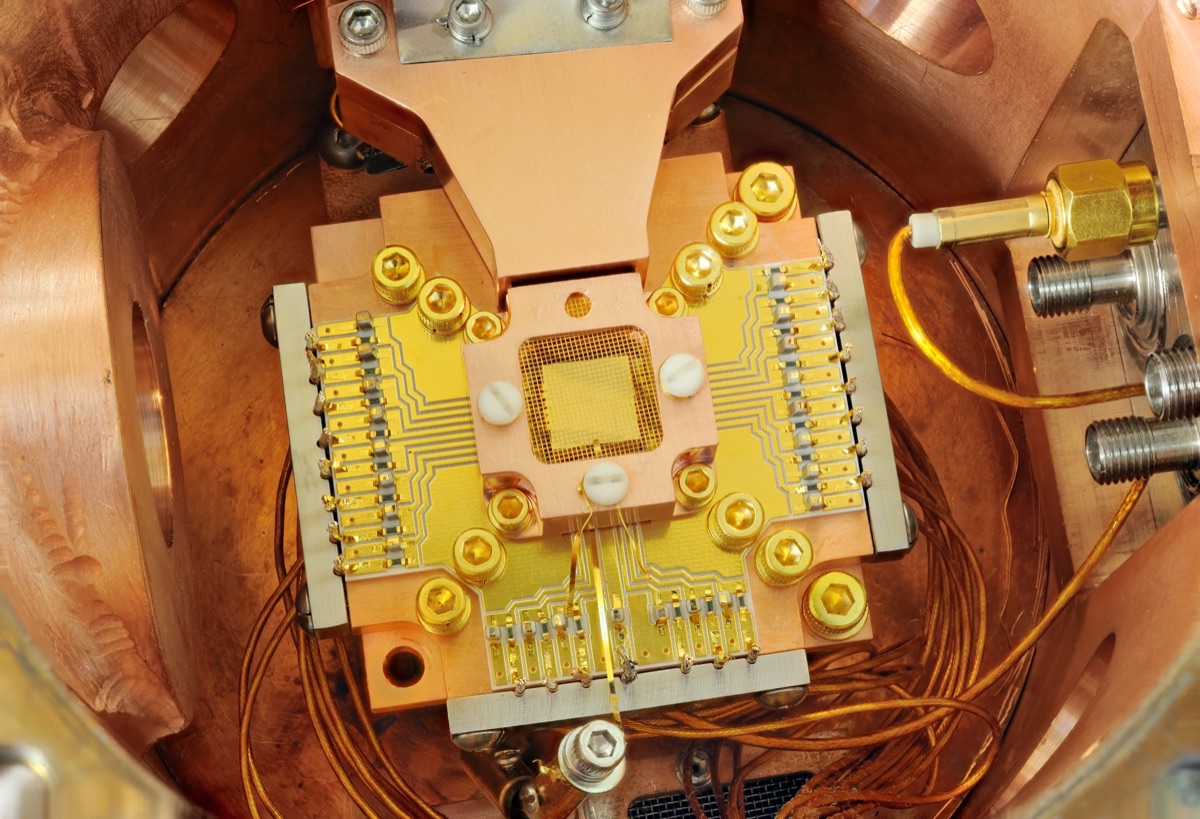
Quantum computing just passed a quiet but important milestone - and this time, an outside referee checked the work. On June 17-18, 2026, the journal Nature published a peer-reviewed paper describing Helios, the newest trapped-ion quantum computer from Quantinuum. It runs 98 qubits with some of the highest operation accuracies ever reported for a machine this size - and, unusually for the field, its performance was independently verified by Sandia National Laboratories, a U.S. Department of Energy lab. In a field where impressive-sounding benchmarks are easy to cherry-pick, that independent check may be the most important result of all.
Here is what was announced, what the numbers mean, and why accuracy - not raw qubit count - is the metric that actually matters right now.
- What: Quantinuum's Helios, a 98-qubit trapped-ion quantum computer
- Published: peer-reviewed in Nature, June 17-18, 2026 (DOI 10.1038/s41586-026-10676-4)
- Independently verified by: Sandia National Laboratories
- Single-qubit accuracy: 99.9975%
- Two-qubit accuracy: 99.921%
- Readout (state prep & measurement): 99.967%
- Connectivity: all-to-all - any qubit can interact directly with any other
- Qubits: individual barium-137 ions, held and moved by electric fields on a chip
1. What Quantinuum Announced
Helios is Quantinuum's largest and highest-performing quantum computer to date, stepping up from the 56 qubits of its predecessor (the H2 system) to 98 qubits. The peer-reviewed results - titled “A 98-qubit trapped-ion quantum computer with all-to-all connectivity” - appeared in Nature after first being posted as a preprint (arXiv:2511.05465). Lead architect Anthony “Tony” Ransford summarized the claim plainly: Helios “operates beyond the capabilities of classical simulation alone and established a new benchmark of fidelity and complexity for quantum computers.”
2. The Numbers
In quantum computing, “fidelity” is the probability that an operation does exactly what it is supposed to do. Helios posted fidelities that put it among the most accurate systems ever benchmarked at this scale:
| Operation | Fidelity | Error rate |
|---|---|---|
| Single-qubit gate | 99.9975% | ~1 in 40,000 |
| Two-qubit gate | 99.921% | ~1 in 1,270 |
| State prep & measurement (readout) | 99.967% | ~1 in 3,000 |
The two-qubit number is the one specialists watch most closely, because two-qubit “entangling” gates are both the hardest to do well and the workhorses of any quantum algorithm. Clearing 99.9% there is a meaningful threshold.
3. Why Accuracy Beats Raw Qubit Count
It is tempting to keep score by qubit count alone, but that is misleading. Because quantum operations run in long sequences, their errors multiply. A program that applies 1,000 two-qubit gates at 99% accuracy has roughly a 0.991000 chance of finishing clean - effectively zero. At 99.9% the same program clears with double-digit odds; push the accuracy higher and longer programs become realistic. That is why shaving an error rate from 1-in-100 to 1-in-1,270 matters far more than simply adding qubits.
Sandia co-author Robin Blume-Kohout put the priority in one line: “The most important aspect of today's quantum computers is not speed, but reliability.” Reliable, low-error operations are the prerequisite for quantum error correction - the technique that will eventually let many imperfect physical qubits behave like a few near-perfect logical ones. Better raw fidelity means fewer physical qubits are needed to protect each logical qubit, which makes the whole path to fault tolerance cheaper.
4. The Architecture: Ions on the Move
Helios is a trapped-ion machine. Each qubit is a single barium-137 ion - a charged atom - suspended just above a chip by precisely tuned electric fields. Information is stored in two ultra-stable internal energy levels of the ion (so-called “clock” states), and lasers nudge the ions to perform operations.
The clever part is movement. Helios uses a quantum charge-coupled device (QCCD) architecture built on a two-dimensional surface-electrode trap: the machine physically shuttles ions around the chip so that any qubit can be brought next to any other to perform a gate. That gives Helios all-to-all connectivity.
On many chip-based designs, a qubit can only directly interact with its immediate neighbors. To entangle two distant qubits, the machine must perform a chain of intermediate operations - each one an extra chance to introduce error. With all-to-all connectivity, any pair of qubits can interact directly, so algorithms run with fewer steps and less accumulated error. It is the difference between calling someone directly and passing a message down a long line of people.
5. The Real Headline: An Independent Lab Checked the Work
Quantum computing has a credibility problem that has nothing to do with the physics: vendors set their own tests, and it can be hard for outsiders to know whether a benchmark is meaningful or marketing. Helios is notable precisely because Quantinuum did not grade its own homework.
Working under a Cooperative Research and Development Agreement (CRADA) that was renewed in May 2026, researchers at Sandia National Laboratories independently evaluated the system using rigorous third-party benchmarking - including specialized methods for assessing mid-circuit measurements. Sandia senior manager Mike Descour framed the lab's role in the national interest: “As a national resource, we are committed to accelerating quantum computing technology in support of economic and national security.” An outside, government-backed verification turns a vendor claim into a result the broader community can trust.
6. Beyond Classical Simulation
The team also reports that Helios now runs deep, random quantum circuits whose results cannot be efficiently reproduced by ordinary computers - reproducing the statistics of its hardest circuits would overwhelm even the world's fastest classical supercomputers. That does not mean Helios is solving a useful real-world problem faster than a classical machine yet; it means the system has crossed into a regime where a classical computer can no longer easily keep up - a necessary stepping stone toward practical quantum advantage.
What This Is - and Isn't
- It is a peer-reviewed, independently verified step up in scale (98 qubits) and accuracy (two-qubit fidelity past 99.9%) with full all-to-all connectivity.
- It is not a fully fault-tolerant, error-corrected quantum computer - that remains the field's defining goal, and Helios is a building block toward it, not the finish line.
- It is not a claim of practical advantage on a commercially useful task; “beyond classical simulation” refers to specially chosen benchmark circuits.
- The big picture: higher fidelity, all-to-all connectivity, and outside validation are exactly the ingredients that move quantum computing from promise toward dependable machines.
Sources
- Nature: A 98-qubit trapped-ion quantum computer with all-to-all connectivity (DOI 10.1038/s41586-026-10676-4) · preprint arXiv:2511.05465
- The Quantum Insider: peer-reviewed results on Helios · Phys.org: Helios tops 99.9% fidelity
- Quantum Computing Report: Sandia and Quantinuum validate 98-qubit Helios · HPCwire: high-fidelity results
- Image: surface-electrode ion-trap chip, credit Y. Colombe / NIST (public domain, U.S. government work)
Curated by Jerry Cards - jerrycards.com. We research the week's most consequential tech, science, and business news so you don't have to. More at jerrycards.com/news.