
 العربية
 Español
 中文
中文 Deutsch
 Français
 Português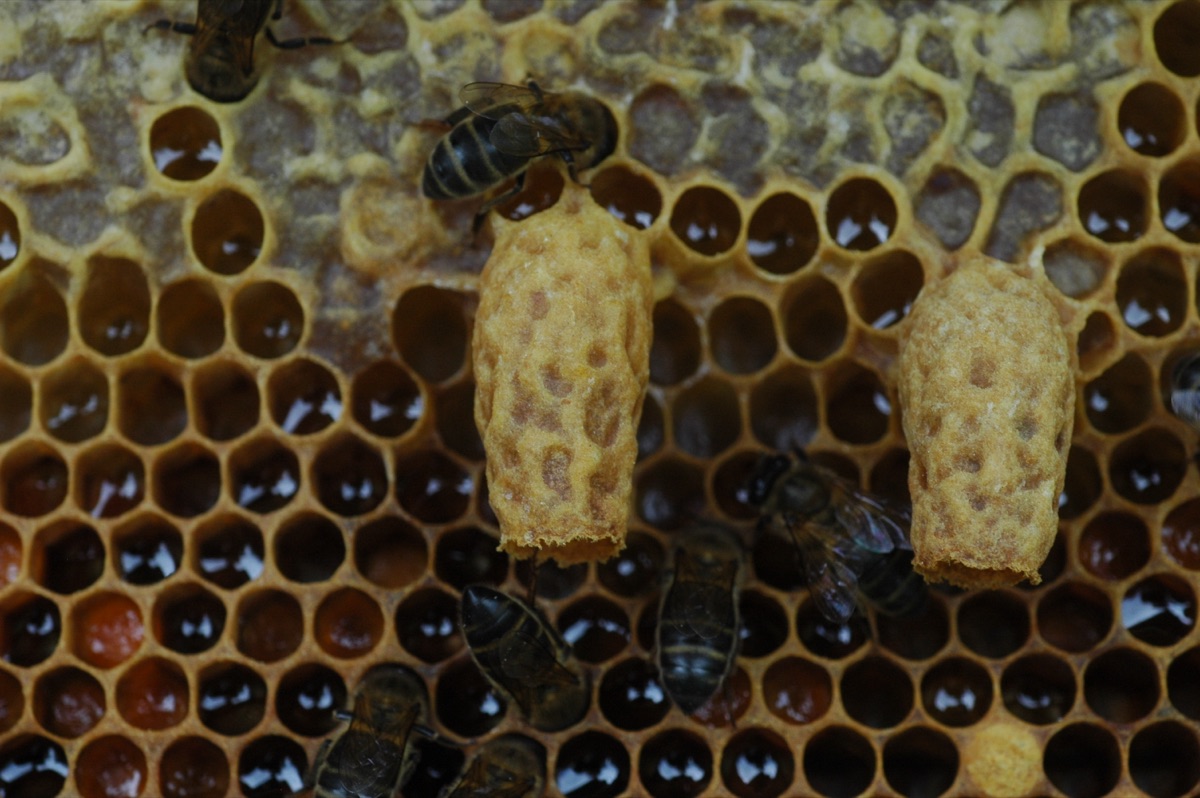
A queen bee and the thousands of workers who serve her begin life as exactly the same thing: an ordinary fertilized egg. For a century, biologists thought one luxury explained how one of those identical eggs becomes a long-lived, egg-laying queen while her sisters become short-lived workers — a diet of royal jelly. A new study in Nature shows the real answer is stranger, and far more collective: the colony also builds the future queen a custom-engineered nursery, staffed by a dedicated crew of young workers who warm it with their own bodies and rework the wax until it is exactly right. Feed a larva the very same royal jelly in the wrong wax, and she comes out smaller — and dies sooner.
It is the kind of finding that rewrites a line every biology textbook teaches. And it is a quietly beautiful example of what a beehive really is: not 50,000 individuals, but a single problem-solving superorganism that engineers its own royalty.
- Paper: “Queen cell architecture shapes honey bee queen development”
- Journal: Nature (2026), vol. 654, DOI 10.1038/s41586-026-10534-3
- Teams: UC Riverside Center for Integrative Bee Research (CIBER) + the Chinese Academy of Agricultural Sciences, with collaborators in China, Germany and the US
- Old rule: royal jelly alone turns a larva into a queen — “you are what you eat”
- New rule: the wax cell she is raised in matters too — “you are where you live, too”
- The clincher: identical royal-jelly diet, but raised in ordinary worker wax → smaller queens that were more likely to die
1. The Hundred-Year-Old Rule: “You Are What You Eat”
Start with the genetics, because it is the part that makes the whole thing remarkable. A queen and a female worker are not different breeds. They hatch from the same kind of fertilized egg and carry the same genome. Whether a larva becomes a queen — large, fertile, able to live for years and lay up to a couple of thousand eggs a day — or a worker — sterile, living only a few weeks in summer — is decided entirely by how the colony treats her in her first days of life.
For most of a century, the explanation was diet. Worker larvae are weaned onto pollen and nectar; a chosen few are flooded with royal jelly, the protein-rich glandular secretion of nurse bees. Royal jelly became the textbook switch, and researchers even singled out one of its proteins, royalactin, as a possible trigger of queen development. The story was tidy: change the food, change the fate.
| Queen | Worker | |
|---|---|---|
| Starts as | Fertilized egg | The same fertilized egg |
| Egg to adult | ~16 days | ~21 days |
| Raised in | Large, peanut-shaped queen cell hanging vertically | Small horizontal hexagonal cell |
| Lifespan | Often several years | A few weeks (summer) |
| Fertility | Lays up to ~2,000 eggs/day | Sterile |
2. The Twist: “You Are Where You Live, Too”
The new work, led by former UC Riverside postdoctoral researchers Yu Fang and Yahya Al Naggar with senior authors Boris Baer (director of CIBER at UC Riverside) and Kai Wang (Chinese Academy of Agricultural Sciences), started from a detail beekeepers have stared at for generations without explaining it: the queen does not grow up in a normal cell. She grows in a large, downward-hanging structure shaped like a peanut shell — the queen cell — and that cell is made of a different wax.
When the team analyzed it, the queen-cell wax was not ordinary comb. It was less dense and more pliable, noticeably better at holding on to heat and moisture, and chemically distinct, with a different profile of fatty acids and chemical signals than the wax of standard worker cells. In other words, the workers were not just building a bigger room. They were manufacturing a specialized material with its own physical and chemical recipe.
Most of a honeycomb is a grid of small, horizontal, six-sided cells used to raise workers and store honey and pollen. A queen cell is the exception: a large, vertically hanging, peanut-textured pod, built only when the colony decides to raise a new queen (to replace a failing one, or to swarm). The new study shows this distinctive shell is not just a bigger cradle — its very material is engineered for the job.
3. A Construction Crew That Runs a Fever
Who makes this special wax? Not the colony at large. The researchers identified a dedicated group of young workers — call them the queen-cell builders — whose entire job is to construct and tend the royal nursery. While they worked, these bees held their body temperatures elevated, effectively running a warm “fever” that helps soften, blend and shape the wax, and they showed internal physiological changes tied to the role.
“You can think of it as something like Buckingham Palace,” said Boris Baer. “There is a dedicated group of bees focused entirely on raising the queen, and if they don’t get it right, the colony cannot reproduce.” The point is not poetry: the survival of the entire colony rests on a small specialist crew getting a single piece of architecture right.
4. The Graphite Trick That Proved It
How do you prove that bees are selectively sourcing and reworking wax, rather than just reusing whatever is nearby? The team used a wonderfully simple tracer. They laced ordinary honeycomb with graphite to darken it, then watched where that marked wax ended up.
The darkened wax turned up inside the queen cells — evidence that the workers were actively gathering material, transporting it, and transforming it into the specialized queen-cell wax, rather than passively building with the wax already at hand. It was direct, visible proof of a deliberate manufacturing process.
5. The Decisive Test: Same Jelly, Wrong Wax
The cleanest experiment is the one that pulls diet and housing apart. The researchers raised queen larvae on identical royal-jelly diets, but in cups made of either queen-cell wax or ordinary worker wax. If diet were the whole story, the two groups should have turned out the same.
They did not. The larvae raised in worker wax — despite eating the very same royal jelly — were more likely to die, and the ones that survived grew into smaller queens. The material of the cradle, on its own, changed the outcome.
“For centuries, we believed ‘you are what you eat’ was the only rule for making a queen bee,” said co-senior author Kai Wang. “Our study rewrites that rule to say ‘you are where you live, too.’”
6. Why It Matters
The first reason is pure wonder. A beehive has long been the textbook case of a superorganism — a colony whose coordinated behavior produces outcomes no single bee understands. This study adds a striking new chapter: the colony doesn’t just feed its future queen, it engineers her environment, down to the chemistry and thermal properties of the wax around her. “There’s an entire machinery behind this process,” Baer said. “It’s much more sophisticated than we imagined.”
The second reason is practical. Honey bees are among the planet’s most important pollinators, and the quality of a colony’s queen is the single biggest factor in how healthy and productive that colony will be. Commercial queen rearing is a multi-million-dollar foundation of modern agriculture — and beekeepers have long noticed that lab-reared queens can underperform the ones a colony raises for itself. If part of the secret is the wax architecture and the warmth of a dedicated builder crew, that points to concrete, hopeful ways to raise stronger, longer-lived queens and healthier hives.
“No one had ever thought that there might be a specialized group of workers that were building these queen cells,” said Julia Bowsher, a biologist at North Dakota State University who was not involved in the work — a measure of how much the result surprised the field.
What We Still Don’t Know
- The exact active ingredients. The queen-cell wax differs in its fatty acids and chemical signals, but precisely which compounds drive the larger, healthier queens is still open. “I would really like to know more about the specific chemical composition of this wax and which active ingredients are directly affecting the growth of the queens,” Bowsher noted.
- How the ‘fever’ reshapes the wax. The builders’ elevated body heat clearly matters, but the chain from warmth to wax chemistry to queen size is not yet fully mapped.
- How far it generalizes. The work centers on the Western honey bee, Apis mellifera; whether the same architecture-driven effects hold across other bees and conditions remains to be tested.
Sources
- Fang, Y., Al Naggar, Y., et al. “Queen cell architecture shapes honey bee queen development.” Nature 654, 689 (2026). DOI 10.1038/s41586-026-10534-3
- UC Riverside News: How honeybees really crown their queens · PBS NewsHour: A diet of royal jelly isn’t the only thing that makes a queen bee
- Image: honeybee queen cells on comb, by Wikimedia Commons user Piscisgate, CC BY-SA 4.0 (file page).
Curated by Jerry Cards - jerrycards.com. We research the week’s most consequential science, tech and health news so you don’t have to. More at jerrycards.com/news.