
 العربية
 Español
 中文
中文 Deutsch
 Français
 Português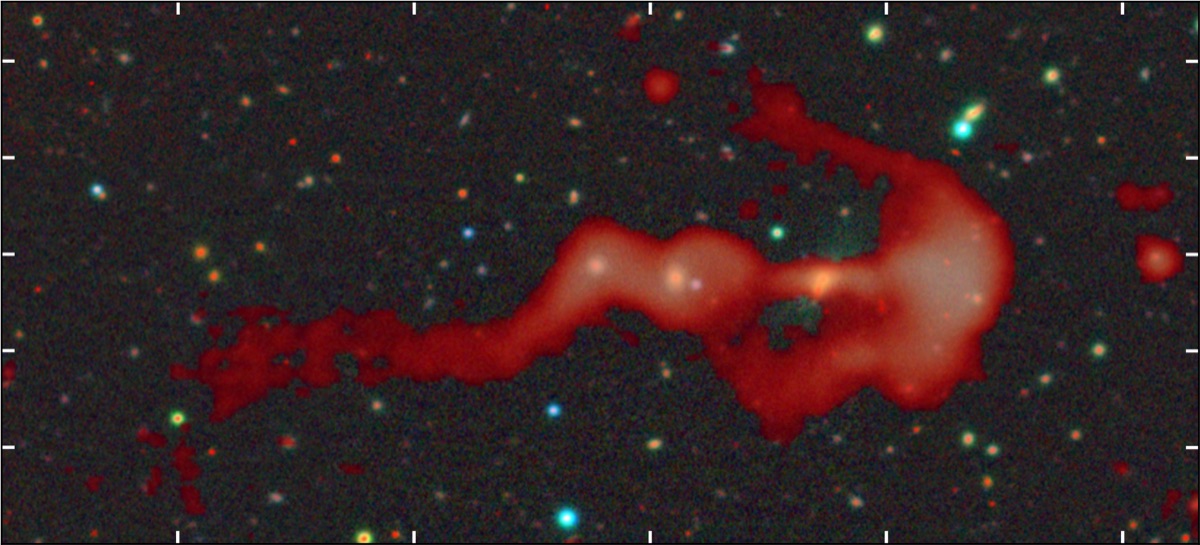
An astronomer who has studied galaxies for a quarter of a century says he has never seen anything quite like it. The remarkable part of the story is who found it. Not a team huddled inside one of the world's great observatories, but a volunteer - a citizen scientist named Pranim Limbo, reviewing radio-telescope images from a remote hill region of the Himalayas. The object he flagged has been named RAD-BAARG, the ‘Bow-And-Arrow Radio Galaxy,’ and it is one of the clearest pictures astronomers have ever captured of a cosmic shockwave they have predicted for decades but almost never managed to see.
- What: a radio galaxy tracing a giant bow shock - a curved shockwave - as it falls into a galaxy cluster
- Size: the glowing arc spans about 560 kiloparsecs (1.8 million light-years), roughly 18x the width of the Milky Way
- Where: the host galaxy sits at redshift z = 0.159 - about 2 billion light-years away
- Found by: citizen scientist Pranim Limbo via India's RAD@home Astronomy Collaboratory, in LOFAR radio-survey images
- Instrument: the LOFAR Two-metre Sky Survey (LoTSS) at 144 MHz, plus optical data from the BASS survey
- Published: Monthly Notices of the Royal Astronomical Society, June 22, 2026
1. A shape that stops you
Look at the image and the nickname explains itself. On one side, a narrow jet feeds a vast, sweeping arc of radio light - the bow. On the other, the structure twists into a distorted S-shape and trails off into a long, faint tail - the arrow. The two halves are wildly asymmetric, which is exactly what first caught the eye. Most radio galaxies are reasonably symmetric, with twin jets and lobes balanced on either side of a central galaxy. RAD-BAARG is lopsided in a way that demands an explanation.
“The structure of this source is unlike that of any radio galaxy I have seen in the last 25 years,” said lead researcher Dr. Ananda Hota of the University of Mumbai and the RAD@home Astronomy Collaboratory.
2. First, what is a radio galaxy?
At the heart of many large galaxies sits a supermassive black hole. As matter spirals toward it, magnetic fields can fling some of that material back out in two tightly focused jets of plasma moving at nearly the speed of light. Those jets inflate enormous clouds, or lobes, of charged particles that glow brightly at radio wavelengths - invisible to your eye, but lit up like a beacon to a radio telescope. A galaxy with this kind of black-hole-powered radio emission is called a radio galaxy, and the plasma it produces can stretch far beyond the visible galaxy itself.
That glowing plasma turns out to be the perfect paint. When it drapes over something otherwise invisible, it makes that hidden structure suddenly show up - which is precisely what happened here.
3. The bow shock: a sonic boom the size of a galaxy
RAD-BAARG's host galaxy is not sitting still. It is falling supersonically - faster than sound can travel through the surrounding medium - toward a massive cluster of galaxies. The space between galaxies is not truly empty; it is filled with an extremely thin, extremely hot gas. As the galaxy barrels through that gas, it cannot simply slip past it. The gas piles up ahead of the galaxy into a curved front, the same way water heaps up ahead of a boat's prow, or air compresses into a shockwave ahead of a supersonic jet.
That curved front is a bow shock. Normally it would be impossible to see - the gas is far too faint. But RAD-BAARG's radio plasma is being compressed right against the shock, brightening it and tracing its outline in radio light. The result is that glowing 1.8-million-light-year arc: the bow shock made visible.
The bow is the arc-shaped bow shock - hot cluster gas compressed ahead of the infalling galaxy. The arrow is the galaxy's own jet and trailing tail of plasma, swept back as it races forward. Together they form a structure that looks, uncannily, like a drawn bow with an arrow nocked.
4. Why this is such a rare catch
Theorists have expected bow shocks around galaxies falling into clusters for a long time - they are a natural consequence of basic physics. The problem has always been seeing one. The shocked gas is so faint and spread so thinly that it slips below the sensitivity of most telescopes. RAD-BAARG is special because the radio plasma happens to illuminate the shock from the inside, and because the survey that caught it is unusually good at faint, diffuse light.
“LOFAR allows us to see this faint, low-surface-brightness emission in remarkable detail,” noted co-author Dr. Pratik Dabhade of the National Centre for Nuclear Research in Poland. The LOFAR Two-metre Sky Survey maps the sky at very low radio frequencies (144 MHz), where these gentle, extended glows show up best; optical images from the BASS survey pinned down the galaxies behind the radio light. The result is one of the clearest radio signatures of a galactic bow shock yet recorded - a direct window into how galaxies stir up and reshape the vast environments they fall into.
5. Discovered from a village in the Himalayas
The most human part of the story is the discovery itself. RAD-BAARG was first noticed by Pranim Limbo, a citizen scientist working from a remote Himalayan hill region in India through the RAD@home Astronomy Collaboratory - a program that trains members of the public to sift through openly available data from professional telescopes and flag the oddballs that automated pipelines miss. A trained eye spotted what an algorithm had passed over, and a research-grade discovery followed.
The peer-reviewed study, led by Dr. Ananda Hota with co-leads Dr. Pratik Dabhade and Dr. Shubhrangshu Ghosh (SRM University Sikkim), turns that flagged image into a full scientific case. It is a vivid reminder that frontline discovery no longer belongs only to those inside the world's great observatories. With open data and a curious mind, a volunteer thousands of miles from any major telescope can still be the first human being to lay eyes on something new in the universe.
The numbers
| Feature | Value |
|---|---|
| Bow-shock arc length | ~560 kpc (~1.8 million light-years) |
| Jet + trailing tail | ~600 kpc on the opposite side |
| Host galaxy distance | redshift z = 0.159 (~2 billion light-years) |
| Survey / frequency | LOFAR LoTSS DR2 at 144 MHz (+ optical from BASS) |
| For scale | the arc is ~18x the width of the Milky Way |
What scientists still want to confirm
- The bow-shock interpretation is the leading explanation, not a closed case. The team describes the western arc as consistent with compression near a bow-shock-like feature, possibly linked to the galaxy's supersonic infall. Confirming it will take more multi-frequency radio and X-ray data.
- The dynamics are inferred. Exactly how fast the galaxy is moving, and the precise geometry of its plunge into the cluster, are modeled from the radio structure rather than measured directly.
- It is a complex neighborhood. RAD-BAARG sits in a tangled, multi-halo environment with several nearby cluster-scale systems, so disentangling cause and effect is genuinely hard - which is part of why a follow-up campaign is the natural next step.
None of that dims the result. Whether or not every detail of the model survives, RAD-BAARG is a strikingly clear look at a phenomenon astronomers have chased for decades - found, fittingly, by someone simply curious enough to look.
Sources
- Royal Astronomical Society: Bow-and-arrow-shaped radio galaxy discovered by citizen scientist
- Hota et al. (2026), ‘RAD@home discovery of a bow-and-arrow radio galaxy tracing a ~560 kpc bow-shock structure in a multi-halo environment,’ Monthly Notices of the Royal Astronomical Society · arXiv:2606.23106
- Phys.org: Bow-and-arrow-shaped radio galaxy discovered by citizen scientist · Universe Today
Image: composite LOFAR radio (144 MHz) and BASS optical view of RAD-BAARG, credit Hota et al. (2026) and the RAD@home Astronomy Collaboratory, CC BY 4.0. Curated by Jerry Cards - jerrycards.com. We research the week's most fascinating science, tech, and space news so you don't have to. More at jerrycards.com/news.