
 العربية
 Español
 中文
中文 Deutsch
 Français
 Português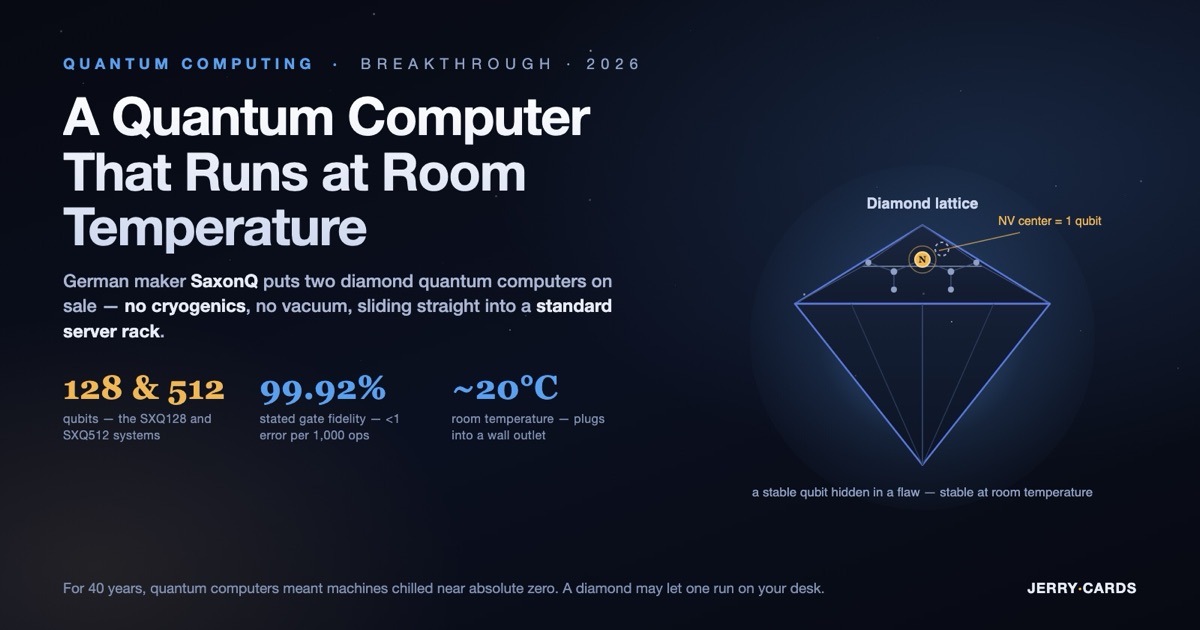
For most of its history, a quantum computer has been an exotic, fragile thing - a superconducting chip chilled to within a whisker of absolute zero inside a room-sized refrigerator, humming in a specialized lab and tended by a team of physicists. On July 21, 2026, a German startup put a very different machine on sale: a quantum computer that runs at ordinary room temperature, slides into a standard server rack, and plugs into a normal wall outlet. The qubit inside it does not live in a supercooled circuit. It lives in a single atom-sized flaw in a diamond.
The company is SaxonQ, a spin-out of Leipzig University, and its two new systems - the SXQ128 and SXQ512 - are, by the company’s account, the first diamond quantum processors to scale past a mere handful of qubits. Here is what was announced, how a flaw in a diamond becomes a qubit, why running at room temperature matters so much - and the honest caveats to keep in mind.
- Who / when: SaxonQ (spin-out of Leipzig University, Germany), announced July 21, 2026
- What: two commercial quantum computers — the SXQ128 (128 qubits) and SXQ512 (512 qubits)
- The qubit: a nitrogen-vacancy (NV) center — a flaw in a diamond — which is stable at room temperature
- Infrastructure: no cryogenics, no vacuum, no cleanroom; fits a standard server rack and a wall outlet
- Company-stated specs: up to 99.92% single-qubit gate fidelity; a manufacturing yield above 85%; 6–10× the energy efficiency of comparable GPU hardware
- Availability: SXQ128 to order now (delivery ~3 months); SXQ512 on advance order (shipments in 2027)
1. What SaxonQ actually launched
SaxonQ announced two products aimed squarely at the commercial market rather than the physics lab. Both are built from the same building block — a small ‘core’ of fully entangled diamond qubits — tiled together into a larger machine.
| System | Qubits | Architecture | Availability |
|---|---|---|---|
| SXQ128 | 128 | 8 fully entangled qubits per core, multi-core | Order now; delivery within ~3 months |
| SXQ512 | 512 | 16 entangled qubits per core, multi-core | Advance order; shipments in 2027 |
The company describes these as the first diamond nitrogen-vacancy processors to exceed ten physical qubits — a jump that, if it holds up under independent testing, would be a big deal for a technology that had been stuck at single digits for years. Crucially, these are physical qubits, not the error-corrected ‘logical’ qubits that the broader field is ultimately working toward (more on that below).
2. Why ‘room temperature’ is the headline
To appreciate the news, you have to know what the alternative looks like. The quantum computers that have dominated headlines — the superconducting machines from the likes of Google and IBM — keep their qubits stable by making the world around them almost perfectly still and cold. That means cooling the chip to roughly 15 millikelvin — colder than deep space — inside a dilution refrigerator, a chandelier of gold-plated plumbing that fills a room and never switches off. Other leading approaches trade one kind of difficulty for another: trapped-ion machines run their ions near room temperature but need ultra-high vacuum and precisely tuned lasers.
Diamond qubits sidestep the deep-freeze entirely. Because the qubit is locked inside a rigid carbon lattice, it holds its quantum state at room temperature — which is why SaxonQ can ship a box that needs none of the heavy infrastructure.
| Approach | Typical operating conditions |
|---|---|
| Superconducting (Google, IBM) | ~15 millikelvin in a dilution refrigerator |
| Trapped ion (e.g. Quantinuum) | Near room temperature, but ultra-high vacuum + lasers |
| Diamond NV (SaxonQ) | Room temperature; standard server rack + wall outlet |
As the company frames it, the systems are meant to run “reliably, continuously and without a team of specialists to keep it running” — the way an ordinary computer does.
3. How a flaw in a diamond becomes a qubit
A perfect diamond is pure carbon in a flawless lattice. A nitrogen-vacancy (NV) center is a specific, well-studied imperfection: one carbon atom is replaced by a nitrogen atom, and right next to it sits an empty spot — a vacancy where an atom should be. Together, that nitrogen-plus-empty-space pair traps a few electrons whose combined spin can point in quantum superpositions of ‘up’ and ‘down.’ That spin is the qubit.
Two properties make the NV center special. First, it can be initialized and read out with ordinary light — a green laser sets its state, and the flaw glows back in a way that reveals whether it is a 0 or a 1. Second, the stiff diamond lattice shields the spin from its surroundings so effectively that it keeps its quantum information at room temperature, no refrigeration required. Physicists have prized NV centers for exactly this reason for two decades — in quantum sensing, they are already used to measure magnetic fields with astonishing precision.
A quantum bit needs to be isolated enough to stay fragile-and-quantum, yet accessible enough to control. The NV center pulls off both by hiding the qubit inside a diamond and talking to it with light.
4. The part that was hard: making many of them
If NV centers are so wonderful, why is a 128-qubit diamond machine news in 2026? Because the long-standing bottleneck was never a single qubit — it was manufacturing many of them, precisely placed, at high quality. Creating NV centers where you want them, reliably, has historically had a tiny success rate.
SaxonQ says its answer is a proprietary sulfur co-implantation process that raises the conversion yield to above 85%, compared with roughly 1–10% for traditional methods. The company reports single-qubit gate fidelity of up to 99.92% — fewer than one error per 1,000 operations — and quantum states stable long enough to run real calculations. It says the approach is protected by more than 220 patents and applications. These are the numbers to watch as independent groups get their hands on the machines.
5. Who is using it, and what for
This is not a slideware announcement. SaxonQ says earlier-generation systems are already deployed and running at the German Aerospace Center (DLR) and at a Fraunhofer institute (its machine-tools and forming-technology institute, IWU), with one reported to have operated continuously since it was installed. The company points its systems at near-term, practical workloads: quantum machine learning (including quantum convolutional neural networks), quantum chemistry and materials simulation, variational algorithms, and optimization problems in areas like industrial materials processing and robotics. It also claims a 6–10× energy-efficiency advantage over comparable GPU-based hardware for those tasks.
What to keep in mind
- Physical, not logical, qubits. The 128 and 512 figures are physical qubits. The field’s ultimate prize is error-corrected logical qubits, which bundle many physical ones together; that is a different and harder milestone, and this announcement is not about it.
- Company-stated specs. The fidelity, yield, and efficiency figures come from SaxonQ and await broad independent benchmarking. Product launches naturally lead with best-case numbers.
- No single approach has won. Superconducting, trapped-ion, photonic and neutral-atom platforms all have genuine strengths. Room-temperature operation is a real advantage for access and cost — it is not, by itself, a verdict on which technology ends up on top.
With those caveats honestly on the table, the direction is genuinely exciting. For decades, quantum computing has been something that happened behind cryostat glass, far from ordinary computing. A machine that boots up inside a diamond, at room temperature, and plugs into the wall is a real step toward quantum hardware that lives where the rest of our computers already do.
Sources & further reading
- The Quantum Insider: SaxonQ launches commercial diamond NV-center quantum computers
- Quantum Computing Report: SaxonQ launches 100+ qubit diamond-based room-temperature quantum computers
- HPCwire: SaxonQ brings room-temperature diamond quantum computing to the commercial market
- Electronics Weekly: SaxonQ puts quantum computer on the market
- Background: Nitrogen-vacancy center · SaxonQ
Curated by Jerry Cards - jerrycards.com. We research the week’s most consequential tech and science news so you don’t have to. More at jerrycards.com/news.